Design tools laid out on a gray paper surface: a compass, pencils, color swatches, fabric, a ruler, a cup, a model chair, tape, a knife, a loupe, a brush, film, a map, a sketchbook and a phone showing a wireframe

Everything About Design

The Full-Stack Designer’s Handbook
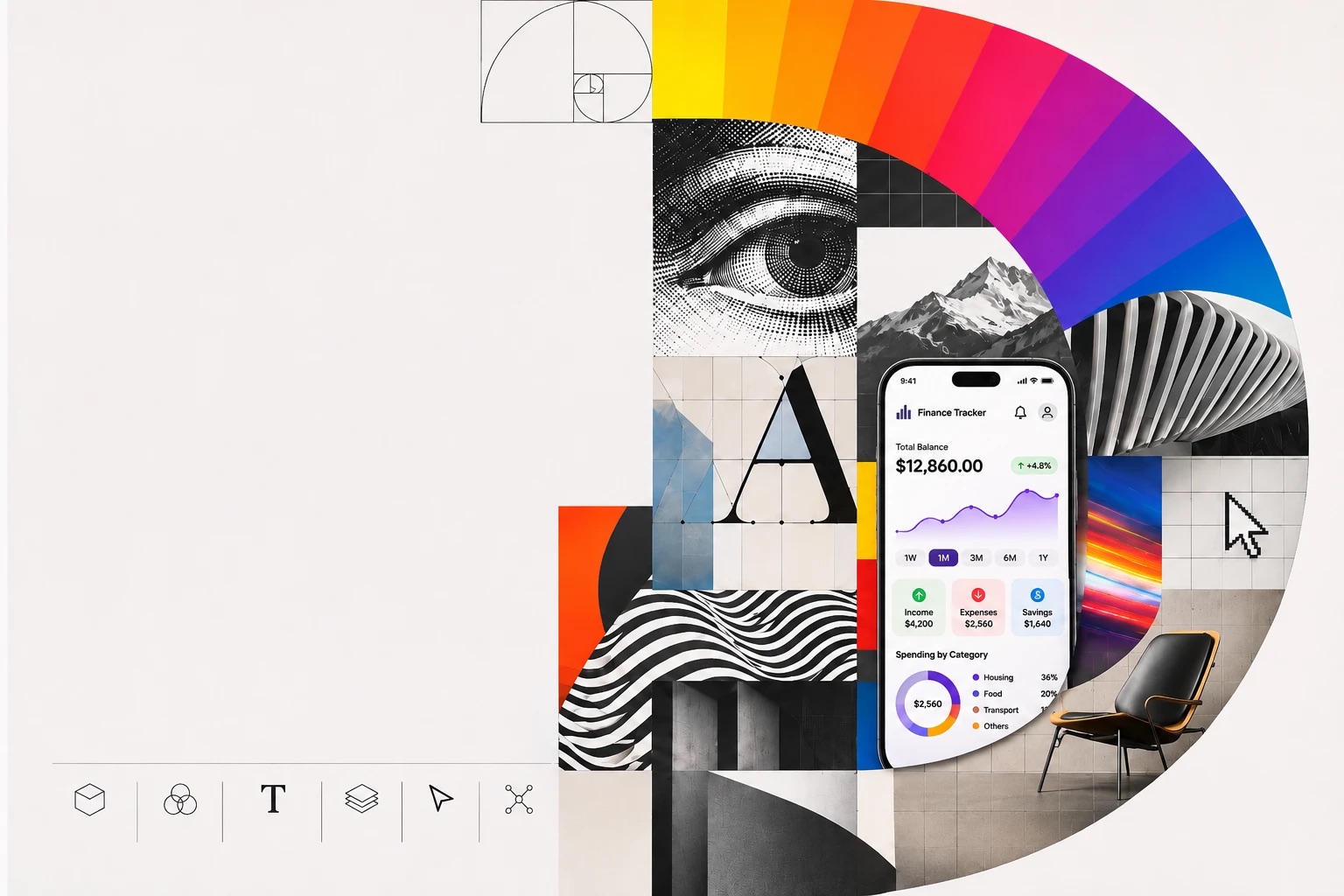
A collage of design subjects arranged in a large arc: a color spectrum, a halftone eye, a letter A on a construction grid, a phone app, a mountain photograph, op-art stripes, concrete architecture and a lounge chair, with a golden-spiral diagram and a row of tool icons on a plain left side

Everything About Design

The Full-Stack Designer’s Handbook

A reference book for designers who work across disciplines. Its 99 chapters, in 16 parts, run from the history of design, color and type to research, interaction, code, business and the law.

Each chapter stands on its own, so there’s no need to read in order. Use the contents on the left to find a subject, or search for a term you’ve heard and want pinned down. Terms in bold are defined where they first appear and collected in the glossary. A term with a dotted underline is defined in another chapter: tap it for the definition. Boxes headed Commonly confused separate words that people often mix up. A check mark appears beside each chapter you finish, so the contents doubles as a checklist.

A few images are still awaiting permission to reproduce. Each placeholder says what it will show.

Part 1

Design: ideas and history

  1. 1What design is
  2. 2The design disciplines
  3. 3Design processes
  4. 4Design before 1900
  5. 5Modern movements, 1900–1970
  6. 6Contemporary design, 1970 to now
  7. 7Design traditions beyond the West

Part 2

Seeing and drawing

  1. 8Creativity and aesthetics
  2. 9Elements and principles of design
  3. 10Visual perception
  4. 11Drawing, perspective and composition
  5. 12Digital drawing and illustration tools

Part 3

Color

  1. 13Color basics and relationships
  2. 14Color psychology and culture
  3. 15Color in screen and print
  4. 16Building a palette

Part 4

Typography

  1. 17Anatomy and classification of type
  2. 18A history of type
  3. 19Setting text
  4. 20Choosing, pairing and legibility
  5. 21Typography on screens
  6. 22Type across scripts

Part 5

Layout and visual communication

  1. 23Grid systems
  2. 24Hierarchy, alignment and white space
  3. 25Editorial and book design
  4. 26Information design and data visualization
  5. 27Illustration, icons and symbols

Part 6

Brand and communication

  1. 28Brands and brand strategy
  2. 29Logo design
  3. 30Identity systems
  4. 31Advertising and art direction
  5. 32Brand case studies

Part 7

Image, motion and 3D

  1. 33Photography
  2. 34Image editing
  3. 35Resolution, formats and units
  4. 36Motion, video and sound
  5. 373D design

Part 8

Print, packaging and physical production

  1. 38Prepress and printing
  2. 39Paper and finishing
  3. 40Packaging design
  4. 41Environmental and spatial design
  5. 42Product and industrial design

Part 9

People and behavior

  1. 43Human cognition
  2. 44Psychology and behavior
  3. 45Human-computer interaction: history and theory
  4. 46Affordances, signifiers, feedback and constraints
  5. 47Laws and heuristics
  6. 48Usability and ergonomics
  7. 49Accessibility and inclusive design

Part 10

Research and problem framing

  1. 50Planning design research
  2. 51Qualitative and quantitative research
  3. 52Interviews, observation and contextual inquiry
  4. 53Usability testing
  5. 54Synthesis and insight
  6. 55Personas, journeys and service design
  7. 56Problem framing and ideation

Part 11

Interaction and product design

  1. 57UX, UI and user-centered design
  2. 58Tasks and flows
  3. 59Information architecture
  4. 60Navigation and findability
  5. 61Interaction patterns, forms and states
  6. 62Wireframes, mockups and prototypes
  7. 63Content design and UX writing
  8. 64Visual interface design
  9. 65Design systems
  10. 66Design in agile teams

Part 12

Platforms and devices

  1. 67Responsive, mobile-first and cross-device design
  2. 68Platform guidelines
  3. 69Mobile patterns and gestures
  4. 70Wearables, ubiquitous computing and IoT
  5. 71Virtual, augmented and mixed reality
  6. 72Conversational and AI interfaces

Part 13

Technology for designers

  1. 73How the internet and the web work
  2. 74HTML and CSS
  3. 75JavaScript, browsers and performance
  4. 76Frontend, backend and architecture
  5. 77APIs
  6. 78Data and databases
  7. 79Native, hybrid and web apps
  8. 80The software development lifecycle
  9. 81Handoff and accessibility in code

Part 14

Business, product and marketing

  1. 82How businesses work
  2. 83Product strategy
  3. 84Marketing
  4. 85Analytics, experiments and data-informed design
  5. 86Entrepreneurship and innovation

Part 15

Practice and leadership

  1. 87Critique, peer review and feedback
  2. 88Presenting, storytelling and case studies
  3. 89Clients and stakeholders
  4. 90Multidisciplinary teams
  5. 91Project and delivery management
  6. 92Consulting and freelance practice
  7. 93Design leadership and operations

Part 16

Law, ethics and responsibility

  1. 94Intellectual property and licensing
  2. 95Privacy and data ethics
  3. 96Ethical design
  4. 97Sustainability
  5. 98Accessibility law
  6. 99Professional responsibility

Reference

Look things up