Chapter 3: Design processes
A design process is the sequence of activities a team follows to get from a loosely stated problem to a solution it has tested with the people it’s for. The named models of it differ more in vocabulary and diagrams than in substance: each alternates between research and making, and each expects the team to loop back.
Design thinking
Design thinking is the reasoning and methods of designers, packaged so that people outside design can apply them to business, service and policy problems. IDEO, the consultancy that did most to spread the term, describes it as a human-centered approach to solving complex problems that weighs what people need against what technology can do and what an organization needs to succeed.1
The term started in design research: Peter Rowe’s Design Thinking (MIT Press, 1987) studied how architects and urban planners work.23 The management version came two decades later, in Tim Brown’s Change by Design and Roger Martin’s The Design of Business, both from 2009.3 Stanford’s d.school, founded in 2005 by its own account, and the Hasso Plattner Institute in Potsdam, teaching it since 2007, carried it into schools.45
The d.school’s version is the one most people meet. It names five modes: empathize, define, ideate, prototype and test.6 Empathize is learning about people by watching and talking to them (→ 52 Interviews, observation and contextual inquiry); define turns that into a point of view on the problem; the other three make and try out answers. The d.school calls these modes, not steps, and its card deck tells readers to start wherever they want. A straight line of five boxes, run once, gets that wrong.
Double Diamond
The Double Diamond is a model of the design process that the UK Design Council published in 2004, drawn as two diamonds side by side.7 Each widens, then narrows: the first around the problem, the second around the solution. The council names four phases:8
- Discover: understand the problem, instead of assuming it, by spending time with the people it affects.
- Define: use what discovery found to frame the challenge differently.
- Develop: produce a range of answers, looking elsewhere for ideas and co-designing with others.
- Deliver: test answers at small scale, drop what fails and improve what works.
By the council’s own account, its team codified an existing process and renamed the steps.8 The model’s most useful idea is the first diamond: the brief a team receives is not yet the problem it should solve.
Divergent and convergent thinking
Divergent thinking is producing many possible answers to one question; convergent thinking is narrowing them to the one that best fits. In the Design Council’s diagram, the widening half of each diamond is divergent and the narrowing half convergent.7 The terms come from the psychologist J. P. Guilford, whose Structure of Intellect model, first presented in 1955 at a conference in Paris, listed convergent production and divergent production among its operations.9 Design teams keep the two apart in time, because judging ideas while they are still coming cuts the list short. The brainstorming rule against criticism exists for this (→ 56 Problem framing and ideation).
Iteration
Iteration is repeating a cycle of making, testing and revising until the result does what it should. ISO 9241-210 defines it, for design, as “repeating a sequence of steps until a desired outcome is achieved”, and says the best design for an interactive system usually can’t be reached without it.10 Many needs only emerge as users react to possible solutions, the standard explains, so each round of prototyping (→ 62 Wireframes, mockups and prototypes) and testing (→ 53 Usability testing) is partly research.
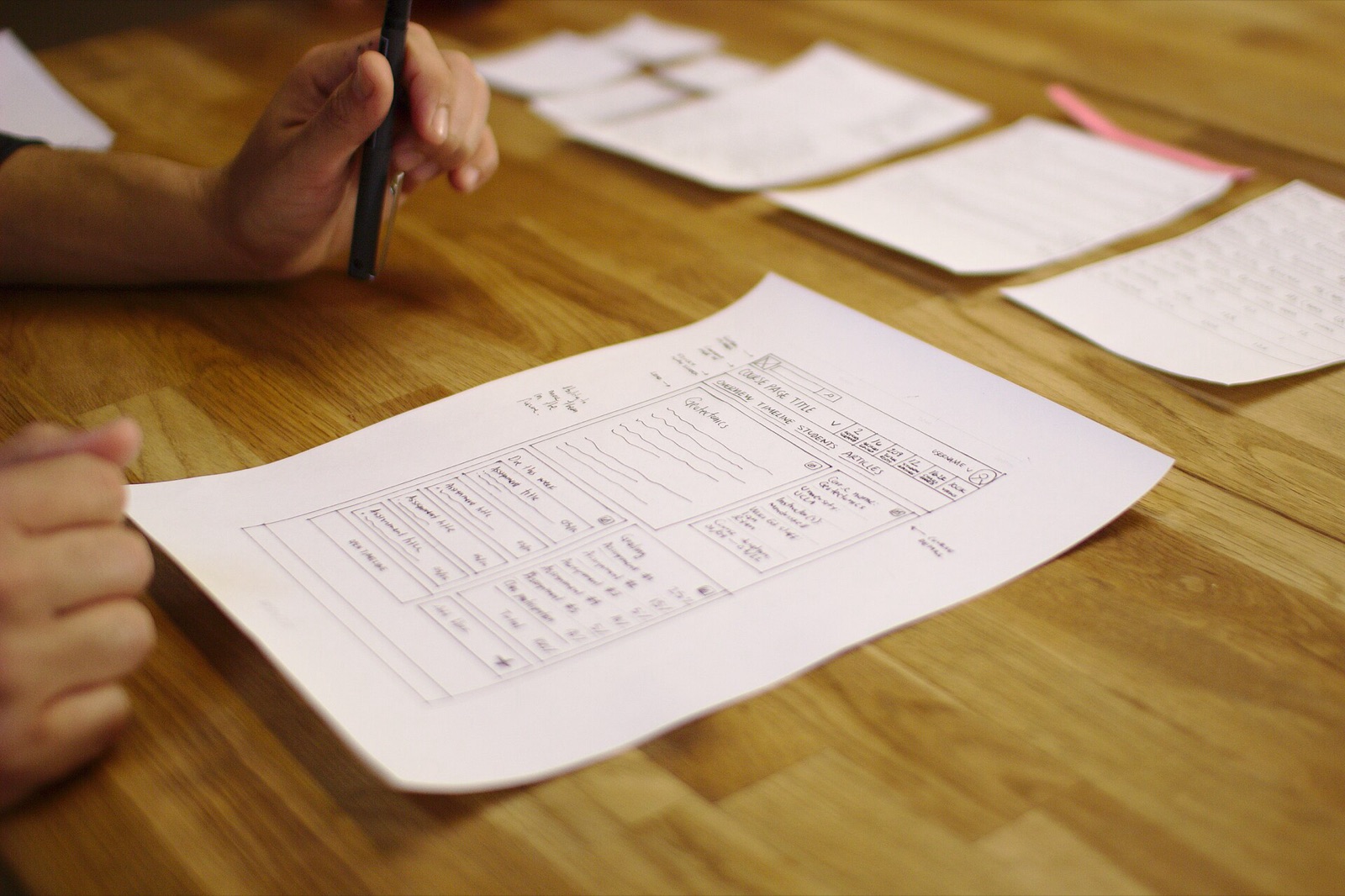
Cheap prototypes buy more rounds. A paper sketch of a screen can be redrawn between two test sessions. Physical products take longer. James Dyson built 5,127 prototypes of his cyclonic vacuum cleaner, working for five years in a garden shed, according to a London Business School account.11
Sage Ross, CC BY-SA 4.0, via Wikimedia Commons.
Human-centered design (ISO 9241-210)
Human-centered design is, in the definition of ISO 9241-210, an approach to designing interactive systems that “aims to make interactive systems more usable” by focusing on how the system is used and by applying human factors and usability knowledge.10 The 2019 edition revises the 2010 one, which carried forward principles from ISO 13407. It sets six:10
- The design is based on an explicit understanding of users, tasks and environments.
- Users are involved throughout design and development.
- User-centered evaluation drives and refines the design.
- The process is iterative.
- The design addresses the whole user experience.
- The design team includes multidisciplinary skills and perspectives.
The characteristics of the users, their tasks and their environment make up the context of use. The standard’s four activities follow from it: understand and specify the context of use, specify user requirements, produce design solutions, and evaluate them. It prescribes no process, and says it fits methods as different as waterfall and rapid application development.10 That makes it the model to cite in a contract, where “human-centered” has to mean something checkable.
Criticisms of design thinking
The first criticism is that it is nothing special. Don Norman wrote in 2010 that it was “a public relations term for good, old-fashioned creative thinking”, useful mainly because it persuaded businesses that designers do more than style things.12 In 2013 he changed his mind and argued that designers do have a special claim to it.13
The second is academic. Lucy Kimbell argued in 2011 that the popular accounts separate thinking from acting in the world, flatten designers’ varied and historically situated practices into one method, and treat the designer as the main agent of design.3
The third comes from practice. Natasha Jen, a partner at Pentagram, told Adobe’s 99U conference in New York in 2017 that design thinking had shrunk to sticky notes and a diagram of five hexagons. She said it left out critique and asked for no evidence of the work, such as thought processes, inspiration and failed prototypes.1415 None of these critics objects to research or prototyping; their target is a workshop format sold as a replacement for skill and judgment (→ 87 Critique, peer review and feedback).
See also
1 What design is · 52 Interviews, observation and contextual inquiry · 53 Usability testing · 56 Problem framing and ideation · 57 UX, UI and user-centered design · 62 Wireframes, mockups and prototypes
Sources
- Comrey, A. L. (1993). “Joy Paul Guilford, 1897–1987.” Biographical Memoirs. National Academy of Sciences.
- Design Council (n.d.). “The Double Diamond” and “Framework for Innovation.” designcouncil.org.uk.
- Hasso Plattner Institute (n.d.). “School of Design Thinking.” hpi.de.
- IDEO (n.d.). “Design Thinking.” designthinking.ideo.com.
- ISO (2019). ISO 9241-210:2019, Ergonomics of human-system interaction, Part 210: Human-centred design for interactive systems, 2nd edition. International Organization for Standardization.
- Kimbell, L. (2011). “Rethinking Design Thinking: Part I.” Design and Culture 3(3): 285–306.
- London Business School (n.d.). “DIIE innovation icons: Dyson.”
- Norman, D. (2010). “Design Thinking: A Useful Myth.” Core77.
- Norman, D. (2013). “Rethinking Design Thinking.” Core77.
- Rowe, P. G. (1987). Design Thinking. MIT Press.
- Shapiro, E. (2019). “Is Design Thinking Really Bullshit? Thoughts from Marty Neumeier.” PRINT.
- Stanford d.school (2018). “Design Thinking Bootleg”; (n.d.) “History.”
- Sherrington, A. (2018). “Design thinking sucks, but it doesn’t have to.” The Next Web.
Notes
- IDEO (n.d.). “Design Thinking.” IDEO Design Thinking. https://designthinking.ideo.com/ ↩
- Rowe, P. G. (1987). Design Thinking. MIT Press. Catalog record: https://www-users.york.ac.uk/~ss44/books/pages/r/PeterGRowe.htm ↩
- Kimbell, L. (2011). “Rethinking Design Thinking: Part I.” Design and Culture 3(3): 285–306. https://doi.org/10.2752/175470811X13071166525216 ↩ ↩ ↩
- Stanford d.school (n.d.). “History.” https://dschool.stanford.edu/study/undergraduate-degree/history ↩
- Hasso Plattner Institute (n.d.). “School of Design Thinking.” https://hpi.de/en/school-of-design-thinking/ ↩
- Stanford d.school (2018). “Design Thinking Bootleg.” https://dschool.stanford.edu/resources/design-thinking-bootleg ↩
- Design Council (n.d.). “Framework for Innovation.” https://www.designcouncil.org.uk/our-resources/framework-for-innovation/ ↩ ↩
- Design Council (n.d.). “The Double Diamond.” https://www.designcouncil.org.uk/our-resources/the-double-diamond/ ↩ ↩
- Comrey, A. L. (1993). “Joy Paul Guilford.” Biographical Memoirs. National Academy of Sciences. https://www.nasonline.org/wp-content/uploads/2024/06/guilford-joy-paul.pdf ↩
- ISO (2019). ISO 9241-210:2019, Ergonomics of human-system interaction, Part 210: Human-centred design for interactive systems, 2nd edition. Introduction, 3.7, 5.1–5.5, clause 7. Preview: https://cdn.standards.iteh.ai/samples/77520/8cac787a9e1549e1a7ffa0171dfa33e0/ISO-9241-210-2019.pdf ↩ ↩ ↩ ↩ ↩
- London Business School (n.d.). “DIIE innovation icons: Dyson.” https://www.london.edu/faculty-and-research/lbsr/diie-innovation-icons-dyson ↩
- Norman, D. (2010, June 28). “Design Thinking: A Useful Myth.” Core77; republished at https://jnd.org/design-thinking-a-useful-myth/ ↩
- Norman, D. (2013, March 18). “Rethinking Design Thinking.” Core77; republished at https://jnd.org/rethinking-design-thinking/ ↩
- Shapiro, E. (2019, February 24). “Is Design Thinking Really Bullshit? Thoughts from Marty Neumeier.” PRINT. https://www.printmag.com/design-criticism/design-thinking-process-bs/ ↩
- Sherrington, A. (2018, April 23). “Design thinking sucks, but it doesn’t have to.” The Next Web. https://thenextweb.com/news/design-thinking-sucks-doesnt ↩