Chapter 33: Photography
A photograph is a record of light, and a handful of physical settings decide what that record looks like: how much light, for how long, through what lens, from where. Most designers commission, crop and judge far more photographs than they take. Knowing what each setting does lets you brief a photographer in their own terms and say why a picture isn’t working.
Camera and sensor
A camera is a light-tight box with a lens at one end and a light-sensitive surface at the other. The idea is older than the lens. A camera obscura is a dark room or box with a small hole in one wall, through which light throws an upside-down image of the scene outside onto the opposite wall. Ibn al-Haytham (965–c. 1040), born in Basra and later working in Cairo, used such images to argue that light travels in straight lines, and his Book of Optics reached Europe in Latin translation.12 Photography began when that projected image could be fixed on a chemical surface, in the 1820s and 1830s.
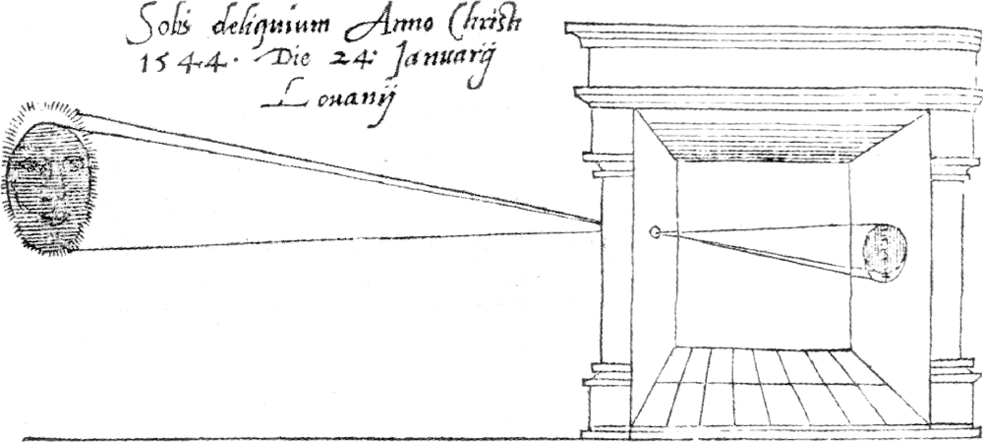
Gemma Frisius, public domain, via Wikimedia Commons.
In a digital camera the surface is an image sensor, a grid of millions of photosites. Each one measures how much light fell on it and nothing else, so a bare sensor sees in grayscale. Color comes from a Bayer filter, a mosaic of colored filters laid over the photosites, patented by the Kodak engineer Bryce Bayer in 1976. Half the filters are green and a quarter each are red and blue, because the eye resolves detail in brightness better than in color, and green carries most of the brightness signal.3 The camera then estimates the two missing colors at every pixel from its neighbors. Kodak had already built a hand-held digital camera in 1975: Steven Sasson’s prototype weighed 3.6 kg, made 100 × 100 pixel black-and-white images and took 23 seconds to write each one to cassette tape.4
Sensor size matters as much as pixel count. A full frame sensor is 36 × 24 mm, the size of a 35 mm film frame. Most interchangeable-lens cameras use APS-C sensors with a crop factor of about 1.5 (1.6 on Canon), and phone sensors are smaller still. At the same pixel count, a bigger sensor has bigger photosites, and Nikon notes that large pixels produce less noise than small ones.5
Exposure: aperture, shutter speed, ISO
Exposure is the total amount of light that reaches the sensor for one picture. Two settings control it, aperture and shutter speed, and a third, ISO, controls how much the camera brightens what it receives. Photographers measure all three in the same unit. A stop is a doubling or halving of light, and “one stop under” means the picture got half the light it needed.
The aperture is the adjustable opening inside the lens. Its size is given as an f-number, the focal length divided by the diameter of the opening, so a 100 mm lens at f/4 has an opening 25 mm wide.6 Because it’s a ratio, f/4 lets in the same light on any lens. The standard sequence runs f/1.4, 2, 2.8, 4, 5.6, 8, 11, 16, and each step halves the light.7 The numbers go up by about 1.4, the square root of 2, because the light depends on the area of the opening, not its width. Bigger numbers mean smaller openings.
Shutter speed is how long the sensor is exposed, usually a fraction of a second: 1/1000, 1/500, 1/250, 1/125, each twice as long as the last. Each setting has a side effect. A wider aperture gives less depth of field, and a longer exposure gives more motion blur, from the subject moving or the camera shaking.7
ISO sets how much the camera amplifies the signal from each photosite. Each doubling of the ISO number brightens the result by one stop.7 Digital ISO ratings are defined by ISO 12232.8
These four settings all give the same exposure. They make different pictures.
| Aperture | Shutter speed | Result |
|---|---|---|
| f/2.8 | 1/500 | Shallow focus, motion frozen |
| f/5.6 | 1/125 | Middle ground |
| f/11 | 1/30 | Deep focus, a moving subject blurs |
| f/16 | 1/15 | Deepest focus, needs a tripod |
Lenses and focal length
Focal length is the distance, in millimeters, from a lens’s optical center to the sensor when the lens is focused at infinity. With the sensor size, it sets the angle of view: as focal length increases, the view narrows.9 A normal lens has a focal length close to the sensor’s diagonal and gives a view that looks natural at ordinary print sizes. The diagonal of a full-frame sensor is 43 mm, and 50 mm became the standard normal lens. Shorter lenses are wide-angle; longer ones are telephoto, with 85–135 mm the usual range for portraits.
Because angle of view depends on the sensor, the same lens frames differently on different cameras. A 50 mm lens on a Canon APS-C body frames like an 80 mm lens on full frame (50 × 1.6). Phone makers quote this “equivalent” focal length; the real one is a few millimeters.
A prime lens has one focal length; a zoom lens covers a range, such as 24–70 mm. Primes are usually smaller and open wider, often to f/1.8 or f/1.4.
Depth of field
A lens focuses exactly at one distance. Depth of field is the range in front of and behind that distance that still looks acceptably sharp. “Acceptably” is defined by the circle of confusion, the largest blur spot that still looks like a point at the intended print or screen size.
Four things set depth of field. A smaller aperture (larger f-number) increases it. It grows with the square of the subject distance, so a distant scene is easy to get sharp and a close-up isn’t. It shrinks with the square of the focal length. And a larger allowed circle of confusion widens it. Wherever you focus, more of the depth of field lies behind the point of focus than in front of it.11
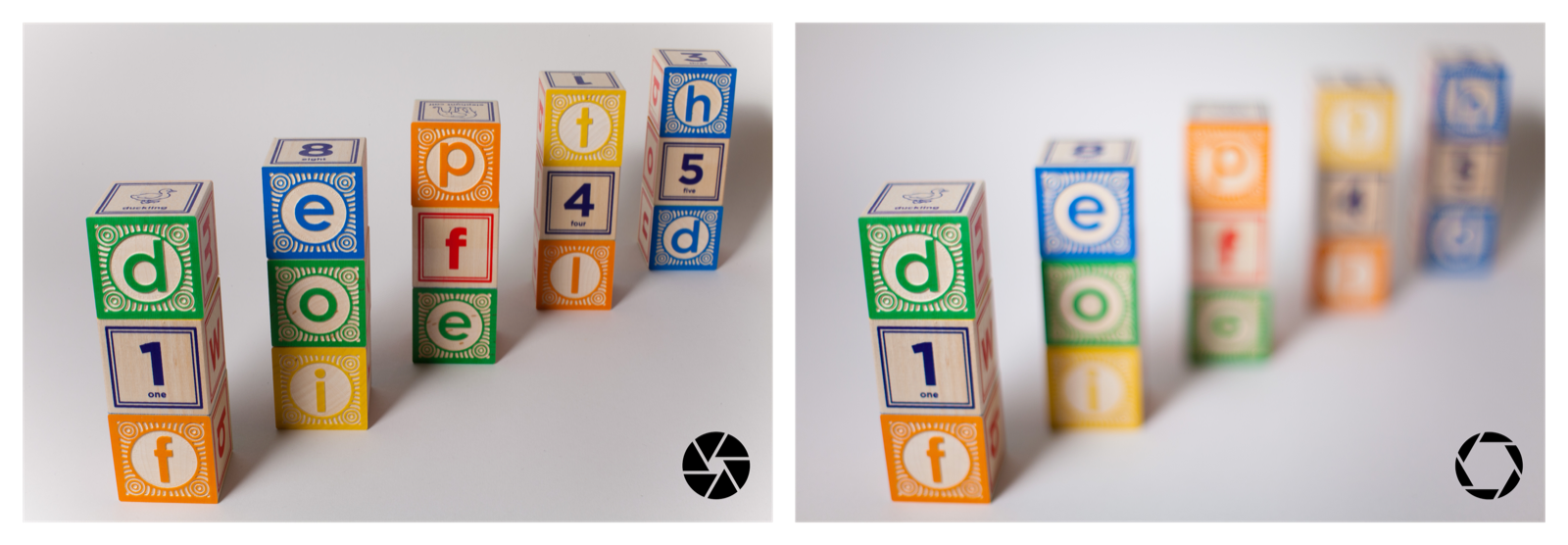
MikeRun, CC BY-SA 4.0, via Wikimedia Commons.
In practice, shallow depth of field separates a subject from a busy background, which is why portraits are often shot at f/2 to f/2.8. A product shot that must be sharp from front to back needs a small aperture, enough light to support it, or several frames combined later (→ 34 Image editing).
Lighting: key, fill, rim
Three-point lighting is the standard starting arrangement for lighting a person or object, using a key, a fill and a back light. The key light is the main source. It usually sits about 45 degrees to one side of the camera and sets which side of the face is lit and where the shadows fall. The fill light goes on the opposite side and controls how dark those shadows are; it doesn’t need to remove them.12 The difference between the two is the lighting ratio, measured with a light meter in stops. A one-stop difference means the fill is half as bright as the key (2:1); two stops, a quarter (4:1).12 Low ratios look open and even. High ratios look dramatic.
The back light sits behind the subject and separates it from the background.12 Placed behind and to one side so that it traces a bright edge along the subject’s outline, it’s called a rim light, and it’s how dark products are kept from disappearing into dark backgrounds.
Whether a light is hard or soft depends on its size relative to its distance from the subject.13 A small source far away, such as a bare flash or the midday sun, gives hard light with sharp shadow edges. A large source close by, such as a softbox or a north-facing window, gives soft light with gradual ones.
Photographic composition
Most of composition is shared with drawing and layout (→ 11 Drawing, perspective and composition, for framing and the rule of thirds). What’s specific to photography is that the photographer arranges a scene mostly by moving and waiting. The viewpoint fixes perspective and decides what overlaps what, and a step to the left can take a lamp post out of someone’s head. Check the edges of the frame and the background before you shoot.
Seydou Keïta’s Bamako studio, which he opened in 1948, shows control of the background. He worked mostly in natural light in a courtyard, posed sitters against a fabric backdrop (changed every two or three years, so the cloth now helps date the prints), and from 1949 used a 13 × 18 cm view camera.14 Henri Cartier-Bresson worked the other way, in the street, composing as events unfolded. His 1952 book Images à la sauvette was published in the United States as The Decisive Moment, a title chosen by Simon and Schuster that became the usual name for his approach.15
See also
10 Visual perception · 11 Drawing, perspective and composition · 34 Image editing · 35 Resolution, formats and units · 36 Motion, video and sound · 37 3D design
Sources
- Bayer, B. E. (1976). “Color imaging array.” US Patent 3,971,065.
- CAAC, The Pigozzi Collection (n.d.). “Seydou Keïta.”
- Clemens, C., Shlisky, S., et al. (n.d.). “Lighting design.” Video Production Handbook I. City College of San Francisco.
- Fondation Henri Cartier-Bresson (n.d.). “‘The Decisive Moment’ at the ICP of New York.”
- Holben, J. (2020). “Light quality 101.” American Cinematographer.
- IEEE Spectrum (n.d.). “The first digital camera.”
- International Organization for Standardization (2019). ISO 12232:2019.
- Levoy, M. (n.d.). “Variables that affect exposure,” “Zoom lenses,” “Depth of field.” CS 178, Stanford University.
- Nave, R. (n.d.). “Stops.” HyperPhysics, Georgia State University.
- Nikon USA (n.d.). “Understanding ISO sensitivity.”
- O’Connor, J. J., and Robertson, E. F. (n.d.). “Abu Ali al-Hasan ibn al-Haytham.” MacTutor.
- Ovchar, I. (2021). “Lenses don’t cause perspective distortion and ‘lens compression’.” PetaPixel.
- Sherry, B. (n.d.). “The Universe Through a Pinhole.” OER Project.
Notes
- O’Connor, J. J., and Robertson, E. F. (n.d.). “Abu Ali al-Hasan ibn al-Haytham.” MacTutor History of Mathematics, University of St Andrews. https://mathshistory.st-andrews.ac.uk/Biographies/Al-Haytham/ ↩
- Sherry, B. (n.d.). “The Universe Through a Pinhole.” OER Project. https://www.oerproject.com/OER-Materials/OER-Media/HTML-Articles/BHP/Unit2/The-Universe-Through-a-Pinhole ↩
- Bayer, B. E. (1976). “Color imaging array.” US Patent 3,971,065, filed March 5, 1975, granted July 20, 1976. Eastman Kodak. https://patents.google.com/patent/US3971065A/en ↩
- IEEE Spectrum (n.d.). “The first digital camera.” https://spectrum.ieee.org/first-digital-camera-history ↩
- Nikon USA (n.d.). “Understanding ISO sensitivity.” Learn & Explore. https://www.nikonusa.com/en/learn-and-explore/c/tips-and-techniques/understanding-iso-sensitivity ↩
- Nave, R. (n.d.). “Stops.” HyperPhysics, Georgia State University. https://hyperphysics.gsu.edu/hbase/geoopt/stop.html ↩
- Levoy, M. (n.d.). “Variables that affect exposure.” CS 178 applets, Stanford University. https://graphics.stanford.edu/courses/cs178/applets/exposure.html ↩ ↩ ↩ ↩
- International Organization for Standardization (2019). ISO 12232:2019, “Photography: Digital still cameras: Determination of exposure index, ISO speed ratings, standard output sensitivity, and recommended exposure index.” https://www.iso.org/standard/73758.html ↩
- Levoy, M. (n.d.). “Zoom lenses.” CS 178 applets, Stanford University. https://graphics.stanford.edu/courses/cs178/applets/zoom.html ↩
- Ovchar, I. (2021). “Lenses don’t cause perspective distortion and ‘lens compression’.” PetaPixel, August 2, 2021. https://petapixel.com/2021/08/02/lenses-dont-cause-perspective-distortion-and-lens-compression/ ↩
- Levoy, M. (n.d.). “Depth of field.” CS 178 applets, Stanford University. https://graphics.stanford.edu/courses/cs178/applets/dof.html ↩
- Clemens, C., Shlisky, S., et al. (n.d.). “9.06: Lighting design.” In Video Production Handbook I, City College of San Francisco, LibreTexts. CC BY-NC 4.0. https://human.libretexts.org/Courses/City_College_of_San_Francisco/Video_Production_Handbook_I/09%3A_Lighting/9.06%3A_Lighting_Design ↩ ↩ ↩
- Holben, J. (2020). “Light quality 101.” American Cinematographer, November 19, 2020. https://theasc.com/blog/shot-craft/light-quality-101 ↩
- CAAC, The Pigozzi Collection (n.d.). “Seydou Keïta.” https://www.caacart.com/?p=14879 ↩
- Fondation Henri Cartier-Bresson (n.d.). “‘The Decisive Moment’ at the ICP of New York.” https://henricartierbresson.org/en/?p=5099 ↩