Chapter 39: Paper and finishing
Paper and finishing change a job’s cost, how it folds, how color prints and how it feels. Decide them before building the file, because weight and grain limit which folds and bindings work.
Paper weight, grain and finish
Grammage is the weight of paper in grams per square meter (g/m², or gsm), the measure used in most of the world. North American labels also give basis weight: the weight in pounds of 500 sheets at a “parent” size that differs by grade.1 Text paper is weighed at 25 × 38 in and cover paper at 20 × 26 in, so 80 lb text is about 118 gsm and 80 lb cover is about 216 gsm.1 Standard US office paper, 20 lb bond, is about 75 gsm. If a quote gives pounds, ask for grammage too.
Caliper is thickness, measured in North America in thousandths of an inch (points). It can’t be worked out from weight: a rough sheet is thicker than a smooth one of the same weight.1 Opacity, on a scale of 1 to 100, says how much printing on the back shows through.1
Grain is the direction in which most of the fibers in a machine-made sheet lie. It forms as pulp travels along the paper machine’s moving mesh.1 A fold along the grain is clean; across it, the fold is ragged, and toner on digitally printed sheets cracks.1 Bookbinders run the grain of every material from head to tail, parallel to the spine, so the pages turn easily and don’t warp in damp air.2
Finish is the surface of the paper. Uncoated papers come off the machine smooth, vellum, laid or felt, or have patterns such as linen pressed in afterward.1 Coated paper has a layer of calcium carbonate or china clay that fills the gaps between fibers. The amount of coating and of calendering, pressing between polished rollers, sets the finish: matte, dull, satin, silk or gloss, in rising order of shine.1 Ink prints differently on coated and uncoated stock (→ 15 Color in screen and print), so settle the paper before converting color.
Binding methods
Binding is the way pages are held together. Most books and booklets start as signatures, large printed sheets folded into sections, commonly of 8, 16 or 32 pages.3 The binding fixes which page counts work.
Saddle stitching staples through the fold of nested sheets. Each folded sheet makes four pages, so the total, covers included, must be a multiple of four. The School of the Art Institute of Chicago’s print service recommends 8 to 60 pages.4 In thicker booklets the inner pages stick out at the fore-edge, a shift called creep.4
Perfect binding mills off the folds at the spine and glues the leaves into a wrap-around cover, as on most paperbacks. The Sheridan Perfect Binder of 1911 began the move from sewn to glued books. Glued leaves can work loose with heavy use.5 Section sewing threads each signature through its fold and links the sections, so the book opens well and lasts.5 In case binding, the hardback cover is made separately and the book pasted into it.6 Wire and coil bindings let a manual or notebook lie flat.
Japanese printed books used fukurotoji, pouch binding. Sheets printed on one side are folded text outward and stitched through holes along the spine edge, so each leaf is a pouch closed at the fore-edge. It came from China and largely replaced other Japanese bindings after the 14th century.7
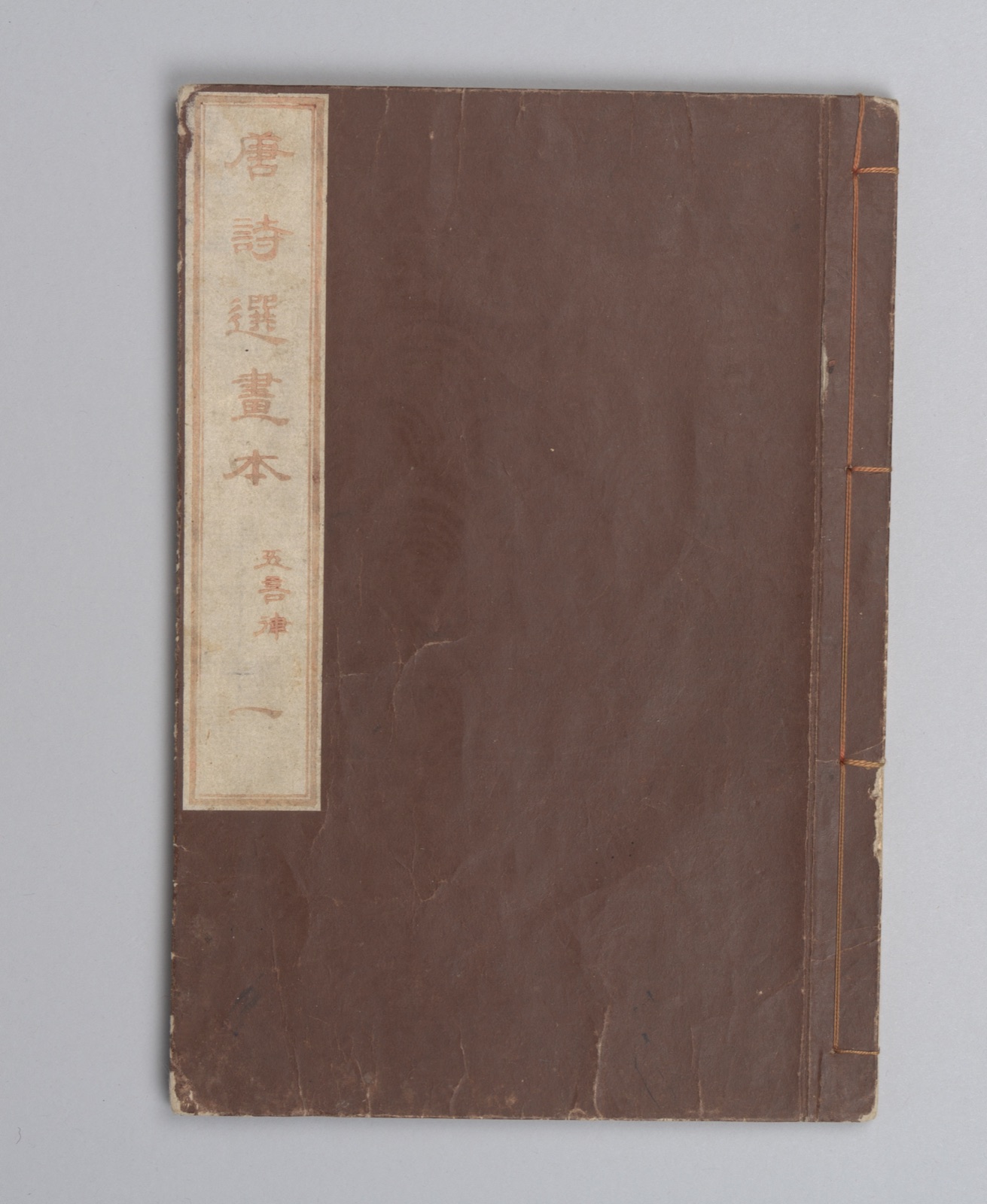
The Metropolitan Museum of Art, CC0, via Wikimedia Commons.
Die-cutting, embossing, foil and varnish
Finishing is work done on a printed sheet after the press, usually with tooling made for the job, so each process adds a fixed cost.
Die-cutting cuts shapes out of the sheet with a die, a shaped steel blade pressed through it.9 It makes windows, shaped edges and cartons, cut along a dieline (→ 40 Packaging design). Embossing raises an image between a hard die of brass or steel and a softer counter-die that fits it exactly.10 Debossing presses the image down into the sheet. Without ink or foil it’s blind embossing.10
Foil stamping uses a heated die to transfer a thin metallic or colored layer from a carrier film to the sheet, at 80–220 °C in graphic work.11 It can be done in the same pass as embossing.10
Varnish is a clear coating that protects the ink and changes its gloss. It can cover the whole sheet or, as spot varnish, only chosen areas, often gloss against a matte background.12 Water-based dispersion varnish, called aqueous coating in North America, goes on in a coating unit on the press. UV varnish cures in seconds under ultraviolet light, usually to a high gloss.1314 Both can crack, so keep them off folds.1314
See also
15 Color in screen and print · 25 Editorial and book design · 38 Prepress and printing · 40 Packaging design
Sources
- Cornell University Library (n.d.). “Glossary.” Library Preservation and Conservation Tutorial.
- Fickeissen, S. (2013). “Conservation: Speaking of Books, 3rd Edition: Thread vs. Glue.” Hagley Museum and Library.
- HTWK Leipzig (n.d.). Veredelungslexikon: “Die-cutting,” “Relief embossing,” “Hot foil stamping,” “Varnishing,” “Dispersion varnish,” “UV varnish.”
- JAANUS (n.d.). “fukurotoji.”
- Medeiros, R. (2015). “6.5 Paper Basics.” In Graphic Design and Print Production Fundamentals. BCcampus.
- The Metropolitan Museum of Art (n.d.). Object 2013.731a–e.
- School of the Art Institute of Chicago Service Bureau (n.d.). “Saddle Stitch Books.”
- UC Library Bindery, University of California, Berkeley (n.d.). “Definitions of common terms.”
- University of Brighton (n.d.). “Grain Direction.”
Notes
- Medeiros, R. (2015). “6.5 Paper Basics.” In Graphic Communications Open Textbook Collective, Graphic Design and Print Production Fundamentals. BCcampus, CC BY 4.0. https://opentextbc.ca/graphicdesign/chapter/6-5-paper-basics/ ↩ ↩ ↩ ↩ ↩ ↩ ↩ ↩
- University of Brighton, Visual Communication Technical Resource (n.d.). “Grain Direction.” https://blogs.brighton.ac.uk/viscommtech/bookarts/worksheets-for-bookbinders/grain-direction ↩
- UC Library Bindery, University of California, Berkeley (n.d.). “Definitions of common terms.” https://bindery.berkeley.edu/campus-libraries/definitions-common-terms ↩
- School of the Art Institute of Chicago Service Bureau (n.d.). “Saddle Stitch Books.” https://sites.saic.edu/servicebureau/home/services/saddle-stitch-books/ ↩ ↩
- Fickeissen, S. (2013). “Conservation: Speaking of Books, 3rd Edition: Thread vs. Glue.” Hagley Museum and Library, 14 November 2013. https://hagley.org/node/693 ↩ ↩
- Cornell University Library (n.d.). “Glossary.” Library Preservation and Conservation Tutorial. https://chinapreservationtutorial.library.cornell.edu/glossary ↩
- JAANUS, Japanese Architecture and Art Net Users System (n.d.). “fukurotoji 袋綴.” https://projects.mcah.columbia.edu/jaanus/node/4590 ↩
- The Metropolitan Museum of Art (n.d.). Katsushika Hokusai, Illustrated “Anthology of Tang-Dynasty Poems” in Five-Syllable Lines (Tōshisen ehon gogon ritsu hairitsu), 1836, 2013.731a–e. https://www.metmuseum.org/art/collection/search/78802 ↩
- HTWK Leipzig (n.d.). “Die-cutting.” Veredelungslexikon (finishing lexicon). https://veredelungslexikon.htwk-leipzig.de/micrositeen/mainnavigation/finishing-by-separating/die-cutting ↩
- HTWK Leipzig (n.d.). “Relief embossing.” Veredelungslexikon. https://veredelungslexikon.htwk-leipzig.de/micrositeen/mainnavigation/finishing-by-forming/stamping/relief-embossing ↩ ↩ ↩
- HTWK Leipzig (n.d.). “Hot foil stamping.” Veredelungslexikon. https://veredelungslexikon.htwk-leipzig.de/micrositeen/mainnavigation/finishing-by-joining/film-transfer/hot-foil-stamping ↩
- HTWK Leipzig (n.d.). “Varnishing.” Veredelungslexikon. https://veredelungslexikon.htwk-leipzig.de/micrositeen/mainnavigation/finishing-by-coating/varnishing ↩
- HTWK Leipzig (n.d.). “Dispersion varnish.” Veredelungslexikon. https://veredelungslexikon.htwk-leipzig.de/micrositeen/mainnavigation/finishing-by-coating/varnishing/dispersion-varnish ↩ ↩
- HTWK Leipzig (n.d.). “UV varnish.” Veredelungslexikon. https://veredelungslexikon.htwk-leipzig.de/micrositeen/mainnavigation/finishing-by-coating/varnishing/uv-varnish ↩ ↩