Chapter 36: Motion, video and sound
Motion design is design for things that change over time: an animated logo, a product film, a title card, a menu that slides open. Time adds decisions a still layout never needs. What moves first, how fast, for how long, what the viewer hears, and where the cut falls all become part of the design. The vocabulary below is shared by animators, editors and sound designers, and most of it is older than the computer.
Animation and motion graphics
Animation is the illusion of movement made from still images, each changed slightly from the last and shown fast enough that the eye reads them as one continuous motion. The images can be drawings, cut paper, clay, objects, computer models or type. Lotte Reiniger made The Adventures of Prince Achmed (1926) from black paper silhouettes moved a little between exposures. The Metropolitan Museum of Art calls it the oldest surviving full-length animated film.1
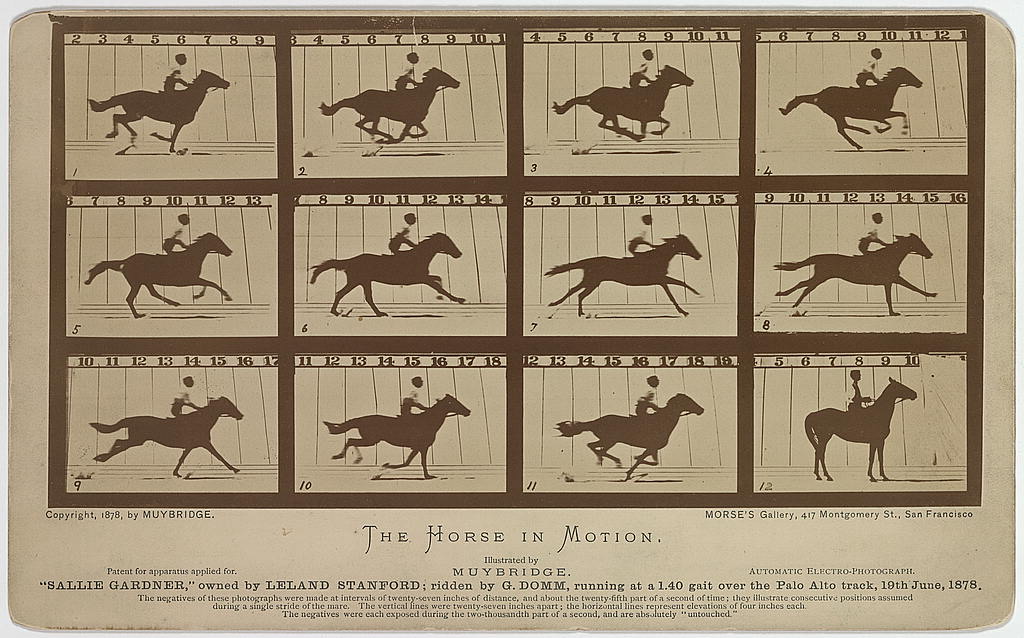
Eadweard Muybridge, public domain, via the Library of Congress.
Motion graphics is graphic design set in motion: type, shapes, logos, charts and interface elements, usually without characters or a story. The name has a commercial origin. In 1960 John Whitney founded a company he called Motion Graphics Incorporated, and used a mechanical analog computer he had built to animate type and abstract patterns for film titles and commercials.2 Today the term covers broadcast graphics, explainer videos, animated logos (→ 30 Identity systems) and much interface motion.
The principles of animation
The principles of animation are twelve rules for making movement look natural and readable, set out by the Disney animators Frank Thomas and Ollie Johnston in The Illusion of Life (1981). They grew out of practice at the Disney studio in the 1930s.34 The twelve are squash and stretch, anticipation, staging, straight-ahead action and pose-to-pose, follow-through and overlapping action, slow in and slow out, arcs, secondary action, timing, exaggeration, solid drawing, and appeal.
In 1987 John Lasseter published a SIGGRAPH paper applying the same principles to 3D computer animation (→ 37 3D design).5
Several of the principles carry straight over to graphic and interface motion. Squash and stretch is deforming a shape as it moves or lands, which tells the viewer how heavy and soft it is. Anticipation is a small move that prepares the main one, such as a crouch before a jump or a slight pull back before a card flies off. Follow-through is the part that keeps moving after the main action stops. Slow in and slow out means more frames near the start and end of a move than in the middle, so things accelerate and settle instead of starting and stopping dead. In code, that principle is called easing.
Timing and easing
Timing is how long a movement takes. Easing is how its speed changes during that time. A panel can open in 300 ms at a constant rate, or in the same 300 ms starting fast and settling gently. The duration is identical, but the second one looks like a physical object.
An easing curve plots progress against time, and its slope is the speed. CSS names four standard curves as cubic Béziers. ease-in is cubic-bezier(0.42, 0, 1, 1), ease-out is cubic-bezier(0, 0, 0.58, 1), ease-in-out is cubic-bezier(0.42, 0, 0.58, 1), and the default, ease, is cubic-bezier(0.25, 0.1, 0.25, 1). linear keeps the speed constant.6
For interfaces, Nielsen Norman Group recommends durations of 100–500 ms for most animations, and about 100 ms for small feedback such as a toggle switch. It advises ease-out for elements entering the screen, ease-in for elements leaving, and avoiding linear motion, which it says looks unnatural.7
Some people can’t tolerate movement. WCAG 2.2 notes that animation can bring on nausea and migraines in people with vestibular disorders, and its success criterion 2.3.3 (level AAA) asks that motion triggered by interaction can be switched off unless it is essential.8 Operating systems offer a reduce-motion setting, and CSS exposes it as the prefers-reduced-motion media query (→ 49 Accessibility and inclusive design).
Keyframes
A keyframe is a frame that fixes where something is, or what value it has, at a given moment. In hand-drawn studios a key animator drew the main poses, and assistants drew the in-betweens. Around 1970 Nestor Burtnyk and Marceli Wein at Canada’s National Research Council wrote software that computed the in-betweens from an artist’s key drawings.9 Peter Foldès used it for Hunger (1974), a ten-minute film that was the first computer-animated film nominated for an Academy Award.9
Computing the in-between values is called interpolation, and it is how all motion software works now. In CSS, an @keyframes rule lists states at percentages of the animation, from 0% to 100%, and the browser interpolates each property between them.10
Kinetic typography and title sequences
Kinetic typography is text whose movement carries part of its meaning. Researchers at Carnegie Mellon, where the School of Design began exploring it in 1996, define it as “the art and technique of expression with animated text.”11 Words can tremble, shrink away, arrive on the beat or hold still for emphasis, the way a speaker’s voice does.
A title sequence is the opening of a film or program that presents its title and credits. Saul Bass made the form a piece of design in its own right. For Otto Preminger’s The Man with the Golden Arm (1955), about heroin addiction, he reduced the story to white bars and a jagged black arm, cut to Elmer Bernstein’s jazz score. Preminger sent prints to cinemas with a note telling projectionists to open the curtains before the first reel, so audiences would see the titles.12 For Hitchcock’s North by Northwest (1959), Bass ran the credits along a grid of lines that dissolves into the glass facade of an office building. Art of the Title says the sequence is often credited as the first to use kinetic type.13
The same techniques now appear in lyric videos, brand films and app onboarding. The rules of type still apply in motion (→ 20 Choosing, pairing and legibility), with one added: viewers can’t reread. Each line must stay on screen long enough to be read twice.
Storyboards and animatics
A storyboard is a sequence of drawn panels that plans a film shot by shot. Its history and its use in UX are covered in → 11 Drawing, perspective and composition.
An animatic is a storyboard cut into a video, with each panel held on screen for as long as its shot will run, set against a scratch track of temporary voice, music and effects.14 It tests pacing before anything expensive is animated or filmed. A ten-second shot that drags in the animatic will drag in the finished film, and cutting it then costs nothing.
Shots and editing
A shot is a continuous run of picture between two cuts. Shot size describes how much of the subject fills the frame. Yale’s Film Analysis guide runs from the extreme long shot, where a person is dwarfed by a building or a crowd, through the long shot (a full standing figure), the medium close-up (chest up) and the close-up (a head), to the extreme close-up of an eye or a hand.15 Wider shots establish where things are; closer shots tell the viewer what to feel about them.
Continuity editing is cutting that keeps space, direction and time clear, so viewers follow the action without noticing the cuts.16 Its best-known rule is the 180-degree rule. Draw an imaginary line between two people in a scene and keep the camera on one side of it, so the person on the left stays on the left. Cross the line without a new establishing shot and the characters seem to swap places.16 Shot/reverse shot, which cuts back and forth between two people in a conversation, depends on it. Cross-cutting alternates between two lines of action happening in different places at once.
Editing also creates meaning that no single shot holds. In the experiment attributed to the Soviet filmmaker Lev Kuleshov, the same neutral face, cut against different images, was read as hungry, sad or happy. The original footage is lost. In 2016 Daniel Barratt and colleagues repeated the test with 36 viewers and concluded that “some sort of Kuleshov effect does in fact exist,” although eye tracking showed no difference in where viewers looked at the face.17
Frame rate and aspect ratio
Frame rate is the number of frames shown per second (fps). Silent cameras were hand-cranked, and 16 fps became an unofficial standard because it was the cheapest rate that looked smooth enough. With sound, Warner Bros.’ Vitaphone and Fox’s Movietone ran at 24 fps, judged the lowest rate that didn’t harm the sound, and 24 has been the cinema standard since.18 Peter Jackson shot The Hobbit trilogy (2012–14) at 48 fps, and the format didn’t catch on.18
North American (NTSC) television runs at 29.97 fps, not 30. When color was added in 1953, engineers slowed the frame rate by a thousandth so the color signal wouldn’t interfere with existing black-and-white sets. The leftover fraction is why editors still use drop-frame timecode, which skips frame numbers to keep the count in step with the clock.19 Animation often draws fewer images than it shows. Astro Boy (1963), Japan’s first long-form TV anime, made a weekly half-hour possible with “limited animation”: fewer frames, reused drawings and, often, only the mouth moving.20
Aspect ratio is the width of a picture divided by its height (→ 11 Drawing, perspective and composition). Silent films were usually 1.33:1 (4:3). In 1932 the Society of Motion Picture Engineers adopted the Academy ratio of 1.37:1 for sound films. In the 1950s CinemaScope used anamorphic lenses to squeeze images as wide as 2.66:1 onto the same film.21 Video now defaults to 16:9, which YouTube calls the standard on a computer, and phone video to vertical 9:16.22
Sound design
Sound design is planning and making everything an audience hears: dialogue, effects, ambience and, by some definitions, music. The title is recent. Walter Murch, who edited the picture and mixed the sound for Apocalypse Now (1979), was credited as its “sound designer”. He has said that he took the term by comparison with a production designer, since he was arranging sound in the three-dimensional space of the theater.23
Film sound divides first by source. Diegetic sound comes from within the story’s world: speech, footsteps, a car radio. Nondiegetic sound, such as the score or a narrator, comes from outside it, and only the audience hears it.24 Many everyday sounds are recorded after shooting, because microphones on set are placed for dialogue. Foley is the craft of performing those effects in sync with the picture, named after Jack Foley, who began doing it at Universal when the silent Show Boat (1929) was converted to sound.25 For Spartacus (1960), he made the clink of marching soldiers’ armor by shaking keys on rings.25
Loudness is now specified in the brief. The European Broadcasting Union’s R 128, first published in 2010, asks for program loudness to be normalized to −23 LUFS (loudness units relative to full scale), measured with a loudness meter, not a peak meter.26 If a commercial or brand film is going to broadcast, ask for the target before the mix starts.
See also
11 Drawing, perspective and composition · 30 Identity systems · 33 Photography · 35 Resolution, formats and units · 37 3D design · 49 Accessibility and inclusive design
Sources
- Adobe. “The 12 principles of animation.” Adobe Creative Cloud.
- Barratt, D., Rédei, A. C., Innes-Ker, Å., & van de Weijer, J. (2016). “Does the Kuleshov effect really exist? Revisiting a classic film experiment on facial expressions and emotional contexts.” Perception 45(8), 847–874.
- Beacham, F. (2015). “How a 1953 standards decision affects today’s global television industry.” The Broadcast Bridge, June 11.
- Boords. “What is the definition of an animatic storyboard?”
- Britannica Editors and Vaughan, D. “Foley artist.” Encyclopaedia Britannica.
- Carnegie Mellon University. “What is kinetic typography.” Johnny C. Lee, Kinetic Typography Engine project page.
- Ebiri, B. (2025). “Dreams per second: a history of the frame rate.” Notebook, MUBI, July 30.
- European Broadcasting Union. “Loudness.” EBU Technology & Innovation (EBU R 128).
- Holmstrom, H. (2018). “The measure of a screen: motion picture aspect ratios in the archives.” The Unwritten Record, US National Archives, January 18.
- IEEE Canada. “Retired NRC scientists Burtnyk and Wein honoured as fathers of computer animation technology in Canada.”
- Lasseter, J. (1987). “Principles of traditional animation applied to 3D computer animation.” Computer Graphics 21(4), 35–44 (SIGGRAPH ‘87).
- Laubheimer, P. (2020). “Executing UX animations: duration and motion characteristics.” Nielsen Norman Group, February 9.
- Metropolitan Museum of Art (2020). “The art of Lotte Reiniger, 1970.” From the Vaults, December 11.
- MDN Web Docs. “@keyframes.” Mozilla.
- Murch, W. “The term ‘sound design’.” Web of Stories.
- Nakano, H. (2026). “Manga media and content in postwar Japan.” Nippon.com, April 7.
- SIGGRAPH Education Committee (1999). “Principles of traditional animation applied to 3D computer animation.” HyperGraph.
- SIGGRAPH Arts. “John Whitney: Motion Graphics.”
- Thomas, F., & Johnston, O. (1981). The Illusion of Life: Disney Animation. Abbeville Press.
- Art of the Title. “The Man with the Golden Arm” (1955); “North by Northwest” (1959).
- W3C (2023). CSS Easing Functions Level 1, Candidate Recommendation Draft, February 13.
- W3C. “Understanding success criterion 2.3.3: Animation from Interactions.” WCAG 2.2.
- Yale University. Film Analysis Guide: “Cinematography,” “Editing,” “Sound.”
- YouTube Help. “Video resolution & aspect ratios.”
Notes
- Metropolitan Museum of Art (2020). https://www.metmuseum.org/perspectives/from-the-vaults-lotte-reiniger ↩
- SIGGRAPH Arts, “John Whitney: Motion Graphics.” https://siggrapharts.hosting.acm.org/wp/john-whitney/other/motion-graphics/ ↩
- Adobe, “The 12 principles of animation.” https://www.adobe.com/creativecloud/animation/discover/principles-of-animation.html ↩
- SIGGRAPH HyperGraph (1999). https://education.siggraph.org/static/HyperGraph/animation/character_animation/principles/prin_trad_anim.htm ↩
- Lasseter (1987). Bibliographic details from SIGGRAPH History, https://history.siggraph.org/?p=116057 ↩
- W3C, CSS Easing Functions Level 1, §2. https://www.w3.org/TR/css-easing-1/ ↩
- Laubheimer (2020). https://www.nngroup.com/articles/animation-duration/ ↩
- W3C, Understanding SC 2.3.3. https://www.w3.org/WAI/WCAG22/Understanding/animation-from-interactions.html ↩
- IEEE Canada. https://ewh.ieee.org/reg/7/millennium/computer_animation/animation_honoured.html ↩ ↩
- MDN Web Docs, “@keyframes.” https://developer.mozilla.org/en-US/docs/Web/CSS/@keyframes ↩
- Carnegie Mellon University, Kinetic Typography Engine. https://www.cs.cmu.edu/~johnny/kt ↩
- Art of the Title, “The Man with the Golden Arm.” https://www.artofthetitle.com/title/the-man-with-the-golden-arm/ ↩
- Art of the Title, “North by Northwest.” https://www.artofthetitle.com/title/north-by-northwest/ ↩
- Boords. https://boords.com/blog/what-is-the-definition-of-an-animatic-storyboard ↩
- Yale Film Analysis Guide, “Cinematography.” https://filmanalysis.yale.edu/cinematography/ ↩
- Yale Film Analysis Guide, “Editing.” https://filmanalysis.yale.edu/editing/ ↩ ↩
- Barratt et al. (2016), abstract. https://lup.lub.lu.se/record/5035188 ↩
- Ebiri (2025). https://mubi.com/notebook/posts/dreams-per-second-a-history-of-the-frame-rate ↩ ↩
- Beacham (2015). https://www.thebroadcastbridge.com/content/entry/2881/how-a-1953-standards-decision-affects-todays-global-television-industry ↩
- Nakano (2026). https://www.nippon.com/en/japan-topics/b11507/ ↩
- Holmstrom (2018). https://unwritten-record.blogs.archives.gov/2018/01/18/the-measure-of-a-screen-motion-picture-aspect-ratios-in-the-archives ↩
- YouTube Help. https://support.google.com/youtube/answer/6375112 ↩
- Murch, Web of Stories. https://www.webofstories.com/play/56537 ↩
- Yale Film Analysis Guide, “Sound.” https://filmanalysis.yale.edu/sound/ ↩
- Britannica, “Foley artist.” https://www.britannica.com/art/Foley-artist ↩ ↩
- EBU, “Loudness.” https://tech.ebu.ch/loudness ↩