Chapter 4: Design before 1900
For most of history, the person who decided what a thing should look like was also the person who made it. Design before 1900 is the story of the tools that made that work repeatable (rule-bound letterforms, then type) and of the industrial split that turned designing into a separate job.
Writing systems and calligraphy
A writing system is a set of graphic signs that records a language. Writing was invented from scratch at least four times: in Mesopotamia and Egypt toward the end of the fourth millennium BCE, in China by about 1200 BCE, and in Mesoamerica by the middle of the first millennium BCE. Christopher Woods of the University of Chicago calls these the four pristine writing systems and thinks it likely that every other script derives from or was inspired by one of them.1 The earliest cuneiform texts, from the city of Uruk, are mostly administrative: records of property, materials and labor. China’s first writing recorded royal divinations on turtle shell and ox bone.1
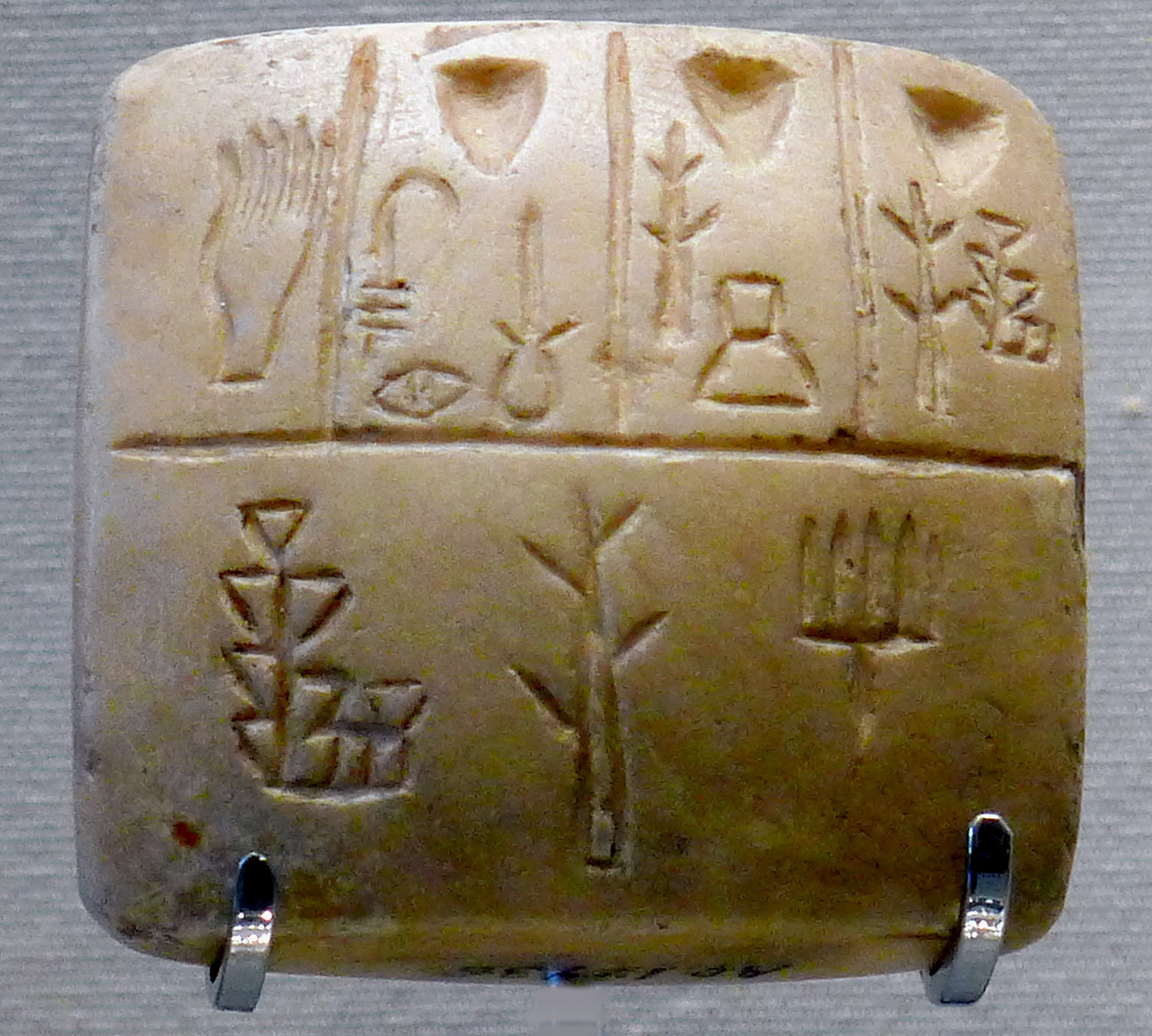
Mbzt, CC BY 3.0, via Wikimedia Commons.
Calligraphy is writing by hand as a disciplined art, and it produced some of the earliest explicit rules for letterforms. Ibn Muqla (886–940), a vizier at the Abbasid court, is credited with a system that sizes every letter from one unit: the rhombic dot the pen nib makes when pressed to paper. A set number of dots fixes the height of the alif, and a circle with that height as its diameter governs the other letters.2 Six proportioned scripts built on this system, the “six pens”, dominated Arabic calligraphy until the 1400s.2 Type designers working with grids and units are doing a version of the same thing (→ 22 Type across scripts).
The Latin lowercase has a traceable line too. Shortly after 1400, the Florentine scholar Poggio Bracciolini created humanist minuscule by imitating Carolingian minuscule, the book hand standardized across Charlemagne’s empire in the early ninth century.3 In 1465 the printers Sweynheym and Pannartz used the first roman typeface, modeled on that humanist script.4
Movable type in China, Korea and Europe
Movable type is a set of individual characters that can be arranged into a page, printed and then broken up for reuse. It differs from woodblock printing, where the whole page is carved into one block. The earliest recorded movable type is Chinese: between 1041 and 1048, the artisan Bi Sheng made one clay piece for each character and fired them hard. The scholar Shen Kuo described the method in his Dream Pool Essays.5 Woodblock printing stayed popular in China for centuries afterward, partly because a full set of type for thousands of characters was a large investment.5
Korea printed with metal. The oldest surviving book printed from movable metal type is the Jikji, a Buddhist text printed in 1377 at Heungdeok-sa temple in Cheongju, 78 years before the Gutenberg Bible. The surviving copy (the second volume) is held by the Bibliothèque nationale de France.6 In 1403 King Taejong of Joseon had the court cast a set of metal type, the gyemija, and later kings kept casting new type for the rest of the dynasty.7
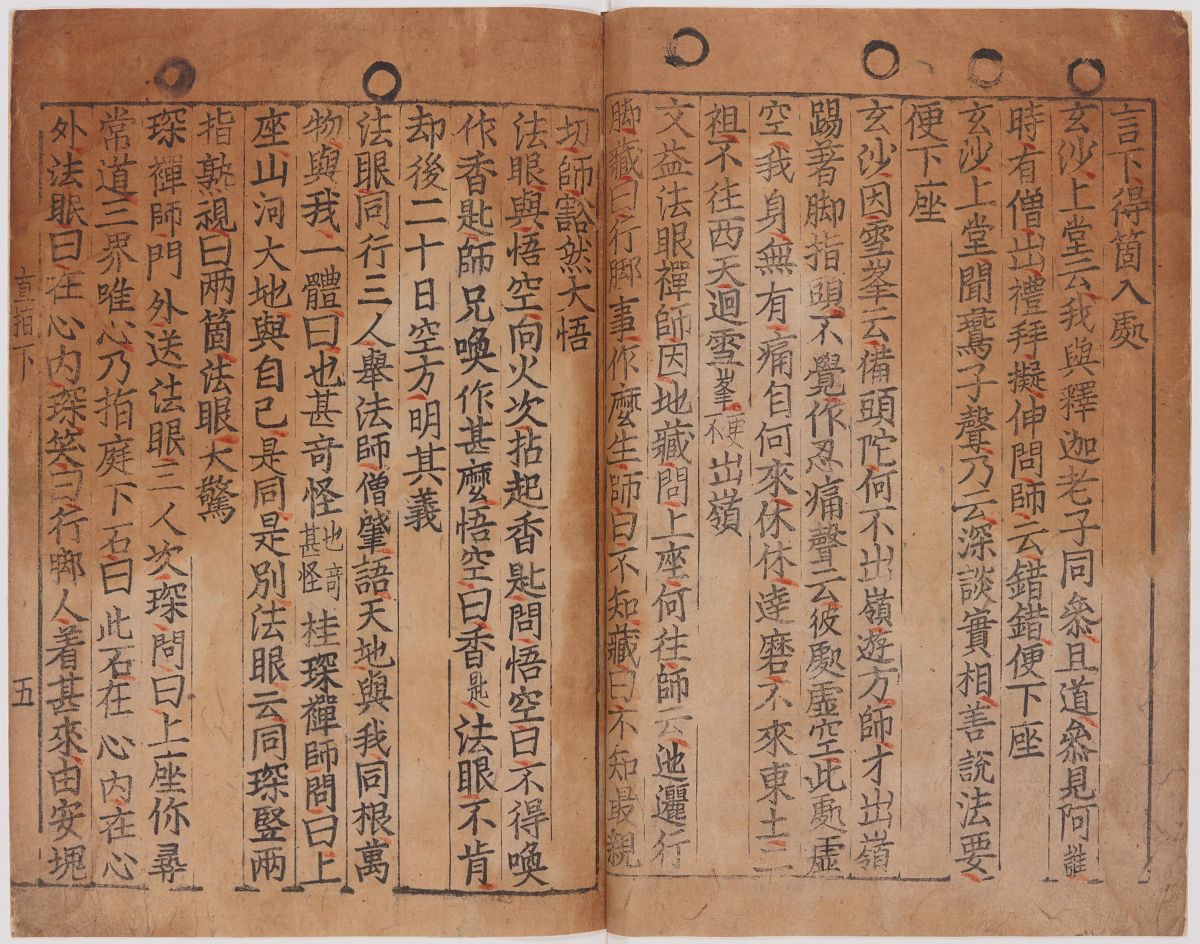
Bibliothèque nationale de France, public domain, via Wikimedia Commons.
In Europe, Johannes Gutenberg’s metal type followed in the mid-fifteenth century (→ 18 A history of type). A Latin font needs a few dozen letters and some punctuation, not thousands of characters.
The Industrial Revolution and the division of labor
The division of labor is splitting the making of a product into separate tasks done by different workers. Adam Smith opened The Wealth of Nations (1776) with a pin workshop where ten men, dividing the work into about 18 operations, made upwards of 48,000 pins a day. One untrained worker alone, he wrote, could not make 20, “perhaps not one”.8
The potter Josiah Wedgwood applied the same logic to goods whose appearance was the selling point. His Etruria works in Staffordshire opened on 13 June 1769.9 The historian Neil McKendrick called Wedgwood a pioneer of the division of labor in English factory organization, with most skilled workers kept to one branch of production.10
The look of the product became a branch of its own, and some of it came from outside the factory. The modeling of the Dancing Hours reliefs on Wedgwood’s blue jasperware, made around 1778, is attributed to the sculptor John Flaxman.11 A modeler made the master form once; molders, throwers and decorators reproduced it thousands of times. The person who decided the form no longer had to touch production, and that separation is the job description most designers still work under (→ 2 The design disciplines).
Arts and Crafts
The Arts and Crafts movement was a British-led reaction against that separation, aiming to rejoin designing and making. Its argument came from John Ruskin, who held that splitting the two damaged both the workers and the work.12 In The Nature of Gothic (1853) he turned Smith’s own example around: the workman left to make only the point of a pin, he wrote, has been divided himself. It isn’t the labor that is divided, “but the men”.13 William Morris reprinted the chapter at his Kelmscott Press in 1892 and called it one of the “very few necessary and inevitable utterances of the century”.13
Morris put the argument into practice. He and his friends founded Morris, Marshall, Faulkner & Co. in 1861 to make furnishings by hand; it became Morris & Co. under his sole control in 1875, and in 1891 he set up the Kelmscott Press.14 The movement got its name in 1887, when a group that first met as “The Combined Arts” took the title Arts and Crafts Exhibition Society on the suggestion of the bookbinder T. J. Cobden-Sanderson. Its first exhibition opened in London on October 1, 1888, with Walter Crane as president.15
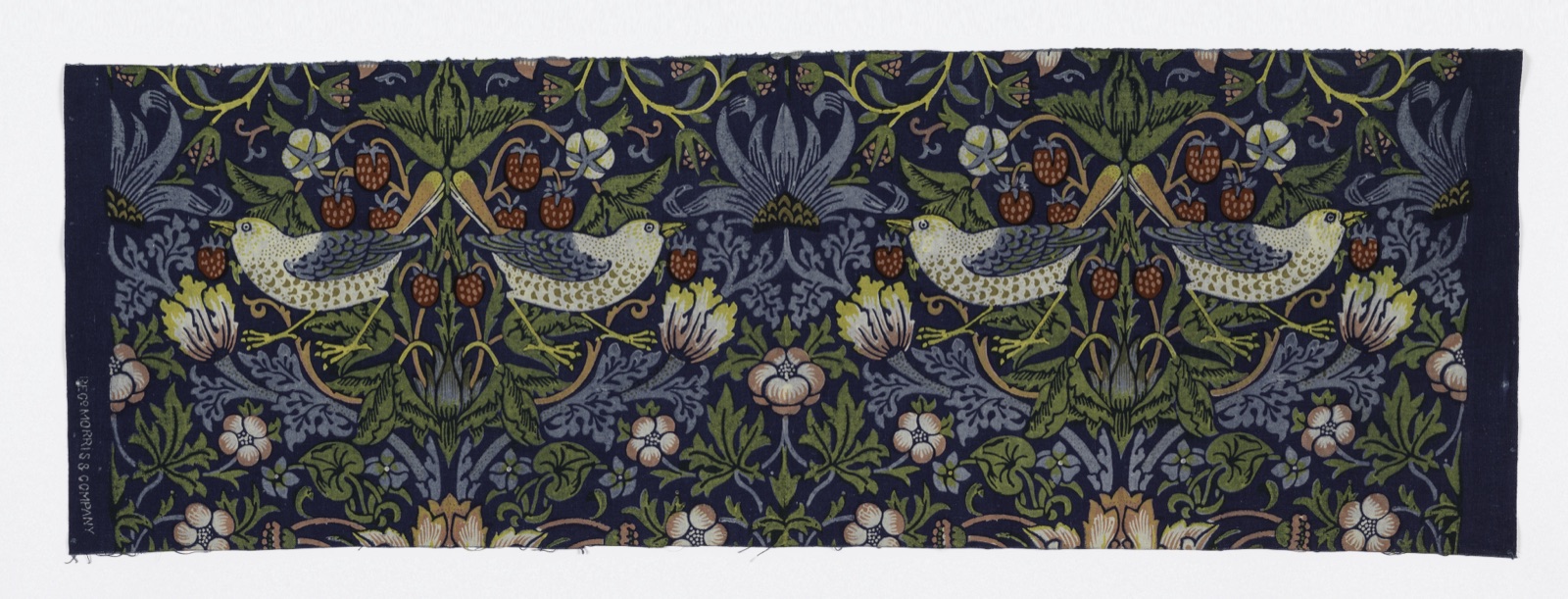
William Morris, public domain, via Wikimedia Commons.
Handwork is slow, and slow work is expensive. Morris & Co. sold hand-printed textiles and whole interiors to rich clients and a cheaper range to everyone else, and Strawberry Thief was one of its most expensive printed cottons.16 The movement never settled the tension between fair work and affordable goods. Its insistence on honest materials and making was taken up in continental Europe, where the V&A counts it among the sparks for radical modernism (→ 5 Modern movements, 1900–1970).12
See also
- 2 The design disciplines
- 5 Modern movements, 1900–1970
- 7 Design traditions beyond the West
- 18 A history of type
- 22 Type across scripts
Sources
- Asian Art Museum. “The history of Islamic calligraphy.” Education resources. https://education.asianart.org/resources/the-history-of-islamic-calligraphy/
- Asian Art Museum. “The invention of woodblock printing in the Tang and Song dynasties.” Education resources. https://education.asianart.org/resources/the-invention-of-woodblock-printing-in-the-tang-and-song-dynasties
- Bibliothèque nationale de France. “Jikji, a treasure of the world of printing.” https://www.bnf.fr/en/jikji-treasure-world-printing
- Dartmouth Ancient Books Lab (2016). “Carolingian minuscule.” https://sites.dartmouth.edu/ancientbooks/?p=261
- Hart, I. (2012). “On the Arts and Crafts Exhibition Society.” BRANCH: Britain, Representation and Nineteenth-Century History. https://branchcollective.org/?p=1352
- Hill Museum & Manuscript Library. “Latin: Humanist.” HMML School. https://hmmlschool.org/latin-humanist/
- Korea.net. Article on Joseon movable metal type. https://www.korea.net/NewsFocus/Culture/view?articleId=137882
- McKendrick, N. (1961). “Josiah Wedgwood and factory discipline.” The Historical Journal 4(1), 30–55.
- Ruskin, J. (1892). The Nature of Gothic: A Chapter of The Stones of Venice, with a preface by William Morris. Kelmscott Press. First published 1853.
- Smith, A. (1776). An Inquiry into the Nature and Causes of the Wealth of Nations, Book I, chapter 1. Library of Economics and Liberty.
- Victoria and Albert Museum. “Arts and Crafts: an introduction”; “Introducing William Morris”; collection records O1715392 (First Day’s Vase) and O1745748 (Dancing Hours plaque).
- William Morris Gallery. “About William Morris.” https://wmgallery.org.uk/collection/about-william-morris/
- Woods, C. (2010). “Visible language: the earliest writing systems.” In C. Woods (ed.), Visible Language: Inventions of Writing in the Ancient Middle East and Beyond, Oriental Institute Museum Publications 32. University of Chicago.
Notes
- Woods, C. (2010), introduction to Visible Language, Oriental Institute Museum Publications 32, pp. 13 (time line) and 15–17. https://oi-idb-static.uchicago.edu/multimedia/81/OIMP%2032%20-%20Woods,%20Chris%20-%20Visible%20Language.pdf ↩ ↩
- Asian Art Museum, “The history of Islamic calligraphy.” https://education.asianart.org/resources/the-history-of-islamic-calligraphy/ ↩ ↩
- Dartmouth Ancient Books Lab (2016, updated 2026), “Carolingian minuscule.” https://sites.dartmouth.edu/ancientbooks/?p=261 ↩
- Hill Museum & Manuscript Library, “Latin: Humanist.” https://hmmlschool.org/latin-humanist/ ↩
- Asian Art Museum, “The invention of woodblock printing in the Tang and Song dynasties.” https://education.asianart.org/resources/the-invention-of-woodblock-printing-in-the-tang-and-song-dynasties ↩ ↩
- Bibliothèque nationale de France, “Jikji, a treasure of the world of printing.” https://www.bnf.fr/en/jikji-treasure-world-printing ↩
- Korea.net, article on Joseon movable metal type. https://www.korea.net/NewsFocus/Culture/view?articleId=137882 ↩
- Smith, A. (1776), The Wealth of Nations, Book I, chapter 1. https://www.econlib.org/library/Smith/smWN.html?chapter_num=4 ↩
- Victoria and Albert Museum, “The First Day’s Vase,” collection record O1715392. https://collections.vam.ac.uk/item/O1715392/the-first-days-vase-vase-josiah-wedgwood/ ↩
- McKendrick, N. (1961), “Josiah Wedgwood and factory discipline,” The Historical Journal 4(1), 30–55. https://www.cambridge.org/core/journals/historical-journal/article/ii-josiah-wedgwood-and-factory-discipline1/2A0B084644F35C5FCBA1A0C629F0DD5A ↩
- Victoria and Albert Museum, Dancing Hours plaque, collection record O1745748. https://collections.vam.ac.uk/item/O1745748/plaque-john-flaxman/ ↩
- Victoria and Albert Museum, “Arts and Crafts: an introduction.” https://www.vam.ac.uk/articles/arts-and-crafts-an-introduction ↩ ↩
- Ruskin, J., The Nature of Gothic (Kelmscott Press, 1892), p. 22 and William Morris’s preface dated February 15, 1892. https://archive.org/details/natureofgothicch00rusk ↩ ↩
- Victoria and Albert Museum, “Introducing William Morris.” https://www.vam.ac.uk/articles/introducing-william-morris ↩
- Hart, I. (2012), “On the Arts and Crafts Exhibition Society,” BRANCH. https://branchcollective.org/?p=1352 ↩
- William Morris Gallery, “About William Morris.” https://wmgallery.org.uk/collection/about-william-morris/ ↩