Chapter 2: The design disciplines
A design discipline is a field of practice defined by what it designs and the knowledge that work needs. Graphic designers work with type and images, industrial designers with materials and factories, service designers with people and procedures. The boundaries are conventions, and they move. They matter because job titles, degrees, professional bodies and hiring all follow them (→ 1 What design is).
Graphic and communication design
Graphic design is the arrangement of type, images and space to communicate a message, mostly in fixed form: a poster, a book, a label, a sign. The American book designer W. A. Dwiggins used the phrase “graphic designer” for his own lettering, typography and advertising work in the Boston Evening Transcript in August 1922. The term stayed rare until the 1930s and 1940s.1
Communication design is the same core skill applied across media, including screens, motion, exhibitions and sound. When the International Council of Design renamed its journal Communication Design, its editor, Teal Triggs, said the term fit newer kinds of practice better than “graphic” did.2
The split between disciplines was never clean. In 1907 AEG, the Berlin electrical company, made the architect Peter Behrens its artistic consultant, and until 1914 he designed its advertising, products and buildings (figures 2.1 and 2.2).3 Graphic design today covers branding (→ 28 Brands and brand strategy), editorial work (→ 25 Editorial and book design) and information design (→ 26 Information design and data visualization).
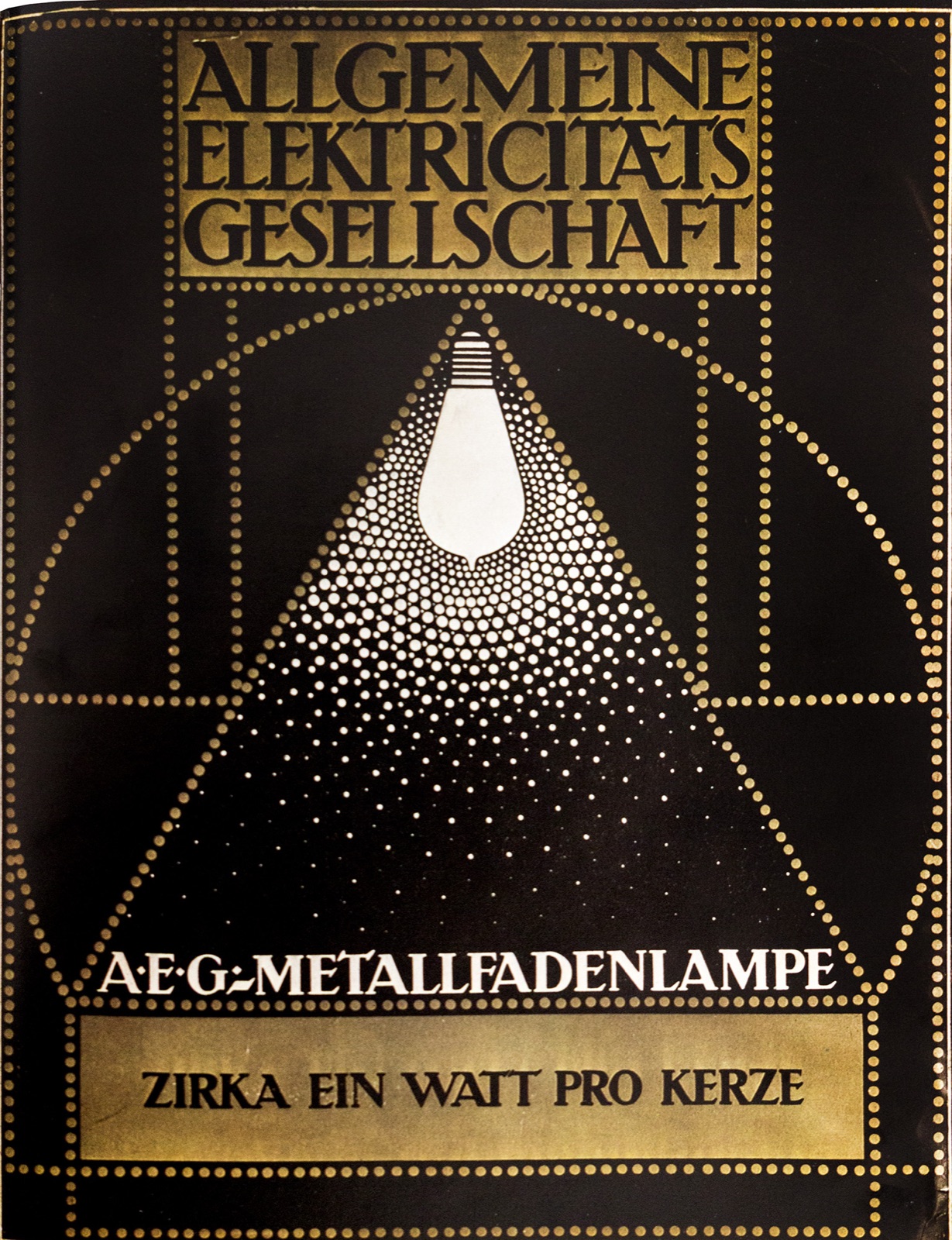
Peter Behrens, public domain, via Wikimedia Commons.
Product and industrial design
Industrial design is the design of objects made in quantity by machine: kettles, chairs, phones, medical devices. The designer decides form, materials and use, then works with engineers until a factory can make it at the right cost (→ 42 Product and industrial design). Behrens’s AEG kettles are early examples. In Japan, Kenji Ekuan’s GK Industrial Design Laboratory designed Kikkoman’s tabletop soy sauce dispenser, introduced in 1961. It doesn’t drip, and Kikkoman counted more than 500 million shipped by March 2018.4
In October 2015 the International Council of Societies of Industrial Design renamed itself the World Design Organization and adopted a definition of industrial design as a strategic problem-solving process whose results include systems, services and experiences as well as products.5
Product design is the name many firms use for the same work on physical goods.

Daderot, CC0, via Wikimedia Commons.
Interaction, UX and product design
Interaction design is the design of how people and digital things act on each other: what a person can do, what the system does in reply, and how the exchange runs over time. The industrial designer Bill Moggridge first presented on the subject in 1984 under the name “soft-face”, and later settled on “interaction design” with Bill Verplank. According to Jonas Löwgren, the term stayed marginal until the mid-1990s.6
User experience (UX) is everything a person meets when using a company’s product or service, on the screen and off it. After retiring from the University of California, San Diego in 1993, the cognitive scientist Don Norman joined Apple and led a three-person User Experience Office. Nielsen Norman Group, which he co-founded, says this was the first use of “user experience” in a job title.7
In software companies, product design now usually means a role that combines interaction, interface and UX work on one digital product, often with some product strategy. How UX, UI, interaction and product design differ in practice is covered in → 57 UX, UI and user-centered design, and the research behind them in → 45 Human-computer interaction: history and theory.
Service design
Service design is the design of a whole service: the people, processes, places and technology a customer meets over time, and the work behind them that the customer never sees. Renewing a passport is a service; the website is one of its touchpoints. G. Lynn Shostack, a bank executive, set out the method in “Designing Services That Deliver” in the Harvard Business Review in January 1984.8 Blueprints still divide each step into customer actions, visible staff actions, backstage actions and support processes.9 A service designer’s output is often a blueprint and changed staff procedures, with no new visual design at all (→ 55 Personas, journeys and service design).
Spatial, interior and environmental design
Spatial design is the umbrella term for the design of places people move through and occupy. Interior design is the planning of interior spaces, and in parts of the US and Canada it is a regulated profession. The Council for Interior Design Qualification (CIDQ), which has worked with regulators there since 1974, sets the NCIDQ examination and frames the job around public health, safety and welfare: codes, exits and accessibility as well as finishes.10 Environmental design, as graphic designers use the term, covers signage, wayfinding and exhibitions: graphic design applied to buildings and public space. All three are covered in → 41 Environmental and spatial design.
Fashion and textile design
Fashion design is the design of clothing and accessories, worked out on the body and usually released in collections. Textile design is the design of the cloth itself: its fiber, weave or knit, and printed pattern. The two are usually separate specialists. Issey Miyake’s A-POC, which he started in the late 1990s with the engineering designer Dai Fujiwara, joined them. A computer-controlled machine made clothing from a single thread in a single process: a continuous tube of knitted fabric with garments outlined inside it, which the wearer cut free.11
Specialists, generalists and the full-stack designer
A specialist has deep skill in one discipline, and a generalist works across several at a working level. The usual model for combining them is the T-shaped person: depth in one area (the vertical bar of the T) and the ability to work across disciplines (the horizontal bar). Tim Brown, chief executive of IDEO, described his firm’s hiring this way in a 2010 interview. The idea is older; Harvard Business Publishing traces it to McKinsey & Company in the 1980s.12
Full-stack designer borrows from software, where a full-stack developer works on both the front end and the back end. In design the phrase has no agreed definition. A 2015 article in Webdesigner Depot used it for a designer who can carry a project from research through wireframes to interface design, knowing enough code to see what can be built. The same article admits the cost: breadth can mean only a basic grasp of some skills.13
This book uses the term to mean literacy. A full-stack designer keeps depth in one or two disciplines and knows enough about the rest (printing, code, research, money) to ask useful questions and spot a bad plan early. Teams still need specialists. A generalist with no depth anywhere is hard to place, and a specialist who can’t talk to the other disciplines slows everyone down (→ 90 Multidisciplinary teams).
See also
1 What design is · 3 Design processes · 41 Environmental and spatial design · 42 Product and industrial design · 57 UX, UI and user-centered design · 90 Multidisciplinary teams
Sources
- Cartwright, D. (2015). “What is a full-stack designer, and should you be one?” Webdesigner Depot.
- Council for Interior Design Qualification (n.d.). “What is Interior Design?” cidq.org.
- Die Neue Sammlung, The Design Museum (n.d.). “Peter Behrens.” Collection database.
- Heller, S. (2020). “Where Does the Term ‘Graphic Designer’ Come From?” Print.
- International Council of Design (n.d.). “The journey of a design journal.” theicod.org.
- Kikkoman Corporation (2020). Kikkoman Today 34(1).
- Löwgren, J. (n.d.). “Interaction Design: brief intro.” The Encyclopedia of Human-Computer Interaction, 2nd ed. Interaction Design Foundation.
- Nielsen Norman Group (n.d.). “Don Norman.” nngroup.com.
- Schaffer, C. (n.d.). “‘Both/And’ Leadership.” Harvard Business Publishing.
- Schoneveld, E., et al. (n.d.). “Constructed flatness.” Japanese Modernism Across Media. Haverford College.
- Shostack, G. L. (1984). “Designing Services That Deliver.” Harvard Business Review, January.
- University of York (n.d.). “Professor Don Norman.”
- W. P. Carey School of Business, Arizona State University (2008). “A key to service innovation: Services blueprinting.”
- World Design Organization (n.d.). “Definition of Industrial Design”; (2015) report on the 29th General Assembly.
Notes
- Heller, S. (2020, March 12). “Where Does the Term ‘Graphic Designer’ Come From?” Print. https://www.printmag.com/featured-design-history/where-does-the-term-graphic-designer-come-from/ ↩
- International Council of Design (n.d.). “The journey of a design journal.” https://www.theicod.org/resources/news-archive/the-journey-of-a-design-journal ↩
- Die Neue Sammlung, The Design Museum (n.d.). “Peter Behrens.” Collection database. https://collection.design-museum.de/en/artists/artist/597/ ↩
- Kikkoman Corporation (2020). Kikkoman Today, vol. 34, no. 1. https://www.kikkoman.com/en/culture/foodforum/today/20200327.html ↩
- World Design Organization (n.d.). “Definition of Industrial Design.” https://wdo.org/about/definition/ ; World Design Organization (2015, December 3), report on the 29th General Assembly, Gwangju. https://wdo.org/?p=2098 ↩
- Löwgren, J. (n.d.). “Interaction Design: brief intro.” In The Encyclopedia of Human-Computer Interaction, 2nd ed. Interaction Design Foundation. https://ixdf.org/literature/book/the-encyclopedia-of-human-computer-interaction-2nd-ed/interaction-design-brief-intro ↩
- Nielsen Norman Group (n.d.). “Don Norman.” https://www.nngroup.com/people/don-norman/ ; University of York (n.d.). “Professor Don Norman.” https://www.york.ac.uk/computer-science/about/equality-and-diversity/heroes-of-computer-science/professordonnorman/ ↩
- Shostack, G. L. (1984). “Designing Services That Deliver.” Harvard Business Review, January 1984. https://hbr.org/1984/01/designing-services-that-deliver ↩
- W. P. Carey School of Business, Arizona State University (2008, January 30). “A key to service innovation: Services blueprinting.” https://news.wpcarey.asu.edu/20080130-key-service-innovation-services-blueprinting ↩
- Council for Interior Design Qualification (n.d.). Home page and “What is Interior Design?” https://www.cidq.org/ ; https://www.cidq.org/what-is-interior-design ↩
- Schoneveld, E., and students of EALC 335 (n.d.). “Constructed flatness.” Japanese Modernism Across Media, Haverford College. https://ds-archive.haverford.edu/japanesemodernism/exhibits/show/issey-miyake/constructedflatness ↩
- Schaffer, C. (n.d.). “‘Both/And’ Leadership: Combining the Benefits of I- and T-Shaped Leaders.” Harvard Business Publishing. https://www.harvardbusiness.org/both-and-leadership-combining-the-benefits-of-i-and-t-shaped-leaders/ ↩
- Cartwright, D. (2015, June 23). “What is a full-stack designer, and should you be one?” Webdesigner Depot. https://www.webdesignerdepot.com/2015/06/what-is-a-full-stack-designer-and-should-you-be-one/ ↩