Chapter 42: Product and industrial design
Industrial design is the design of objects made in quantity by machine (→ 2 The design disciplines). Two constraints set it apart from work on a page or a screen. Every part has to come out of a factory at a cost someone has agreed to, and the finished object has to suit hands and bodies that vary far more than most designers assume.
Materials and manufacturing
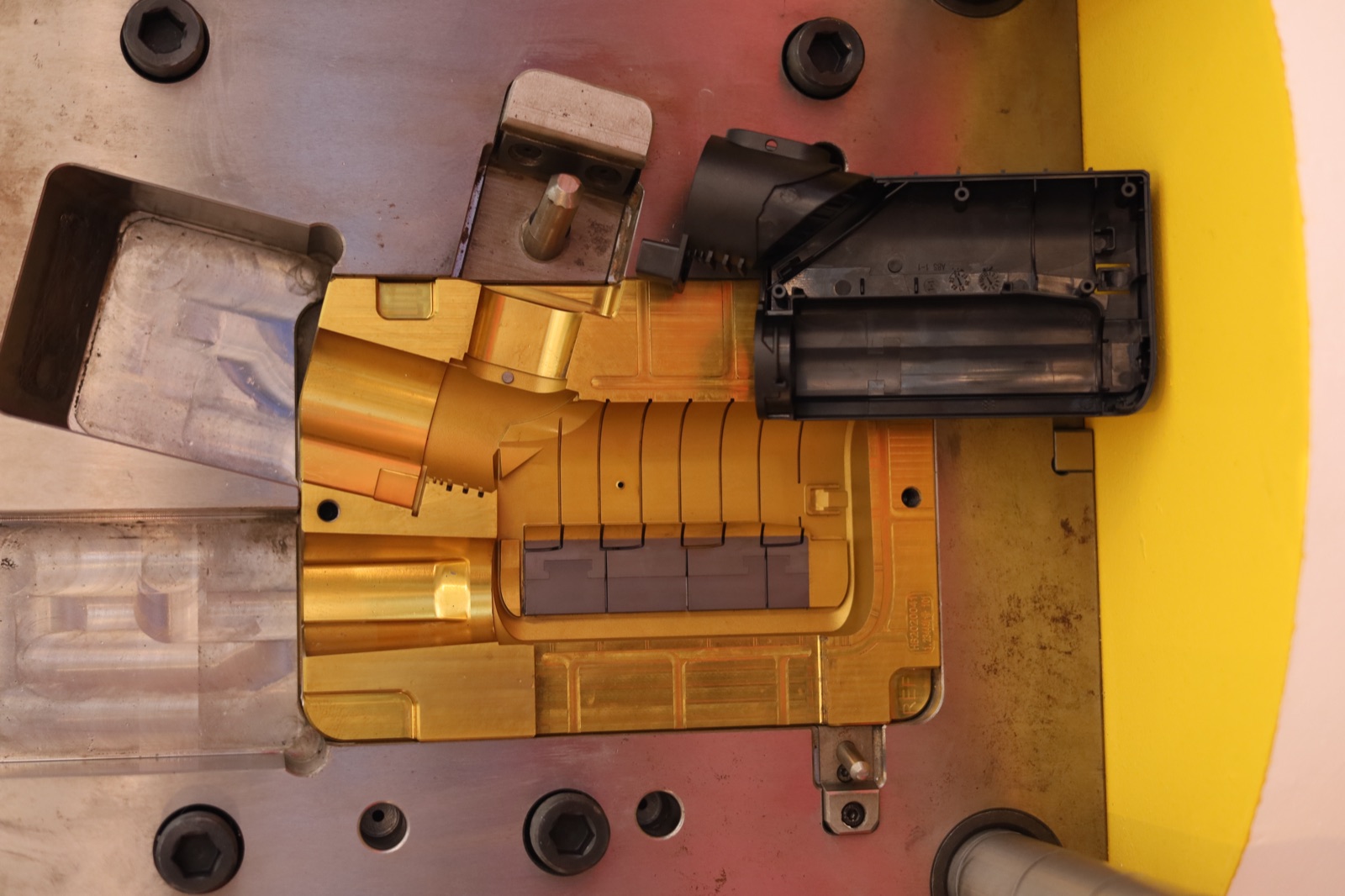
A manufacturing process is the method a factory uses to turn raw material into a part: molding, casting, machining, bending, printing. Material and process are chosen together. Pick a thermoplastic housing and you have almost certainly picked injection molding, in which molten plastic is forced into a closed mold and cooled. Pick a cast aluminum body and you have picked die casting, the same idea with molten metal and a steel die.
What usually decides between processes is quantity. Molding and casting need tooling, the molds and dies made for one part and nothing else. Tooling is paid for once, before the first part exists, and after that parts are cheap. The manufacturing service Fictiv puts steel die-casting dies at $20,000 to over $100,000, and steel molds at four to twelve weeks to make. Its rule of thumb: a $10,000 mold makes sense for 20,000 parts.1 CNC machining, which cuts the part from a solid block, and additive manufacturing (3D printing) need almost no tooling, but the hundredth part costs about what the first did.
Fictiv’s rough bands are 3D printing and CNC for 1 to 50 parts, CNC and sheet metal to 500, sheet metal and short-run molding to 5,000, and injection molding or die casting above that.1 Other vendors draw the lines elsewhere, so get quotes. A printed prototype says little about the cost, finish or lead time of the molded product.
Bricetofly, CC0, via Wikimedia Commons.
Design for manufacture
Design for manufacture (DFM) is shaping each part so the chosen process can make it cheaply and reliably. Design for assembly (DFA) is its partner: fewer parts, and the remaining ones quick to put together. Geoffrey Boothroyd began this research at the University of Massachusetts Amherst in the 1960s and founded Boothroyd Dewhurst Inc. with Peter Dewhurst in 1983.23 Their method asks three questions of every part. Does it move relative to the parts already assembled? Must it be a different material? Must it be separate so that other parts can go in or come out? A part that gets three noes is a candidate to merge into its neighbor.4
For an injection-molded part, three rules do most of the work. Keep walls close to a uniform thickness, because thin areas cool faster than thick ones and the part sinks and warps. Give faces a slight taper, called draft, so the part slides out of the mold; Protolabs suggests 1 degree per inch of depth. Avoid undercuts, features that hook into the mold, because each one needs a side action that adds cost and time.5
None of this is new. Michael Thonet’s chair No. 14, designed in 1859, is six parts of steam-bent beech held by ten screws and two nuts. Thonet says 36 unassembled chairs shipped in a crate of one cubic meter.67
Ergonomics of objects
Anthropometry is the measurement of human body dimensions, the part of ergonomics (→ 48 Usability and ergonomics) that sets the size of a handle, a seat or a reach. The data come as percentiles: 5% of a population is shorter than the 5th-percentile stature.
The commonest mistake is designing for the average. In 1952 Gilbert Daniels of the US Air Force found that none of 4,063 airmen fell in the middle 30% on all ten body dimensions he checked (→ 48 Usability and ergonomics).8
The usual alternative is the 5th to the 95th percentile, but that covers 90% of people on one dimension only. Cornell University’s ergonomics course notes say the same cut-off applied across 13 dimensions can exclude 52% of the population.9 Size clearances such as door widths for the largest users, and make things adjustable where one size can’t fit everyone.9 Henry Dreyfuss’s office put these data in front of designers as charts in The Measure of Man (1959–60), with standing figures at the 2.5th, 50th and 97.5th percentiles.10
Hands differ in strength as well as size. Sam Farber founded OXO in 1989 after watching his wife Betsey, who had arthritis, struggle with an old-fashioned peeler. Smart Design talked to cooks and an arthritis group, and the Good Grips tools that followed had large oval handles of soft, non-slip rubber.11 Tools designed around the hardest case and sold to everyone are the idea behind universal design (→ 49 Accessibility and inclusive design).
See also
2 The design disciplines · 3 Design processes · 37 3D design · 40 Packaging design · 48 Usability and ergonomics · 49 Accessibility and inclusive design
Sources
- Boothroyd Dewhurst Inc. (n.d.). “Background” and “DFMA Product Simplification.”
- Cooper Hewitt, Smithsonian Design Museum (2015). “Getting a Grip on User-Inspired Design.”
- Cornell University Ergonomics Web (n.d.). “Anthropometrics and Design.”
- Daniels, G. S. (1952). The “Average Man”? Aero Medical Laboratory, US Air Force. DTIC AD0010203.
- Dreyfuss, H. (1966). The Measure of Man: Human Factors in Design. Whitney Library of Design.
- Goldense, B. (2022). “A History of Design for Manufacturing and Assembly.” Machine Design.
- Protolabs (n.d.). “9 Mistakes to Avoid When Designing Injection Molded Parts.”
- Thonet GmbH (n.d.). “The Thonet Principle.”
- Victoria and Albert Museum (n.d.). Chair No. 14.
- Willson, D. (2026). “How to choose between CNC vs. Injection Molding vs. Sheet Metal vs. 3D Printing vs. Die Casting.” Fictiv.
Notes
- Willson, D. (2026). “How to choose between CNC vs. Injection Molding vs. Sheet Metal vs. 3D Printing vs. Die Casting.” Fictiv, 31 March 2026. https://www.fictiv.com/articles/manufacturing-process-cost-and-lead-time-comparison ↩ ↩
- Goldense, B. (2022). “A History of Design for Manufacturing and Assembly.” Machine Design, 7 January 2022. https://machinedesign.com/automation-iiot/article/21213546/a-history-of-design-for-manufacturing-and-assembly ↩
- Boothroyd Dewhurst Inc. (n.d.). “Background.” https://www.dfma.com/backgrd.asp ↩
- Boothroyd Dewhurst Inc. (n.d.). “DFMA Product Simplification.” https://www.dfma.com/software/dfma-product-simplification.asp ↩
- Protolabs (n.d.). “9 Mistakes to Avoid When Designing Injection Molded Parts.” https://www.protolabs.com/resources/design-tips/9-mistakes-to-avoid-when-designing-injection-molded-parts/ ↩
- Thonet GmbH (n.d.). “The Thonet Principle.” https://www.thonet.de/en/magazine/history-brand/detail/the-thonet-principle ↩
- Victoria and Albert Museum (n.d.). Chair, No. 14, designed 1859. https://collections.vam.ac.uk/item/O1249163 ↩
- Daniels, G. S. (1952). The “Average Man”? Aero Medical Laboratory, US Air Force, December 1952. DTIC AD0010203. https://archive.org/details/DTIC_AD0010203 ↩
- Cornell University Ergonomics Web (n.d.). “Anthropometrics and Design.” DEA 3250/6510 class notes. https://ergo.human.cornell.edu/DEA3250Flipbook/DEA3250notes/anthrodesign.html ↩ ↩
- Dreyfuss, H. (1966). The Measure of Man: Human Factors in Design, edition with charts dated 1959–60. Whitney Library of Design. https://archive.org/details/TheMeasureOfManDreyfuss ↩
- Cooper Hewitt, Smithsonian Design Museum (2015). “Getting a Grip on User-Inspired Design.” 17 December 2015. https://www.cooperhewitt.org/2015/12/17/getting-a-grip-on-user-inspired-design/ ↩