Chapter 7: Design traditions beyond the West
In most design histories, the canon runs from Arts and Crafts through the Bauhaus to Swiss Style and Ulm. Design has been practiced everywhere else as well, by named makers in particular workshops, schools and studios. These entries don’t survey continents. Each names a few specific people, works and institutions to look up.
South Asian design and craft
Lost-wax casting is a way of making a hollow metal object from a wax model: the wax is coated in clay, melted out, and replaced with molten metal. Newar artists of Nepal’s Kathmandu Valley perfected it for religious images, and the Rubin Museum notes that they still practice it today.1 Newar carpenters worked to the same standard in wood. Radiocarbon tests dated five carved roof struts at Uku Bahal, a monastery in Patan, to between 690 and 890.2
Newar skill traveled. In 1261 the Tibetan lama Pakpa brought a young Newar artist, Anige (1244–1306), to the Mongol Yuan court with twenty-four other Himalayan artisans. Anige rose to direct all of the court’s artisan classes and, with Rinchen Gyeltsen, designed and supervised the building of the White Stupa in what is now Beijing, consecrated in 1279.3
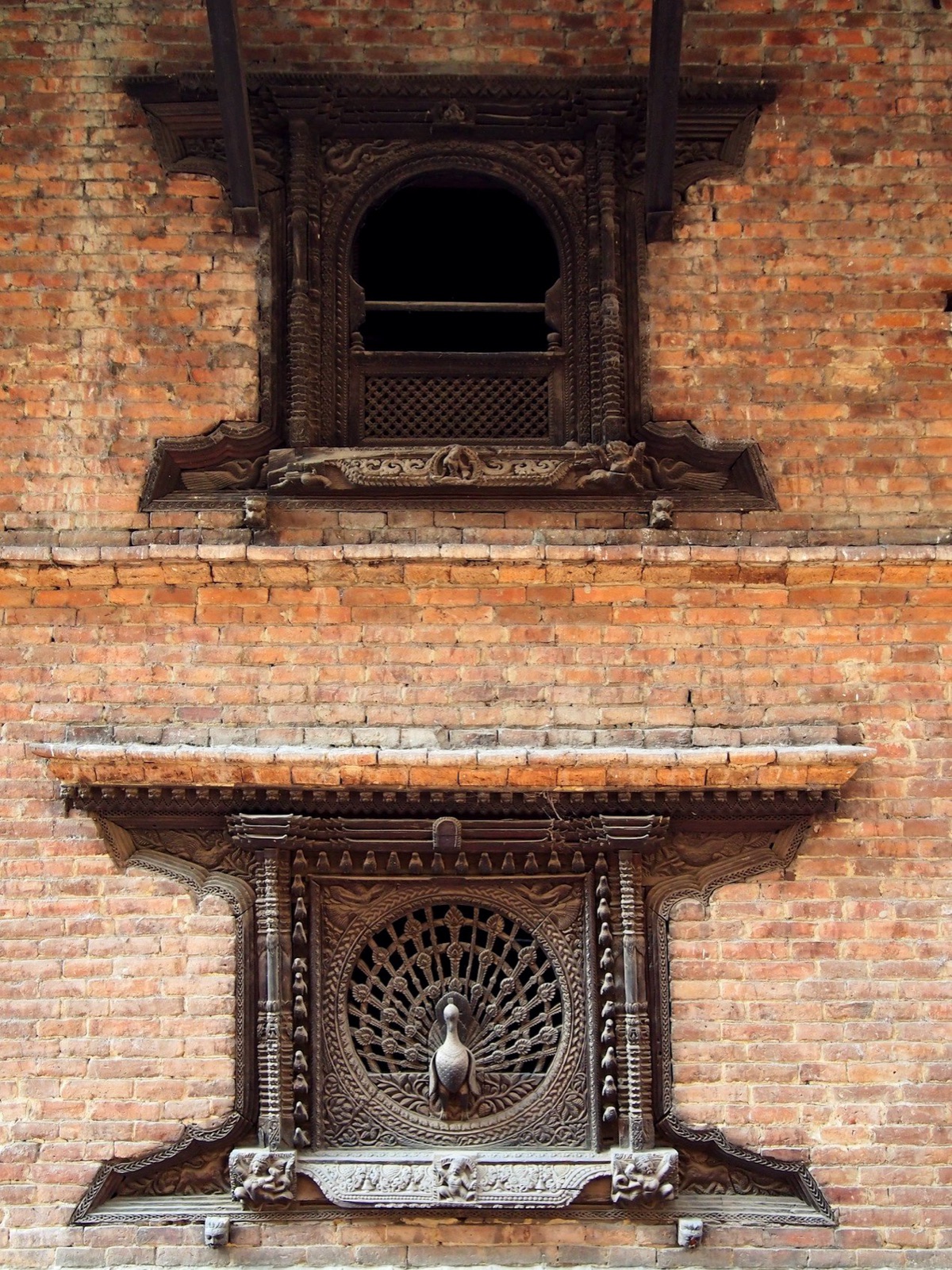
momo, CC BY 2.0, via Wikimedia Commons.
In India, modern design education began with a report. Charles and Ray Eames toured the country and presented The India Report to the government on 7 April 1958. It recommended an institute for design research, service and training, and the government set up the National Institute of Design in Ahmedabad in September 1961.4 The Eameses advised; they didn’t found NID. Indian craft policy owes more to Kamaladevi Chattopadhyay (1903–1988), who headed the All India Handicrafts Board, set up in 1952. She co-founded the World Crafts Council in 1964, the year the Crafts Council of India started in Bombay, and the council describes her as treating craft as a way to strengthen women’s economic position.5
Japanese design
Mingei is the Japanese term for the folk crafts of ordinary people: plain pots, textiles and tools made by unnamed makers for daily use. The philosopher Yanagi Sōetsu coined it in 1925 with the potters Kawai Kanjirō and Hamada Shōji. He opened the Japan Folk Crafts Museum in Tokyo in 1936 and designed its main hall himself.6
The idea reached industrial design through Yanagi’s son. Sori Yanagi (1915–2011) designed the Butterfly Stool in 1954: two curved pieces of molded plywood joined by a brass cross-bar. He developed it with a research institute in Sendai that had molded plywood for wartime aircraft, and the V&A, which holds one, says his father’s mingei ideals shaped it.7
The design committee for the 1964 Tokyo Olympics was led by the critic Katsumi Masaru, who wanted a visual language visitors could read without Japanese.8 Kamekura Yūsaku was design director and made the posters, which won the Ministry of Education’s grand prize.9 Yamashita Yoshirō drew its twenty pictograms of sports in action8 (→ 27 Illustration, icons and symbols).
Chinese and Korean design
Chinese furniture makers of the Ming and early Qing dynasties built chairs, tables and cabinets from dense hardwoods without nails or glue. The parts lock together with joints such as the mortise and tenon, in which a tongue cut on one piece fits a matching hole in another.10 The V&A’s huali-wood armchair of 1600–1700 is one example.
At Jingdezhen, porcelain was design at industrial scale. Under the Ming, imperial kilns there made wares only for the court, and in 1433 a single court order called for 443,500 pieces. Jingdezhen also designed for foreign buyers: Tianqi ware, made from about 1620 to 1683, went mostly to Japan, where it was used in the tea ceremony.11
Korea’s best-known designed object is its alphabet. King Sejong created Hangul’s 28 letters in 1443, and the Hunminjeongeum of 1446 explained how they were made. The basic consonants draw the speech organs: ㄴ shows the tongue touching the upper gums, ㅁ the mouth. The vowels are built from symbols for sky, earth and human.12 The letters, called jamo, stack into square syllable blocks (→ 4 Design before 1900; → 22 Type across scripts). Ahn Sang-soo’s typeface of 1985 broke with the traditional design of Hangul type while keeping, in the type designer Ham Minjoo’s words, “Hangul’s philosophy and construction.” Ahn has also translated Jan Tschichold and Emil Ruder into Korean.13
The two countries’ design histories also cross. Yanagi Sōetsu’s interest in folk craft began partly with Joseon ceramics, which he first saw in 1914, and he opened a Korean folk art museum in Seoul in 1924, during Japanese colonial rule.6
African design traditions
Strip weaving is weaving narrow bands of cloth on a small loom and sewing them edge to edge into a larger cloth. Kente, woven by Asante and Ewe weavers in Ghana, is the best-known example. Men traditionally weave it on a small double-heddle loom, and the strips are laid offset so their patterns alternate. The finished cloth looks like the product of a much larger, more complex loom.14 Asante kente favors geometric patterns in silk; Ewe kente adds animals, people and letters. Weavers usually name each pattern after a proverb, an event or an everyday object, and kente was once reserved for royalty and the elite.14
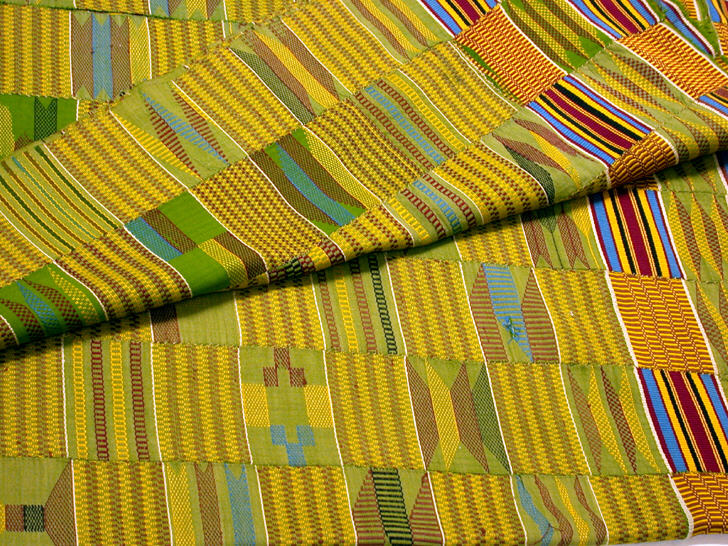
The Metropolitan Museum of Art, CC0, via Wikimedia Commons.
Bògòlanfini is Bamana cotton cloth from Mali, decorated with iron-rich mud. Women traditionally paint it by hand and learn its designs from their mothers; a newer urban form, bogolan, is usually stamped by men.15 The Malian designer Chris Seydou (1949–1994) put simplified bògòlanfini patterns on Western cuts in the 1980s. Givenchy and Oscar de la Renta used the cloth in 2007 and 2008 collections.15
Esther Mahlangu, who learned Ndebele mural painting from the age of ten, painted Ndebele geometry onto a BMW 525i in 1991. BMW calls her the first African and the first woman to paint one of its Art Cars. A retrospective of her work opened at the Iziko South African National Gallery in Cape Town in 2024.16 In architecture, Diébédo Francis Kéré’s Gando Primary School (2001), in his home village in Burkina Faso, used bricks of local clay mixed with cement and a raised, overhanging roof that lets heat escape, so the classrooms stay ventilated without air conditioning. People from Gando helped build it. Kéré won the Pritzker Prize in 2022.17
Latin American design
A khipu is an Inca recording device made of knotted cords hanging from a main cord. In 2005 Gary Urton and Carrie Brezine analyzed 21 khipu from Puruchuco, an Inca administrative site near Lima. In seven of them, values summed upward from one khipu to the next, as if accounts were being totaled on their way up an administrative hierarchy.18 That is information design (→ 26 Information design and data visualization) without paper or script.
The identity for the 1968 Mexico City Olympics mixed 1960s op art with the patterns of Huichol (Wixárika) folk art. The V&A credits the “Mexico 68” logotype to the American designer Lance Wyman, working under the organizing committee’s president, the architect Pedro Ramírez Vázquez, and with the Mexican architect Eduardo Terrazas.19 Wyman has said his team did little research before arriving. They brought in Huichol artists from Jalisco, whose wax-and-wool tablets helped set the program’s colors.20 Wyman’s 1969 signs for the Mexico City Metro gave every station its own icon. He has said the reason was less low literacy than the fact that cities draw visitors from around the world.21
In Brazil, the Escola Superior de Desenho Industrial (ESDI) opened in Rio de Janeiro in 1963; it describes itself as the oldest design college in Brazil and South America.22 Aloísio Magalhães (1927–1982) helped create it and taught visual communication there. His symbol for the fourth centenary of Rio de Janeiro (1964) was his first work with a wide public, and in 1966 he designed Brazil’s new cruzeiro banknotes.23
Arabic and Islamic design
Proportioned script is Arabic calligraphy in which every letter’s dimensions are set by a unit, the dot made by the pen (→ 4 Design before 1900). Later writers credited the system to the calligrapher Ibn Muqla (died 940), but Mohammad Yaghan notes that some historians, Alain George among them, doubt he introduced it.24 Whoever started it, it’s a type specification written about a thousand years before font software (→ 22 Type across scripts).
Girih are the interlacing strapwork lines of Islamic geometric pattern. In 2007 Peter Lu and Paul Steinhardt argued that by about 1200, designers had begun to lay girih out with a small set of decorated tiles, in shapes from pentagons to bow ties. They found that the 1453 pattern on the Darb-i Imam shrine in Isfahan is almost a Penrose tiling, a non-repeating pattern Western mathematicians described only in the 1970s.25 No physical tiles have been found; Lu speculates that they were made as templates.
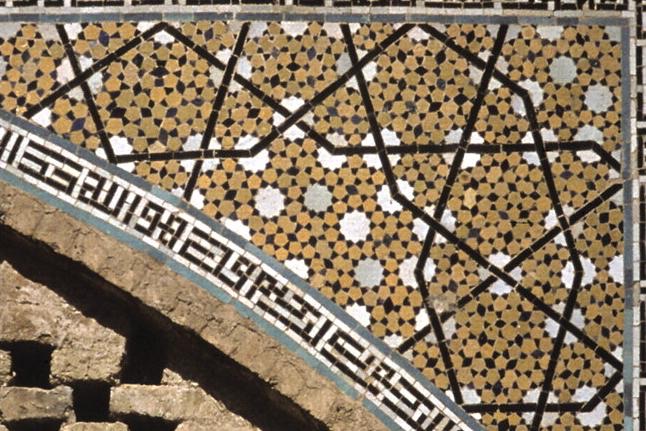
Unknown artisan, 15th century, public domain, via Wikimedia Commons.
In the 20th century, the Egyptian architect Hassan Fathy planned the village of New Gourna, near Luxor, in mud brick instead of steel and concrete. He used vaulting methods he had learned in Nubia, taught villagers to make and lay the bricks, and revived lattice mudwork for screens. He told the story in Architecture for the Poor, published by the University of Chicago Press in 1976.26
Indigenous design and cultural ownership
Cultural appropriation, in design, is using a community’s motifs, names or knowledge without its permission, credit or benefit. Indigenous cultural and intellectual property is the term for the rights communities claim over that material. Article 31 of the UN Declaration on the Rights of Indigenous Peoples, adopted by the General Assembly on 13 September 2007, lists designs among the cultural expressions Indigenous peoples have the right to “maintain, control, protect and develop.”27
Courts have enforced some of this through ordinary law (→ 94 Intellectual property and licensing). In Milpurrurru v Indofurn (1994), Aboriginal artists sued a Perth company that had carpets made in Vietnam from the work of eight artists and sold them in Australia without credit or payment. The artists won, and part of their damages was for cultural harm. Terri Janke, who opened her own law firm in 2000, worked on the case for the National Indigenous Arts Advocacy Association.28 In 2012 the Navajo Nation sued Urban Outfitters over goods sold under the “Navajo” name. The case settled in 2016 on confidential terms, with a plan for the two to work together on American Indian jewelry.29
Designers have also written their own protocols. The Australian Indigenous Design Charter, published in 2016 by Meghan Kelly and Russell Kennedy with Indigenous and professional partners, sets out ten steps of best practice for using Indigenous knowledge in communication design.30
In practice:
- Before using a pattern, name or story, find out who it belongs to. The answer is often a community, not a person.
- Pay and credit the people whose work you draw on, and agree the terms in writing.
- Some designs are restricted even within a community. A pattern you can find online isn’t therefore free to use.
See also
- 4 Design before 1900
- 14 Color psychology and culture
- 22 Type across scripts
- 26 Information design and data visualization
- 27 Illustration, icons and symbols
- 94 Intellectual property and licensing
Sources
- Associated Press (2016). “Navajo Nation, Urban Outfitters settle suit over trademark infringement.” Insurance Journal, November 22.
- Alexander-Hunt, F. (2020). “The case that changed me: Terri Janke.” Law Society Journal (NSW), October 1.
- British Antique Dealers’ Association. “The Makers Series: Jingdezhen kilns.” BADA.
- Byrne, E. (2014). “Radiant discord: Lance Wyman on the ‘68 Olympic design and the Tlatelolco massacre.” Walker Art Center, March 20.
- Charleux, I. “White Stupa, attributed to Nepalese artist Anige.” Project Himalayan Art, Rubin Museum of Art.
- Crafts Council of India. “About.”
- Encyclopaedia Itaú Cultural. “Aloísio Magalhães.” Reproduced on SlideShare.
- ESDI, Universidade do Estado do Rio de Janeiro. “History.”
- Fathy, H. (1976). Architecture for the Poor: An Experiment in Rural Egypt. University of Chicago Press. Publisher’s description.
- Fu, F. (2019). “From the collection: Ahn Sang Soo and AG Typography Institute.” Letterform Archive, May 1.
- Japan Folk Crafts Museum. “History.”
- Kelly, M., and Kennedy, R. (2017). “The Australian Indigenous Design Charter: a ten step best practice protocol document.” ACUADS Conference.
- Liu, S. T. (2022). “Bogolanfini.” Fashion History Timeline, Fashion Institute of Technology.
- Lu, P. J., and Steinhardt, P. J. (2007). “Decagonal and quasi-crystalline tilings in medieval Islamic architecture.” Science 315, 1106–1110. Reported in Nature news, February 22, 2007.
- Matuszyk, G. (2021). “Year of the pictograms.” Eye blog, September 8.
- National Institute of Design. “About NID.”
- National Institute of Korean Language. “Hangeul.” Hangeul.go.kr.
- Pritzker Architecture Prize. “Diébédo Francis Kéré, 2022 Laureate.”
- Rubin Museum of Art. “Lost-wax metal casting.”
- Society for Experiential Graphic Design (2019). “20 questions with Lance Wyman, ‘Navigating life’.” March 8.
- Slusser, M. S. (2009). “Seeing, rather than looking at, Nepalese art: the figural struts.” Asianart.com, December 18.
- Alliance Graphique Internationale. “1964 Tokyo Olympics” (Kamekura Yusaku).
- BMW Group (2024). “BMW celebrates artistic journey of Esther Mahlangu.” Press release.
- United Nations General Assembly (2007). United Nations Declaration on the Rights of Indigenous Peoples. Resolution 61/295, September 13.
- Urton, G., and Brezine, C. J. (2005). “Khipu accounting in ancient Peru.” Science, August 2005. Reported in Harvard University news release, EurekAlert!, August 11, 2005.
- Victoria and Albert Museum. Armchair, FE.66-1983; Butterfly Stool, W.5-2017; Kente, CIRC.766-1967; “Iconic design: the official poster for the Mexico 1968 Olympic Games.”
- Yaghan, M. A. J. (2020). “Mathematical concepts in Arabic calligraphy: the proportions of the ʾAlif.” PLoS One 15(5), e0232641.
Notes
- Rubin Museum of Art, “Lost-wax metal casting.” https://rubinmuseum.org/lost-wax-metal-casting/ ↩
- Slusser (2009). https://asianart.com/articles/slusser-wood/index.html ↩
- Charleux, “White Stupa, attributed to Nepalese artist Anige,” Project Himalayan Art. https://rubinmuseum.org/projecthimalayanart/essays/white-stupa-attributed-to-nepalese-artist-anige/ ↩
- National Institute of Design, “About.” https://nid.edu/about ↩
- Crafts Council of India, “About.” https://craftscouncilofindia.in/about.html ↩
- Japan Folk Crafts Museum, “History.” http://mingeikan.or.jp/about/history/?lang=en ↩ ↩
- V&A, Butterfly Stool, W.5-2017. https://collections.vam.ac.uk/item/O1370748/butterfly-stool-stool-yanagi-sori/ ↩
- Matuszyk (2021). https://www.eyemagazine.com/blog/post/year-of-the-pictograms ↩ ↩
- Alliance Graphique Internationale, “1964 Tokyo Olympics.” https://a-g-i.org/design/1964-tokyo-olympics ↩
- V&A, Armchair, FE.66-1983. https://collections.vam.ac.uk/item/O498891/armchair-unknown/ ↩
- BADA, “The Makers Series: Jingdezhen kilns.” https://www.bada.org/features/makers-series-jingdezhen-kilns ↩
- National Institute of Korean Language, “Hangeul.” https://www.hangeul.go.kr/lang/en/html/education/Hangeul.do ↩
- Fu (2019). https://letterformarchive.org/news/from-the-collection-ahn-sang-soo ↩
- V&A, Kente, CIRC.766-1967. https://collections.vam.ac.uk/item/O263818 ↩ ↩
- Liu (2022). https://fashionhistory.fitnyc.edu/bogolanfini/ ↩ ↩
- BMW Group (2024). https://newsroom.bmwgroup.com/emea/en-za/bmw-celebrates-artistic-journey-of-esther-mahlangu ↩
- Pritzker Architecture Prize. https://www.pritzkerprize.com/laureates/diebedo-francis-kere ↩
- Urton and Brezine (2005), via EurekAlert! news release. https://www.eurekalert.org/news-releases/525379 ↩
- V&A, “Iconic design: the official poster for the Mexico 1968 Olympic Games.” https://www.vam.ac.uk/articles/iconic-design-official-poster-for-the-mexico-1968-olympic-games ↩
- Byrne (2014). https://www.walkerart.org/reader/lance-wyman-mexico-68-olympics-tlatelolco-massacre/ ↩
- SEGD (2019). https://segd.org/resources/20-questions-lance-wyman-navigating-life/ ↩
- ESDI, “History.” https://www.esdi.uerj.br/en/history ↩
- Encyclopaedia Itaú Cultural, “Aloísio Magalhães,” as reproduced at https://www.slideshare.net/slideshow/artistas-5004723/5004723 ↩
- Yaghan (2020). https://pmc.ncbi.nlm.nih.gov/articles/PMC7255603 ↩
- Lu and Steinhardt (2007), as reported in Nature news. https://www.nature.com/news/2007/070219/full/news070219-9.html ↩
- University of Chicago Press, Architecture for the Poor. https://press.uchicago.edu/ucp/books/book/chicago/A/bo3641441.html ↩
- UN General Assembly (2007), Resolution 61/295, Article 31(1). https://www.un.org/esa/socdev/unpfii/documents/DRIPS_en.pdf ↩
- Alexander-Hunt (2020). https://lsj.com.au/articles/the-case-that-changed-me-terri-janke/ ↩
- Associated Press (2016). https://www.insurancejournal.com/news/west/2016/11/22/433082.htm ↩
- Kelly and Kennedy (2017). https://acuads.com.au/conference/article/the-australian-indigenous-design-charter-a-ten-step-best-practice-protocol-document-essential-for-design-educators-and-practitioners/ ↩