Chapter 45: Human-computer interaction: history and theory
Human-computer interaction (HCI) is the study and design of how people use computers. It draws on computer science, psychology and design, and it gained a professional home in 1982, when the Association for Computing Machinery renamed an older group SIGCHI.1 Most of the screen conventions designers now take for granted come from a few research labs in the 1960s and 1970s.
Sketchpad, Engelbart and Xerox PARC
Sketchpad was the first program to let someone draw on a computer display and have the computer understand the drawing. Ivan Sutherland wrote it for his MIT PhD thesis, finished in January 1963, on the TX-2 computer at MIT’s Lincoln Laboratory.2 The user drew with a light pen, a pen-shaped sensor that detects the screen’s light, and pressed buttons to erase or move things. To make two lines parallel, you pointed at each and pressed a button, and the program kept them parallel from then on. Copies of a master drawing updated when the master changed, an idea later programmers would recognize as classes and instances. The program ran on one machine only, so its ideas spread through the thesis and a film.2
Douglas Engelbart, at the Stanford Research Institute (SRI), set out his program in a 1962 report, “Augmenting Human Intellect”, about increasing people’s ability to approach complex problems.3 He conceived the mouse in 1961; his chief engineer, Bill English, machined the first prototype in 1963–64, and the patent, with Engelbart as sole inventor, was granted in 1970.4 On 9 December 1968, at the Fall Joint Computer Conference in San Francisco, Engelbart showed his NLS system to about 2,000 people in a single 90-minute session: the mouse, hypertext links, shared editing and live video from the lab 30 miles away.54
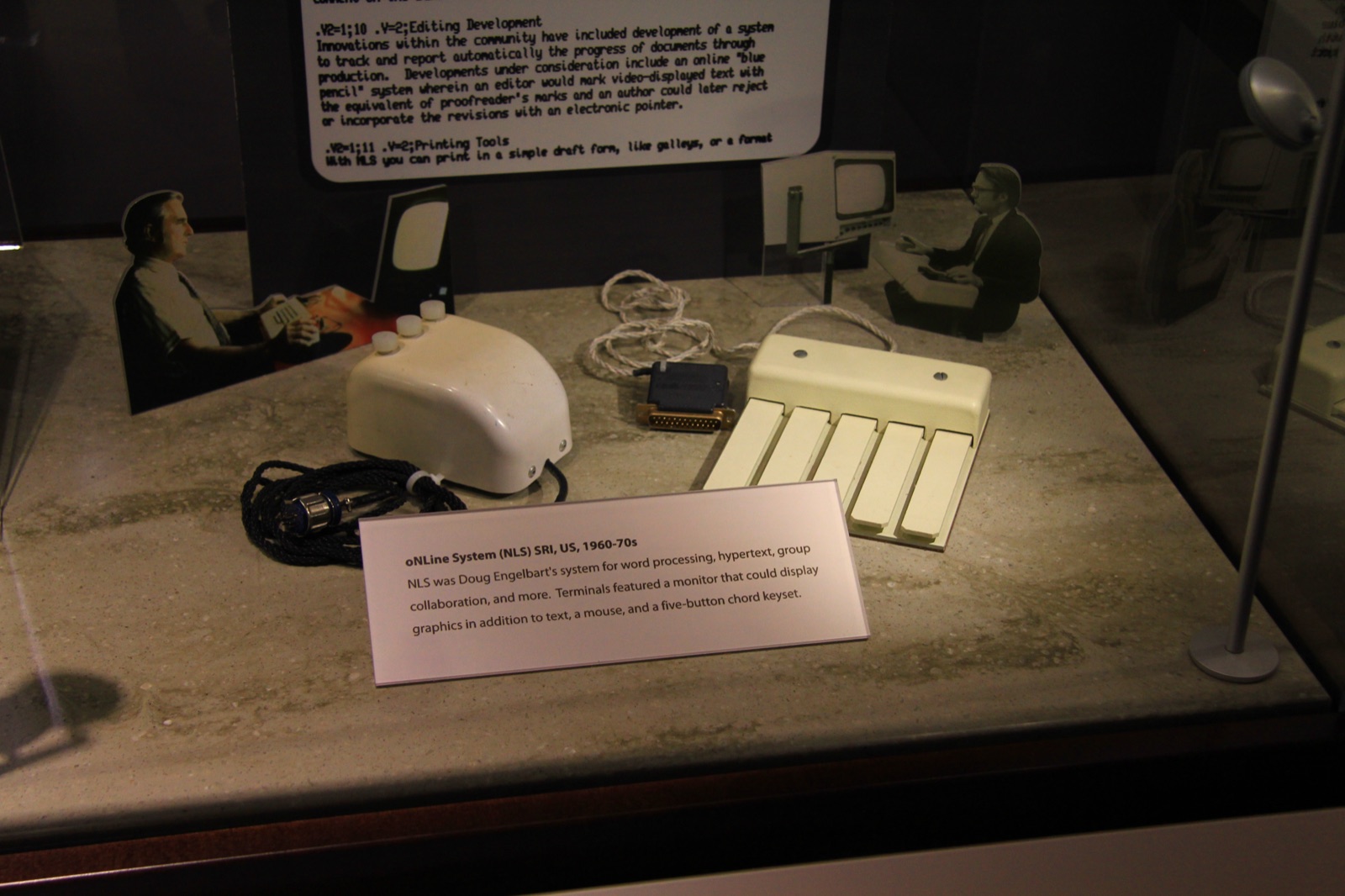
Michael Hicks, CC BY 2.0, via Wikimedia Commons.
Xerox’s Palo Alto Research Center (PARC) put these ideas into a personal computer. The Alto, running in the spring of 1973, had a high-resolution graphical display, a mouse, the Ethernet network and Charles Simonyi’s Bravo, an editor that showed text as it would print.6 Chuck Thacker designed most of the hardware. Hundreds were built, for PARC, Xerox and some universities, and none were sold.67
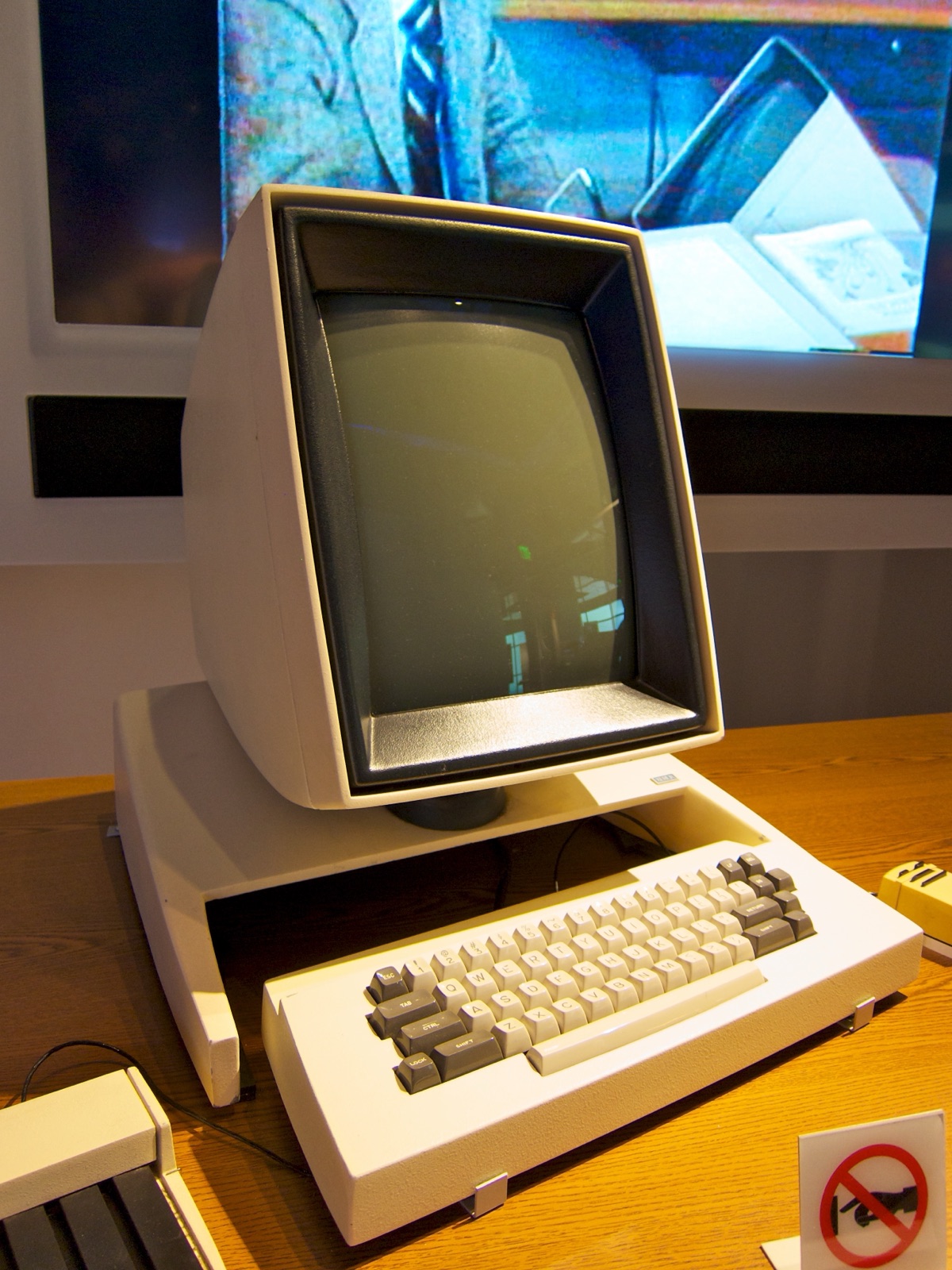
Don DeBold, CC BY 2.0, via Wikimedia Commons.
The GUI and the desktop metaphor
A graphical user interface (GUI) is one you operate by pointing at and moving pictures on a screen, instead of typing commands. Its standard parts are often called WIMP: windows, icons, menus and a pointer.
The desktop metaphor presents the computer’s files and functions as office objects on a simulated desk. Xerox built it into the 8010 Star, announced in April 1981 at $16,595 per workstation.89 The Star team wrote that they chose to “create electronic counterparts to the physical objects in an office”, shown as icons: small pictures of documents, folders and file drawers, plus function icons such as a printer that “absorbs” a document dragged onto it.8 Star was also WYSIWYG (“what you see is what you get”): documents on screen looked like the printed page. The designers said they defined the user’s conceptual model first and let the hardware and software follow from it, an unusual order then and still a good one (→ 46 Affordances, signifiers, feedback and constraints).8
Star was a commercial failure, and so was the next attempt.9 Apple’s team, led by Steve Jobs, saw Smalltalk running on an Alto in 1979. Apple’s Lisa, released in January 1983 at $9,995, had desktop icons and a menu bar with pull-down menus but failed in the market. The Macintosh, at $2,495 in January 1984, was the first commercially successful computer with a GUI, helped by desktop publishing (→ 6 Contemporary design, 1970 to now).10
Phones dropped most of the metaphor. The iPhone opened onto a grid of apps, not a desk of documents, and iOS had no general file browser until the Files app in 2017.11
Touch, mobile and voice
Touch screens are older than most people assume. E. A. Johnson of the Royal Radar Establishment in Malvern, England, described a capacitive touch screen in 1965, the same basic method most phones use. The PLATO IV teaching terminals at the University of Illinois sensed fingers with a grid of infrared beams from 1972.12 A multi-touch surface senses several contact points at once; Nimish Mehta built one at the University of Toronto in 1982, and Bell Labs had a multi-touch screen by 1984. IBM and BellSouth’s Simon, a touch-screen phone, followed in 1992.12
The mobile internet came first to Japan. NTT DOCOMO launched i-mode in February 1999, and it had 5 million subscribers within a year; its picture characters became emoji (→ 27 Illustration, icons and symbols).1314 Apple announced the iPhone on 9 January 2007, operated “with just their fingers” on a multi-touch display, with no stylus (→ 69 Mobile patterns and gestures).15
Voice removes the screen altogether. Apple released Siri in beta on the iPhone 4S in October 2011, in English, French and German.16 A voice interface has no visible signifiers, so users can’t see what it can do and have to guess or be told (→ 72 Conversational and AI interfaces).
Information processing and GOMS
The first HCI theories treated the user as an information processor: input arrives through the senses, is processed, and comes out as movement. Stuart Card, Thomas Moran and Allen Newell’s Model Human Processor split the user into perceptual, cognitive and motor processors, each with measurable timings (→ 43 Human cognition).1718
GOMS is their method for modeling skilled, routine work. It stands for Goals, the Operators available to reach them, Methods (learned sequences of operators) and Selection rules for choosing between methods.18 The simplest version, the Keystroke-Level Model, lists the physical and mental steps a task needs and adds up standard times.19 Typical values are 0.28 seconds per keystroke for an average typist, 1.1 seconds to point with a mouse (→ 47 Laws and heuristics, on Fitts’s law), 0.4 seconds to move a hand between keyboard and mouse, and about 1.2 seconds for a routine mental step such as recalling a file name.19 The method predicts expert speed on a design that exists only on paper. It says nothing about learning, errors or whether anyone likes the result.
Its best-known test was Project Ernestine. NYNEX, a US telephone company, planned to buy new workstations for its toll and assistance operators, expecting them to be faster. Wayne Gray, Bonnie John and Michael Atwood’s GOMS models predicted that the new workstation would be 0.63 seconds slower per call. A four-month field trial of 72,450 calls measured 0.65 seconds slower, a difference the authors put at almost $2 million a year.18
Distributed cognition and activity theory
From the late 1980s, researchers argued that studying one user at one screen missed most of what happens at work. Two frameworks gave the argument a method.
Distributed cognition is Edwin Hutchins’s view that thinking happens across people, tools and surroundings, so the unit of analysis can be a whole team with its equipment. It came from his study of navigation teams on US Navy ships in the 1980s, written up in Cognition in the Wild (1995).20 In “How a cockpit remembers its speeds” (1995) he showed that in an MD-80 the landing speeds were remembered by the cockpit, not by a pilot: the crew looked up a card in a booklet, posted it and set movable pointers called speed bugs on both airspeed dials.21 For design, this means the information people need may live on paper, in a colleague or on another screen, and observing the whole setting shows where (→ 52 Interviews, observation and contextual inquiry).
Activity theory analyzes what people do as activity directed at a motive and carried out with tools. It comes from Soviet psychology of the 1920s and 1930s: Aleksei Leontiev developed it from Lev Vygotsky’s cultural-historical psychology.22 Leontiev’s hierarchy separates an activity, driven by a motive (learning to drive, to get a license), from actions aimed at conscious goals (enrolling in a driving school) and from routine operations that adjust to conditions. Susanne Bødker’s Through the Interface (1991) brought it into HCI. Seen this way, the computer is usually the tool people work through, not the thing they work on. Bonnie Nardi’s Context and Consciousness (1996) set it out for the field, and Yrjö Engeström’s 1987 model added the community, its rules and its division of labor.22
See also
- 6 Contemporary design, 1970 to now
- 43 Human cognition
- 46 Affordances, signifiers, feedback and constraints
- 47 Laws and heuristics
- 69 Mobile patterns and gestures
- 72 Conversational and AI interfaces
Sources
- Apple (2007). “Apple Reinvents the Phone with iPhone.” Press release, January 9.
- Apple (2011). “Apple Launches iPhone 4S, iOS 5 & iCloud.” Press release, October 4.
- Apple (2017). “iOS 11 brings new features to iPhone and iPad this fall.” Press release, June.
- Borman, L. (1996). “SIGCHI: The Early Years.” SIGCHI Bulletin 28(1).
- Brock, D. C. (2023). “50 Years Later, We’re Still Living in the Xerox Alto’s World.” IEEE Spectrum, March 1.
- Buxton, B. “Multi-Touch Systems that I Have Known and Loved.” Overview, updated continuously.
- Card, S. K., Moran, T. P. and Newell, A. (1983). The Psychology of Human-Computer Interaction. Lawrence Erlbaum.
- Computer History Museum. “Input and output: the Xerox Alto.” Revolution online exhibit.
- Computer History Museum (2023). “The Lisa: Apple’s Most Influential Failure.”
- DigiBarn Computer Museum. “Xerox 8010 Star.”
- Doug Engelbart Institute. “The Mother of All Demos.”
- Engelbart, D. C. (1962). Augmenting Human Intellect: A Conceptual Framework. SRI Summary Report AFOSR-3223.
- ETHW. “Milestones: Invention of SRI’s Computer Mouse, 1961–1968.” IEEE.
- Gray, W. D., John, B. E. and Atwood, M. E. (1993). “Project Ernestine.” Human-Computer Interaction 8(3), 237–309.
- Hollan, J., Hutchins, E. and Kirsh, D. (2000). “Distributed cognition.” ACM Transactions on Computer-Human Interaction 7(2), 174–196.
- Hutchins, E. (1995). “How a cockpit remembers its speeds.” Cognitive Science 19, 265–288.
- Kaptelinin, V. “Activity Theory.” The Encyclopedia of Human-Computer Interaction, 2nd ed., Interaction Design Foundation.
- Kieras, D. (1993). “Using the Keystroke-Level Model to Estimate Execution Times.” University of Michigan.
- Nippon.com (2026). “NTT Docomo Ends i-Mode Mobile Service That Pioneered the Emoji.”
- NTT DOCOMO. “History.” Corporate website.
- Smith, D. C., Irby, C., Kimball, R., Verplank, B. and Harslem, E. (1982). “Designing the Star User Interface.” Byte 7(4), 242–282.
- Sutherland, I. E. (1963). Sketchpad: A man-machine graphical communication system. MIT PhD thesis; reprinted as University of Cambridge Computer Laboratory TR-574 (2003).
Notes
- Borman, L. (1996), “SIGCHI: The Early Years,” SIGCHI Bulletin 28(1). https://homepages.cwi.nl/~steven/sigchi/bulletin/1996.1/borman.html ↩
- Sutherland, I. E. (1963/2003), Sketchpad, Cambridge TR-574, abstract, acknowledgments and preface by Blackwell and Rodden. https://www.cl.cam.ac.uk/techreports/UCAM-CL-TR-574.pdf ↩ ↩
- Engelbart, D. C. (1962), Augmenting Human Intellect: A Conceptual Framework, SRI. https://www.dougengelbart.org/content/view/138 ↩
- ETHW, “Milestones: Invention of SRI’s Computer Mouse, 1961–1968.” https://ethw.org/Milestones:Invention_of_SRI%27s_Computer_Mouse,_1961-1968 ↩ ↩
- Doug Engelbart Institute, “The Mother of All Demos.” https://dougengelbart.org/content/view/209/448/ ↩
- Brock, D. C. (2023-03-01), IEEE Spectrum. https://spectrum.ieee.org/xerox-alto ↩ ↩
- Computer History Museum, Revolution, “Input & Output.” https://www.computerhistory.org/revolution/input-output/14/347 ↩
- Smith, D. C., et al. (1982), “Designing the Star User Interface,” Byte 7(4). Reprint: https://www.guidebookgallery.org/articles/designingthestaruserinterface ↩ ↩ ↩
- DigiBarn Computer Museum, “Xerox 8010 Star” (specifications: introduced 27 April 1981, $16,595; “a commercial failure”). https://digibarn.com/collections/systems/xerox-8010/ ↩ ↩
- Computer History Museum (2023), “The Lisa: Apple’s Most Influential Failure.” https://computerhistory.org/blog/the-lisa-apples-most-influential-failure/ ↩
- Apple (2017-06-05), “iOS 11 brings new features to iPhone and iPad this fall.” https://www.apple.com/newsroom/2017/06/ios-11-brings-new-features-to-iphone-and-ipad-this-fall/ ↩
- Buxton, B., “Multi-Touch Systems that I Have Known and Loved.” https://www.billbuxton.com/multitouchOverview.html ↩ ↩
- NTT DOCOMO, “History.” https://www.docomo.ne.jp/english/corporate/about/outline/history/ ↩
- Nippon.com (2026), “NTT Docomo Ends i-Mode Mobile Service That Pioneered the Emoji.” https://www.nippon.com/en/japan-topics/g02591/ntt-docomo-ends-i-mode-mobile-service-that-pioneered-the-emoji.html ↩
- Apple (2007-01-09), “Apple Reinvents the Phone with iPhone.” https://www.apple.com/newsroom/2007/01/09Apple-Reinvents-the-Phone-with-iPhone/ ↩
- Apple (2011-10-04), “Apple Launches iPhone 4S, iOS 5 & iCloud.” https://www.apple.com/newsroom/2011/10/04Apple-Launches-iPhone-4S-iOS-5-iCloud/ ↩
- Card, S. K., Moran, T. P. and Newell, A. (1983), The Psychology of Human-Computer Interaction, Lawrence Erlbaum; as described in Gray, John and Atwood (1993) and Kieras (1993). ↩
- Gray, W. D., John, B. E. and Atwood, M. E. (1993), “Project Ernestine: Validating a GOMS Analysis for Predicting and Explaining Real-World Task Performance,” Human-Computer Interaction 8(3), 237–309. https://www.lri.fr/~mbl/FundHCI/papers/Gray-HCI93.pdf ↩ ↩ ↩
- Kieras, D. (1993), “Using the Keystroke-Level Model to Estimate Execution Times,” University of Michigan. https://www.cs.umd.edu/~golbeck/INST631/KSM.pdf ↩ ↩
- Hollan, J., Hutchins, E. and Kirsh, D. (2000), “Distributed cognition: toward a new foundation for human-computer interaction research,” ACM TOCHI 7(2), 174–196. https://hci.ucsd.edu/hollan/Pubs/tochi-revised.pdf ↩
- Hutchins, E. (1995), “How a cockpit remembers its speeds,” Cognitive Science 19, 265–288. https://courses.ischool.berkeley.edu/i290-3/s05/papers/How_a_cockpit_remembers_its_speeds.pdf ↩
- Kaptelinin, V., “Activity Theory,” The Encyclopedia of Human-Computer Interaction, 2nd ed., ch. 16, Interaction Design Foundation. https://ixdf.org/literature/book/the-encyclopedia-of-human-computer-interaction-2nd-ed/activity-theory ↩ ↩