Chapter 14: Color psychology and culture
Color psychology is the study of how seeing a color affects what people feel, think and do. Designers meet it mostly as advice: blue for banks, red for sale signs, green for anything organic. Some of that advice rests on real findings; much of it rests on charts copied from one website to the next.
Color associations
A color association is a learned link between a color and an idea, object or emotion. Red goes with anger and with love; brown goes with dirt and chocolate. Stephen Palmer and Karen Schloss proposed in 2010 that people like a color about as much as they like the objects they connect with it, and called this ecological valence theory. In their test, people liked blues, linked with clear skies and clean water, and disliked browns, linked with feces and rotten food.1
Many associations are shared. Domicele Jonauskaite and 35 colleagues asked 4,598 people in 30 nations to link 12 color terms with 20 emotions. The patterns were similar across countries, with an average similarity coefficient of 0.88.2 Red was the only color strongly linked with both a positive emotion (love) and a negative one (anger). Brown drew the fewest emotions of all.3 Countries close in language or geography answered more alike.
The study asked about color words, not color samples. And an association isn’t an effect: linking red with anger doesn’t show that a red screen makes anyone angry.
Cultural meanings of color
Color symbolism is the meaning a culture or institution gives a color by convention. The 30-nation study found white tied to sadness far more in China than elsewhere, which the researchers connect to white clothing at Chinese funerals. In Greece, purple was more closely tied to sadness; the Greek Orthodox Church uses dark purple in periods of mourning.3
Weddings show how far conventions differ. Red is the main color of a traditional Chinese wedding, and the bride’s matching jacket and skirt is called hong gua, “red gown”.4 White became the Western ideal only after Queen Victoria wore it in 1840; before that, British brides often married in colors, red and black among them.5 In Islam, green is the color of paradise: the Qur’an describes the people of paradise in green garments of silk.6
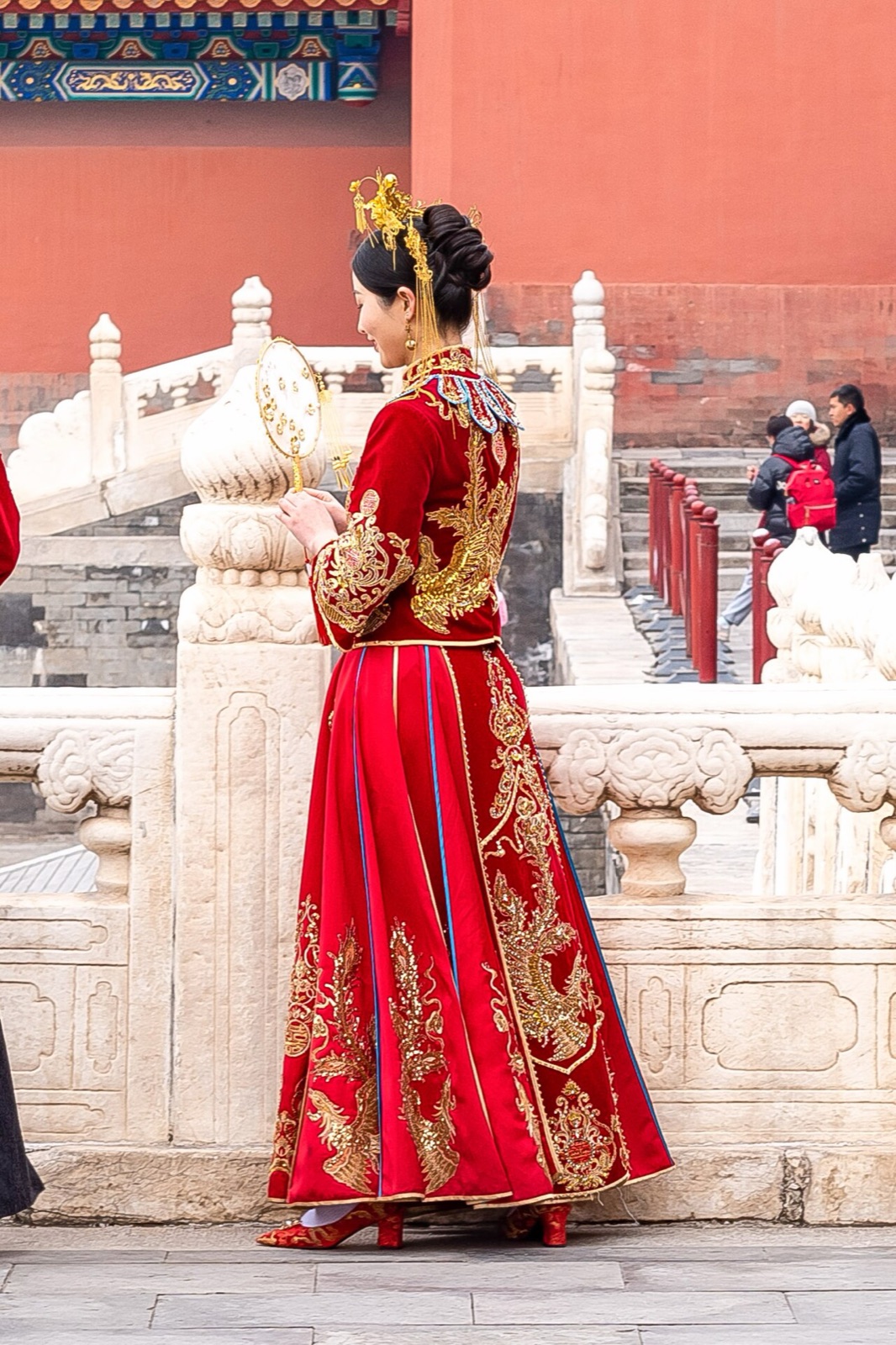
N509FZ, CC BY-SA 4.0, via Wikimedia Commons.
Conventions also live in interfaces. On the Shanghai and Shenzhen exchanges, red means a price went up and green means it went down. Hong Kong uses the opposite, like New York. In a 2013 study, mainland Chinese participants predicted more economic growth from figures printed in red, Hong Kong participants from figures in green.7 A finance app that colors losses red can mislead its users in mainland China (→ 26 Information design and data visualization).
Meanings also change over time. In the United States, department stores still recommended pink for boys in the 1920s; the current pink-for-girls convention settled in the 1940s.8
What the evidence supports
Andrew Elliot and Markus Maier concluded in 2014 that color can affect feeling, thinking and behavior, but that the research was still at a “nascent stage”, with too little known about when effects hold to justify firm advice.9 Small samples are much of the problem: they overstate effects, which then shrink when others repeat the work.10
| Claim | First reported | Later evidence |
|---|---|---|
| Wearing red helps athletes win | Hill & Barton 2005: red won more often across Olympic combat sports11 | A 2024 meta-analysis of 6,589 bouts from 1996 to 2021, with Hill and Barton among its authors, found red won 50.5%, no reliable advantage12 |
| Seeing red lowers test scores | Elliot, Maier and colleagues, 200713 | A 2020 meta-analysis of 67 effect sizes found no evidence after correcting for publication bias14 |
| Blue helps creative work | Mehta & Zhu 200915 | A 2014 replication of their anagram task found no effect16 |
| Red makes women more attractive to men | Elliot & Niesta 200817 | A 2018 meta-analysis found a small effect (d = 0.26), which publication bias may inflate18 |
| Baker-Miller pink calms prisoners | Studies from the early 1980s and before | A controlled 2015 experiment found no reduction in aggression19 |
The claim that people judge a product within 90 seconds, and that 62–90% of the judgment is based on color, comes from a 2006 literature review by Satyendra Singh that offers no new data.20 The study behind it couldn’t be traced. Don’t build a pitch on it.
In practice:
- Treat a color’s meaning as a convention. Test it with the people who’ll see it, not against a color-meaning chart (→ 28 Brands and brand strategy).
- Don’t carry meaning by color alone: conventions conflict, and some users can’t see the difference (→ 16 Building a palette).
See also
- 13 Color basics and relationships
- 16 Building a palette
- 26 Information design and data visualization
- 28 Brands and brand strategy
- 30 Identity systems
- 84 Marketing
Sources
- Dar al-Ifta al-Misriyyah. “Is there any relation between the green color and Prophet Muhammad?”
- Elliot, A. J. (2015). “Color and psychological functioning: a review of theoretical and empirical work.” Frontiers in Psychology 6, 368.
- Elliot, A. J., Maier, M. A., Moller, A. C., et al. (2007). “Color and psychological functioning: the effect of red on performance attainment.” Journal of Experimental Psychology: General 136(1), 154–168.
- Elliot, A. J., & Niesta, D. (2008). “Romantic red: red enhances men’s attraction to women.” Journal of Personality and Social Psychology 95(5), 1150–1164.
- Elliot, A. J., & Maier, M. A. (2014). “Color psychology: effects of perceiving color on psychological functioning in humans.” Annual Review of Psychology 65, 95–120.
- Genschow, O., Noll, T., Wänke, M., & Gersbach, R. (2015). “Does Baker-Miller pink reduce aggression in prison detention cells? A critical empirical examination.” Psychology, Crime & Law 21(5), 482–489.
- Gnambs, T. (2020). “Limited evidence for the effect of red color on cognitive performance: a meta-analysis.” Psychonomic Bulletin & Review 27, 1374–1382.
- Hill, R. A., & Barton, R. A. (2005). “Red enhances human performance in contests.” Nature 435, 293.
- Jiang, F., Lu, S., Yao, X., Yue, X., & Au, W. (2014). “Up or down? How culture and color affect judgments.” Journal of Behavioral Decision Making 27(3), 226–234.
- Johannes Gutenberg University Mainz (2020). “Universal patterns in color-emotion associations.” Press release via ScienceDaily, September 10.
- Jonauskaite, D., et al. (2020). “Universal patterns in color-emotion associations are further shaped by linguistic and geographic proximity.” Psychological Science 31(10), 1245–1260.
- Lehmann, G. K., Elliot, A. J., & Calin-Jageman, R. J. (2018). “Meta-analysis of the effect of red on perceived attractiveness.” Evolutionary Psychology 16(4).
- Mehta, R., & Zhu, R. J. (2009). “Blue or red? Exploring the effect of color on cognitive task performances.” Science 323, 1226–1229.
- Peperkoorn, L. S., Hill, R. A., Barton, R. A., & Pollet, T. V. (2024). “Meta-analysis of the red advantage in combat sports.” Scientific Reports 14.
- Palmer, S. E., & Schloss, K. B. (2010). “An ecological valence theory of human color preference.” PNAS 107(19), 8877–8882.
- Singh, S. (2006). “Impact of color on marketing.” Management Decision 44(6), 783–789.
- Steele, K. M. (2014). “Failure to replicate the Mehta and Zhu (2009) color-priming effect on anagram solution times.” Psychonomic Bulletin & Review 21, 771–776.
- University of Maryland, Department of History. “Pink and blue.”
- Victoria and Albert Museum. “Wedding colour”; object record O167373, pair of bridal shoes.
Notes
- Palmer & Schloss (2010), abstract. https://doi.org/10.1073/pnas.0906172107 ↩
- Jonauskaite et al. (2020), abstract. https://doi.org/10.1177/0956797620948810 ↩
- Johannes Gutenberg University Mainz (2020). https://www.sciencedaily.com/releases/2020/09/200910150247.htm ↩ ↩
- V&A, pair of shoes, O167373. https://collections.vam.ac.uk/item/O167373/pair-of-shoes-sun-sun-shoes ↩
- V&A, “Wedding colour.” https://www.vam.ac.uk/articles/wedding-colour ↩
- Dar al-Ifta al-Misriyyah, citing Qur’an 18:31, 76:21 and 55:76. https://www.dar-alifta.org/en/article/details/481/is-there-any-relation-between-the-green-color-and-prophet-muhammad ↩
- Jiang et al. (2014), published online 2013, abstract. https://doi.org/10.1002/bdm.1800 ↩
- University of Maryland, Department of History, “Pink and blue,” reporting Jo B. Paoletti’s research. https://history.umd.edu/news/pink-and-blue ↩
- Elliot & Maier (2014), abstract. https://doi.org/10.1146/annurev-psych-010213-115035 ↩
- Elliot (2015). https://doi.org/10.3389/fpsyg.2015.00368 ↩
- Hill & Barton (2005), abstract. https://doi.org/10.1038/435293a ↩
- Peperkoorn et al. (2024), abstract. https://doi.org/10.1038/s41598-024-81373-3 ↩
- Elliot et al. (2007). https://doi.org/10.1037/0096-3445.136.1.154 ↩
- Gnambs (2020), abstract. https://doi.org/10.3758/s13423-020-01772-1 ↩
- Mehta & Zhu (2009). https://doi.org/10.1126/science.1169144 ↩
- Steele (2014). https://doi.org/10.3758/s13423-013-0548-3 ↩
- Elliot & Niesta (2008). https://doi.org/10.1037/0022-3514.95.5.1150 ↩
- Lehmann, Elliot & Calin-Jageman (2018), abstract. https://doi.org/10.1177/1474704918802412 ↩
- Genschow et al. (2015). https://fis.leuphana.de/de/publications/does-baker-miller-pink-reduce-aggression-in-prison-detention-cell/ ↩
- Singh (2006), abstract. https://doi.org/10.1108/00251740610673332 ↩