Chapter 52: Interviews, observation and contextual inquiry
Talking to people tells you what they think, remember and want. Watching them tells you what they do. The two rarely match, because people forget steps, tidy up their habits and describe the process they believe they follow. The methods here differ mainly in how much of each they use, and in whether they capture one moment or a stretch of time.
User interviews
A user interview is a session in which an interviewer asks one participant about a topic and follows up on what they say.1 Other fields call it an in-depth, qualitative or semi-structured interview. It’s the right method for learning about people’s lives, goals, frustrations and the mental models they bring to a task, and it feeds personas and journey maps later (→ 55 Personas, journeys and service design).
Most design interviews are semi-structured. The interviewer brings a discussion guide, a short list of topics and open questions, and skips, reorders or adds to it as the conversation goes. The most useful question asks about a specific, recent event: “Tell me about the last time you booked a train ticket.” A particular incident jogs memory in a way a general question doesn’t. Ask “what is your usual process?” and you get the process people think they ought to follow.2 Then probe: “Tell me more about that,” “What happened next?”
The commonest mistake is the leading question, one whose wording points to the answer. “Wasn’t the checkout confusing?” invites a yes. “How did the checkout go?” doesn’t. A quieter problem is the query effect: people will produce an opinion on anything you ask about, so a comment they offered unprompted deserves more weight than one you asked for.2
Interviews collect reported behavior, and reports have three known faults: people misremember, they leave out details that feel too obvious to mention, and they shade answers toward what sounds sensible or virtuous, which is social desirability bias.1 Jakob Nielsen put the remedy plainly in 2001: “Watch what people actually do.”3 Interviews are also the wrong tool for judging whether a design is usable or predicting whether someone would use a feature that doesn’t exist. Test the first (→ 53 Usability testing) and be skeptical of answers to the second.
How many interviews is enough depends on how broad the question is and how varied the people are. Nielsen Norman Group suggests starting with five or six, analyzing as you go, and adding more only while you’re still learning something new (→ 51 Qualitative and quantitative research).4
Contextual inquiry
Contextual inquiry is a field interview in which the researcher watches someone do real work in their own setting and asks about it as it happens. Karen Holtzblatt and Hugh Beyer developed it at Digital Equipment Corporation in the early 1980s and described the full process, Contextual Design, in a 1997 book.5 Its starting point is that people are experts at their own work but can’t fully put that work into words.
The researcher takes the master-apprentice model: the user is the master, and the researcher learns the job the way an apprentice would, by watching and asking while the work is going on. Four principles guide a session:6
- Context. Go to the place where the work happens, not a meeting room.
- Partnership. Researcher and user share control of the conversation.
- Interpretation. Check what you think you’ve seen with the user, who corrects you.
- Focus. Know what you’re there to learn, so you know what to notice.
A session usually runs in four parts: a primer to build rapport, an explicit transition from talking to watching, the contextual interview itself, and a wrap-up in which the researcher summarizes what they think they learned and the user corrects it. Sessions last from an hour or two to several days.6 Soon afterward, the team holds an interpretation session: the interviewer retells the visit in full, and people from design, engineering and business record what each of them hears in it.5
The payoff is the step nobody mentions. In one Nielsen Norman Group study, specialists described copying vehicle data into a system. Watching them showed that they also checked a second tool and clicked Save out of habit, though the software saved automatically.6 Contextual inquiry suits complex, expert work. Its findings feed task analysis (→ 58 Tasks and flows) and affinity mapping (→ 54 Synthesis and insight).
Ethnography
Ethnography is the study of a group’s everyday life from inside it, over a long period, mainly through participant observation: taking part in that life while watching and recording it. The method comes from anthropology. Bronisław Malinowski spent most of 1915–18 in the Trobriand Islands, off eastern New Guinea, and argued that the ethnographer should record ordinary daily life and people’s own explanations of what they do. His Argonauts of the Western Pacific (1922) set the model.7 The researcher’s main instrument is their field notes, a running record of what they saw, heard and thought.
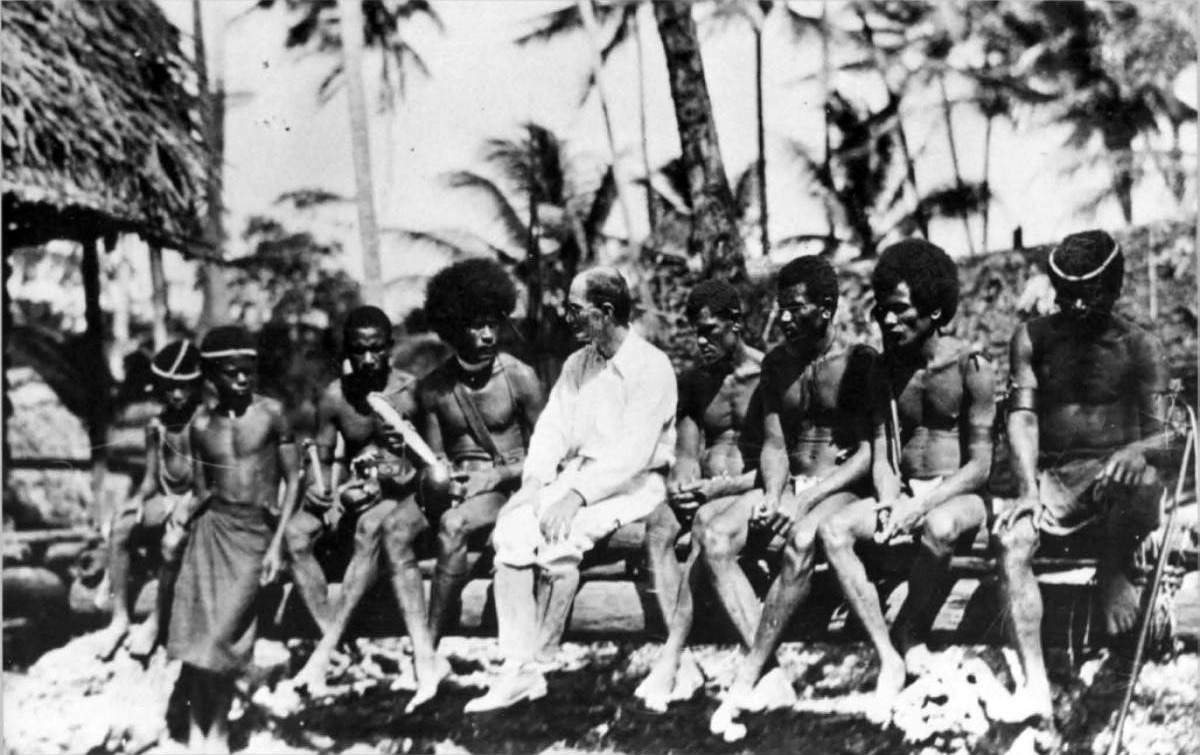
Uncredited, probably Billy Hancock. Public domain, via Wikimedia Commons.
Malinowski is also a warning. His private diary, published in 1967 after his death, showed moods and racist contempt that his published work concealed.7 What an ethnographer records passes through who they are, and a reader of field notes should keep that in mind.
Ethnography entered design through technology companies. In 1983 Lucy Suchman, then an anthropology PhD student at Xerox PARC, filmed people using a new Xerox copier whose screens were meant to coach them step by step. The screens assumed people follow plans; the footage showed people improvising from moment to moment, with the plan as one resource among several. Her book Plans and Situated Actions (1987) made that argument for interface design as a whole.8 At Intel, Genevieve Bell, who joined in 1998, led fieldwork in 100 households in 17 cities across seven Asian countries. She concluded that the United States, not Asia, was the unusual case in how people took up technology.9
Design teams rarely get months in the field. What they call ethnography is usually a few days of observation and interviews, which is closer to contextual inquiry. That’s useful work, but a 30-minute visit to a coffee shop is observation, and calling it ethnography oversells it.
Diary studies
A diary study is a study in which participants record their own activities, thoughts or feelings as they happen, over days or weeks.10 It reaches what a single session can’t: behavior that changes over time, happens in many places, or happens rarely. John Rieman described it as a workplace research tool for human-computer interaction in a 1993 conference paper.11
The study runs from a few days to a month or more, matched to how often the behavior occurs. A daily habit might need a week, and a weekly one three weeks. Participants log in one of three ways:10
| Logging | Participants record an entry | Suits |
|---|---|---|
| Event-based | Each time the event happens | Infrequent, distinct events |
| Interval-based | At set times, such as each evening | Frequent activity |
| Signal-based | When prompted by a message | Activity spread through the day |
The signal-based kind is also called experience sampling. A typical study has a pilot, a briefing, the logging period with reminders from the researcher, a closing interview to clarify entries, and analysis. Nielsen Norman Group suggests 5–12 participants for a small study of a similar group and 12–30 for a broad one, recruiting extra because people drop out. It suggests paying about $40 for each hour of total commitment in a general US sample, in installments, with a minimum and maximum number of entries so nobody invents them to qualify.10
See also
3 Design processes · 50 Planning design research · 51 Qualitative and quantitative research · 53 Usability testing · 54 Synthesis and insight · 58 Tasks and flows
Sources
- Beyer, H. and Holtzblatt, K. (1997). Contextual Design: Defining Customer-Centered Systems. Morgan Kaufmann. Described in Holtzblatt and Beyer (2014).
- Flaherty, K. (2020). “Contextual Inquiry.” Nielsen Norman Group.
- Flaherty, K. (2024). “Diary Studies.” Nielsen Norman Group.
- Holtzblatt, K. and Beyer, H. R. (2014). “Contextual Design.” The Encyclopedia of Human-Computer Interaction, 2nd ed. Interaction Design Foundation.
- Malinowski, B. (1922). Argonauts of the Western Pacific. Routledge.
- Nielsen, J. (2001). “First Rule of Usability? Don’t Listen to Users.” Nielsen Norman Group.
- Nielsen, J. (2010). “Interviewing Users.” Nielsen Norman Group.
- Rieman, J. (1993). “The diary study.” Proceedings of INTERCHI ‘93. ACM.
- Rosala, M. (2021). “How Many Participants for a UX Interview?” Nielsen Norman Group.
- Rosala, M. and Pernice, K. (2023). “User Interviews 101.” Nielsen Norman Group.
- Suchman, L. (1987). Plans and Situated Actions: The Problem of Human-Machine Communication. Cambridge University Press.
- University of Oregon (2005). Colloquium abstract, Genevieve Bell.
- Women of IxD (n.d.). “Dr. Lucy Suchman.”
- Young, M. W. (2014). “Writing His Life through the Other.” The Public Domain Review.
Notes
- Rosala, M. and Pernice, K. (2023). “User Interviews 101.” Nielsen Norman Group. https://www.nngroup.com/articles/user-interviews/ ↩ ↩
- Nielsen, J. (2010). “Interviewing Users.” Nielsen Norman Group. https://www.nngroup.com/articles/interviewing-users/ ↩ ↩
- Nielsen, J. (2001). “First Rule of Usability? Don’t Listen to Users.” Nielsen Norman Group. https://www.nngroup.com/articles/first-rule-of-usability-dont-listen-to-users/ ↩
- Rosala, M. (2021). “How Many Participants for a UX Interview?” Nielsen Norman Group. https://www.nngroup.com/articles/interview-sample-size/ ↩
- Holtzblatt, K. and Beyer, H. R. (2014). “Contextual Design.” In The Encyclopedia of Human-Computer Interaction, 2nd ed., ch. 8. Interaction Design Foundation. https://ixdf.org/literature/book/the-encyclopedia-of-human-computer-interaction-2nd-ed/contextual-design ↩ ↩
- Flaherty, K. (2020). “Contextual Inquiry: Inspire Design by Observing and Interviewing Users in Their Context.” Nielsen Norman Group. https://www.nngroup.com/articles/contextual-inquiry/ ↩ ↩ ↩
- Young, M. W. (2014). “Writing His Life through the Other: The Anthropology of Malinowski.” The Public Domain Review. https://publicdomainreview.org/essay/writing-his-life-through-the-other-the-anthropology-of-malinowski/ ↩ ↩
- Women of IxD (n.d.). “Challenging the Assumptions of Technology as an Automator: Dr. Lucy Suchman.” https://womenofixd.com/stories/lucy-suchman ↩
- University of Oregon, Department of Computer and Information Science (2005). Colloquium abstract and biography, Genevieve Bell, 27 January 2005. https://www.cs.uoregon.edu/Activities/Public_Talks/20050127-Bell.php ↩
- Flaherty, K. (2024). “Diary Studies: Understanding Long-Term User Behavior and Experiences.” Nielsen Norman Group. https://www.nngroup.com/articles/diary-studies/ ↩ ↩ ↩
- Rieman, J. (1993). “The diary study: a workplace-oriented research tool to guide laboratory efforts.” Proceedings of INTERCHI ‘93, 321–326. ACM. https://doi.org/10.1145/169059.169255 ↩