Chapter 28: Brands and brand strategy
A brand is two things at once: the name and marks that identify a seller, and the ideas people hold about what those marks stand for. Brand strategy is the work of deciding which ideas those should be and lining up what the organization says and does to build them. Designers usually meet it as a brief that asks for “premium but approachable” and then have to turn that into type, color and words.
Brand
A brand in the narrow sense is a mark of origin. The American Marketing Association defines it as any distinctive feature, such as a name, term, design or symbol, that identifies goods or services.1 In everyday use the word also covers what the mark means to people. That is why a company can “have a strong brand” with an unremarkable logo.
The legal sense has a clear start in Britain. The Trade Marks Registration Act 1875 opened a public register, and on 1 January 1876 the red triangle label of the brewer Bass & Co became UK trademark No. 1.2 Six years later Manet painted Bass bottles, red triangle showing, on a bar counter in Paris (figure 28.1).3 A mark registered to stop copying had become a sign a painter could use to say “modern, international, here”.
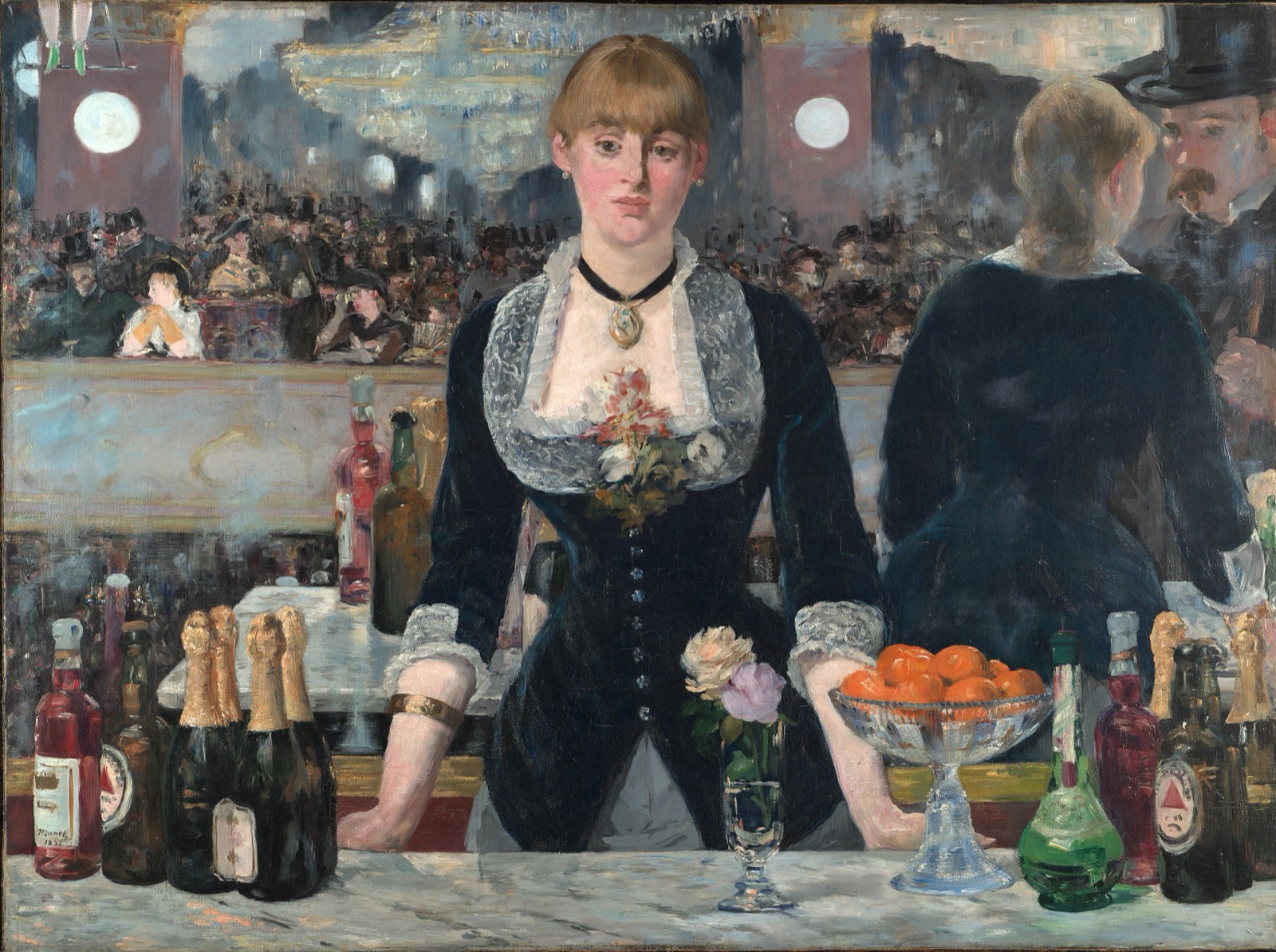
Édouard Manet, public domain, via Wikimedia Commons.
Muji shows the second sense by trying to refuse it. The Japanese retailer began in 1980 as a line of 40 products, mainly food, sold in Seiyu stores under the name Mujirushi Ryohin, “no brand, quality goods”.4 Its stated idea is that a product’s value lies in the thing and the service it gives, not in the name written on it. Plain packaging and an absent label then became exactly what people recognize Muji by.
Brand identity and brand image
Brand identity is the set of associations an organization intends its brand to have. David Aaker, whose planning model made the term standard in marketing, defines it as a unique set of associations the brand “seeks to create or maintain”.5 Brand image is the set of associations people actually hold. Kevin Lane Keller defined it in 1993 as “perceptions about a brand as reflected by the brand associations held in consumer memory.”6
A bank can set out an identity of “careful, local, on your side” while its customers hold an image of “slow app, long queues”. Brand strategy measures that gap and tries to close it. Design changes the image only by changing what people experience.
Studios, and the AMA glossary, also use “brand identity” for the visual system of logo, color, type and imagery (→ 30 Identity systems).1 Here it means the intent behind it.
Brand equity
Brand equity is the value a brand adds to a product beyond what the product would earn without it. Keller’s 1993 definition comes with a test. Show people the same product, price or advertisement once under the brand and once under a made-up name or no name. If they respond more favorably to the branded version, the brand has positive equity; if less favorably, negative.6 Keller split the knowledge behind that response into brand awareness, meaning whether people recognize or recall the brand, and brand image.
Aaker’s version, from Managing Brand Equity (1991), treats equity as assets and liabilities linked to a brand’s name and symbol, in five groups: brand loyalty, brand awareness, perceived quality, brand associations, and other proprietary assets such as patents and trademarks.7 The word “liabilities” matters: after a scandal, people may trust an unbranded alternative more.
Equity is measured in two ways. Customer-based measures come from research: awareness, preference, and the price premium people will pay. Financial measures put a money figure on the brand, usually for an acquisition, a licensing deal or a tax case; this is brand valuation. ISO 10668, published in 2010, sets requirements for monetary brand valuation and allows three approaches: market, cost and income.8 The annual “most valuable brands” tables use consultancies’ own methods, so their figures are estimates, not prices anyone has paid.
In practice
- When a brief says “build equity”, ask which measure will show it: awareness, preference or price premium.
- A redesign that drops a recognized color, shape or name can spend equity. Test recognition before and after.
Brand architecture
Brand architecture is the structure of an organization’s brands: which brands exist, what role each plays, and how they relate. David Aaker and Erich Joachimsthaler set out the standard model in 2000 as the brand relationship spectrum, with four basic strategies:9
| Strategy | How it works | Examples from the article |
|---|---|---|
| Branded house | One master brand covers every offering, with descriptive names below it | Virgin |
| Subbrand | A second name attached to the master brand adds to or changes its associations | Sony Walkman, Ocean Spray Craisins |
| Endorsed brand | An independent brand carries the parent’s name as a guarantee | Courtyard by Marriott, Polo Jeans by Ralph Lauren |
| House of brands | Stand-alone brands, each aimed at its own market, parent kept in the background | Procter & Gamble |
Real companies mix strategies. The Tata group in India puts its name on Tata Steel, Tata Motors and Tata Power, while Titan, Trent and Voltas, also listed group companies, trade under their own names.10 Each company using the name signs an agreement with Tata Sons that grants it the name in return for a commitment to run the business ethically and well.10 It is a branded house held together by contract.
The trade-off runs both ways. Aaker and Joachimsthaler credit the branded house with clarity and efficiency, and warn that it “puts a lot of eggs in one basket”: a stretch into unrelated products can put the core brand at risk.9 A house of brands lets each brand take its own position, even against its siblings, but each has to be built and paid for separately. For designers, architecture decides whether a new product gets its own logo or a descriptive name inside the parent’s system (→ 29 Logo design).
Positioning
Positioning is choosing the place a brand should hold in customers’ minds relative to the alternatives. Al Ries and Jack Trout wrote about it in Industrial Marketing in 1969, popularized it in a three-part Advertising Age series in 1972, “The Positioning Era Cometh”, and expanded it into Positioning: The Battle for Your Mind (1981).11 They argued that a position must take account of competitors’ strengths and weaknesses as well as the company’s own.12
Their standard example is Avis, which advertised that it was only number two to Hertz in car rental and so tried harder. By Ries and Trout’s account, Avis had lost money for 13 years before admitting it was number two, and made money after.12
A positioning statement is a short internal sentence naming the target customer, the category, the main benefit and the reason to believe it. Customers never see it. For designers it works as a filter: a positioning as “the calm, plain choice” rules out a loud, crowded layout before anyone draws one. Segmentation and targeting, the marketing steps that come first, are in → 84 Marketing.
Purpose, mission, vision and values
Companies use these four words loosely. A common split is:
- Purpose: why the organization exists beyond making money. It can never be finished.
- Mission: what it does now, and for whom.
- Vision: the future state it is working toward.
- Values: the few principles it holds to, even when they cost it something.
The most cited framework is Jim Collins and Jerry Porras’s, from “Building your company’s vision” (Harvard Business Review, 1996). It pairs a fixed core ideology, made of core values and core purpose, with an envisioned future: a bold long-term goal plus a vivid description of reaching it. Collins’s workshop material tests each candidate value by asking whether the organization would keep it if it became a competitive disadvantage. It also warns against listing aspirations as values; a group that has never valued innovation should put innovation in its envisioned future, not its values.13
Patagonia’s mission statement reads “We’re in business to save our home planet”, and its four core values include “Cause no unnecessary harm”.14 By the split above, that mission is really a purpose. What matters to a designer is whether a statement rules anything out. A value that never constrains a decision is decoration.
Verbal identity and tone of voice
Verbal identity is a brand’s way with words: its name, taglines, naming rules for products, key messages and voice. Voice is the brand’s consistent personality in writing, and tone is how that voice adjusts to the situation. Mailchimp’s content style guide puts it plainly: “You have the same voice all the time, but your tone changes.”15 It describes its voice as plainspoken, genuine, translating and dryly funny.
Kate Moran of Nielsen Norman Group described tone along four scales: formal to casual, serious to funny, respectful to irreverent, and matter-of-fact to enthusiastic.16 In an online survey of 50 US participants, versions of the same website text written in different tones changed how friendly and how formal people judged the company. The differences were statistically significant but small, about half a point to a point on a five-point scale.16 Placing a brand on each scale tells writers more than the word “friendly” does.
In practice
- Write each voice trait with what it means, what it doesn’t, and a before-and-after example.
- Set tone by situation. Errors, payments and bad news move toward serious and matter-of-fact whatever the voice.
- Check that the voice survives translation. A tone built on English wordplay needs local writers in each market.
See also
- 14 Color psychology and culture
- 29 Logo design
- 30 Identity systems
- 31 Advertising and art direction
- 82 How businesses work
- 84 Marketing
Sources
- Aaker, D. A. (1991). Managing Brand Equity. Free Press. Summarized in Aaker, D. A. (2006), “Aaker’s brand equity model”, WARC.
- Aaker, D. A. (2006). “Brand identity planning model.” WARC (SWOCC Book of Brand Management Models).
- Aaker, D. A., and Joachimsthaler, E. (2000). “The brand relationship spectrum: the key to the brand architecture challenge.” California Management Review 42(4).
- American Marketing Association. “Branding.” https://www.ama.org/topics/branding/
- Brand Finance (2010). “ISO 10668: new international standard on brand valuation.” Press release, October 8.
- Collins, J. (2001). “Vision framework.” JimCollins.com. Companion to Collins, J., and Porras, J. I. (1996), “Building your company’s vision”, Harvard Business Review 74(5).
- The Courtauld. A Bar at the Folies-Bergère, 1882. Virtual tour entry.
- GOV.UK (2026). “Poll reveals public’s most iconic trade marks as register turns 150.” UK Intellectual Property Office, April 22.
- Keller, K. L. (1993). “Conceptualizing, measuring, and managing customer-based brand equity.” Journal of Marketing 57(1), 1–22.
- Mailchimp. Content Style Guide, “Voice and tone.”
- Moran, K. (2016). “The four dimensions of tone of voice.” Nielsen Norman Group, July 17.
- Muji Europe. “About Muji.”
- Patagonia. “Our mission.”
- Ries, A., and Trout, J. (1972). “The positioning era cometh.” Advertising Age. Reprinted at Ries.com.
- Ries.com. “The history of positioning.”
- Tata. “Tata Sons.”
Notes
- American Marketing Association, “Branding.” https://www.ama.org/topics/branding/ ↩ ↩
- UK Intellectual Property Office (2026). https://www.gov.uk/government/news/poll-reveals-publics-most-iconic-trade-marks-as-register-turns-150 ↩
- The Courtauld, virtual tour. https://virtualtour.courtauld.ac.uk/gal-hotspot/a-bar-at-the-folies-bergere-1882/ ↩
- Muji Europe, “About Muji.” https://www.muji.eu/pages/about-muji.html ↩
- Aaker (2006), WARC. https://www.warc.com/content/article/swocc/brand-identity-planning-model/en-gb/88021 ↩
- Keller (1993), abstract (p. 1) and p. 3. ↩ ↩
- Aaker (2006), WARC. https://www.warc.com/en/article/aaker%E2%80%99s-brand-equity-model-6030717e471b42dc91361694de702f63 ↩
- Brand Finance (2010). https://brandfinance.com/press-releases/iso-10668-new-international-standard-on-brand-valuation ↩
- Aaker and Joachimsthaler (2000), definitions and figure 1. Read in a course copy of the article; publisher abstract at https://journals.sagepub.com/doi/abs/10.1177/000812560004200401 ↩ ↩
- Tata, “Tata Sons.” https://www.tata.com/about-us/tata-sons ↩ ↩
- Ries.com, “The history of positioning.” https://ries.com/about/history-of-positioning ↩
- Ries and Trout (1972), reprinted at https://ries.com/about/positioning-articles ↩ ↩
- Collins (2001), “Vision framework.” https://www.jimcollins.com/pdf/Vision_Framework.pdf ↩
- Patagonia, “Our mission.” https://www.patagonia.com.hk/pages/our-mission ↩
- Mailchimp, “Voice and tone.” https://styleguide.mailchimp.com/voice-and-tone/ ↩
- Moran (2016). https://www.nngroup.com/articles/tone-of-voice-dimensions/ ↩ ↩