Chapter 1: What design is
Design is deciding in advance how something should be, so that it does what someone needs. The something can be a chair, a timetable, a typeface, a checkout flow or a hospital’s admission process. Designers do this deliberately, for others, and answer for the result.
Design as a noun and a verb
As a verb, design is the activity: working out what a thing should be before it’s made. As a noun, a design is either the plan that comes out of that work (a drawing, a specification, a prototype) or the arrangement in the finished thing. “The design of this chair” can mean the drawings in the workshop or the way the chair itself is put together.
The double meaning is old. In Renaissance Italy, disegno meant both drawing and design: the skill of making a drawing and the ability to invent what it shows.1
The broadest modern definition comes from the social scientist Herbert Simon, in The Sciences of the Artificial (1969): “Everyone designs who devises courses of action aimed at changing existing situations into preferred ones.” Simon put the engineer, the doctor prescribing a remedy and the manager writing a sales plan in one category.2 That shows what all design shares: a present state, a preferred one and a plan between them. It doesn’t say what a professional designer does that a doctor doesn’t (→ 2 The design disciplines).
Design, art and craft
They overlap but ask different questions. Design asks what a thing should be for someone else’s purpose, usually under a brief, a budget and constraints the designer didn’t set. Art sets its own terms: a painting doesn’t fail because a client can’t use it. Craft is about making, and about the skill of the hand and eye that does it.
The furniture designer David Pye drew the sharpest line between design and making in The Nature and Art of Workmanship (1968).3 He separated the workmanship of risk, in which the result depends on the maker’s judgment and care as the work goes on, from the workmanship of certainty, in which jigs, tools or machines fix the result before production starts. His test was whether the result is “predetermined and unalterable once production begins”.4 A hand-carved bowl is risk; an injection-molded one is certainty. In the second case all the judgment has moved into the design.
Other traditions drew the lines elsewhere. In Japan in 1925, Yanagi Sōetsu, with the potters Kawai Kanjirō and Hamada Shōji, coined mingei (“folk crafts”) for everyday objects made by unknown craftspeople, and argued that such plain, useful things had an honest beauty of their own (→ 7 Design traditions beyond the West).5
Form and function
Form is the shape, structure and appearance of a thing; function is what it’s for. The phrase that ties them together comes from the architect Louis Sullivan, in “The Tall Office Building Artistically Considered”, published in Lippincott’s Magazine in March 1896. His wording was “form ever follows function”, which he called “the law”.6
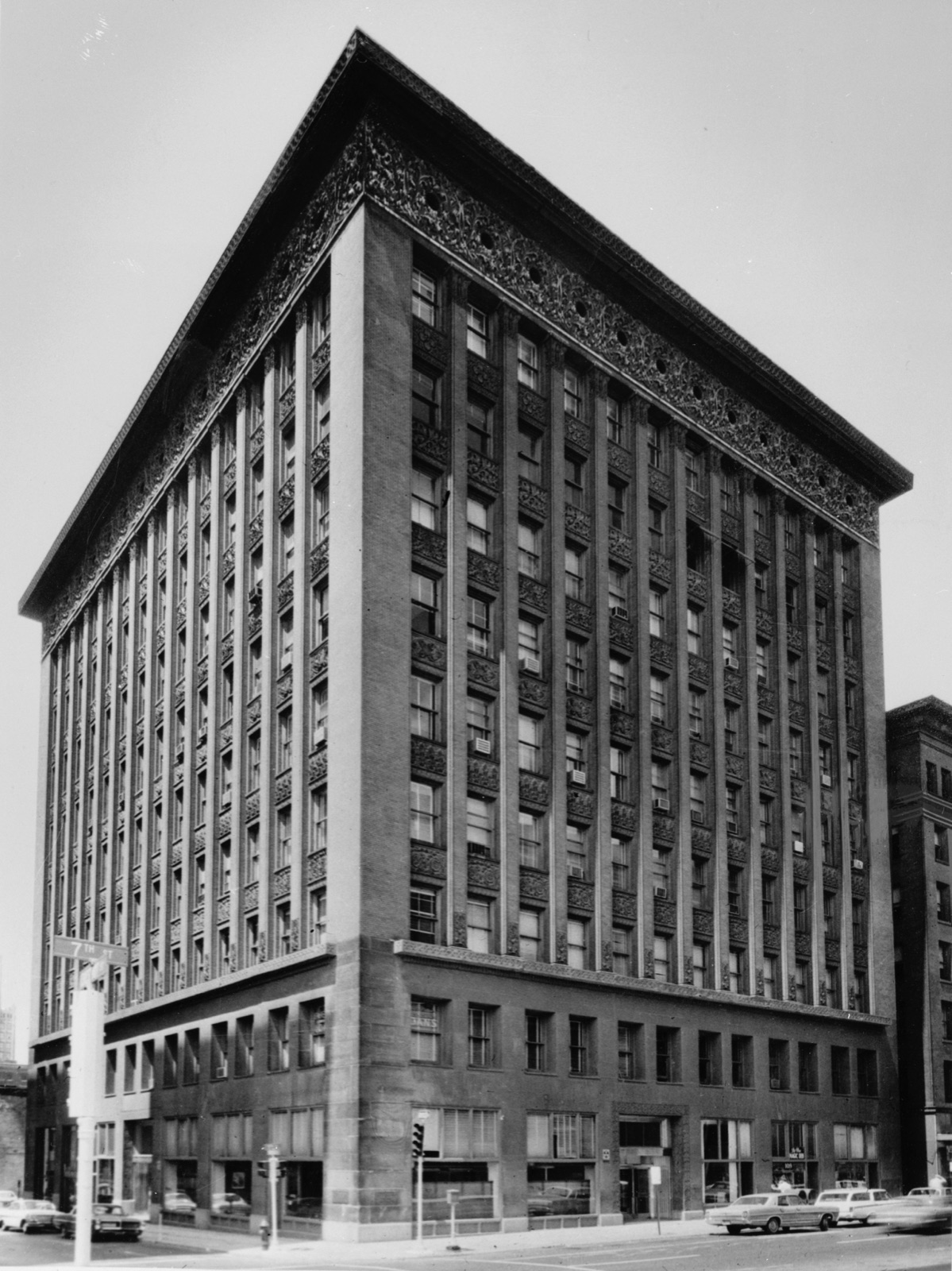
Paul Piaget for the Historic American Buildings Survey, public domain, via Wikimedia Commons.
Sullivan wasn’t arguing against ornament. His point was that a tall office building has distinct jobs (shops at street level, stacked offices, service space at the top) and that its appearance should express them.6 The Wainwright Building (Figure 1.1) does exactly that, and it’s covered in terra-cotta foliage.7 The phrase is now usually quoted as “form follows function” and used as an argument for plain, unornamented design, which is a later reading (→ 5 Modern movements, 1900–1970). As a test, the idea still works: if you can’t say what a part of a design is for, ask whether it needs to be there.
Wicked problems
A wicked problem is one that can’t be fully defined, has no point at which it’s finished, and has no right answer, only better and worse ones. Horst Rittel and Melvin Webber, a design theorist and a city planner at the University of California, Berkeley, set the term out in 1973. They contrasted it with a tame problem, such as solving an equation or finding checkmate in five moves, where the goal is clear and you know when you’ve reached it.8
Their examples were planning problems, such as where to route a freeway or what to do about crime. Among their ten properties: there is no definitive formulation of the problem, because understanding it depends on the solution you have in mind; solutions aren’t true or false but good or bad; and every wicked problem is a symptom of another one.8
The design theorist Richard Buchanan carried the idea into design in 1992, arguing that design problems are wicked because design has no fixed subject matter of its own and has to find one in each situation.9 A typeface for a new script or a city’s bus network is wicked in Rittel and Webber’s sense; choosing a button color usually isn’t. Calling every hard problem wicked turns the term into a complaint. It’s more useful as a warning that analysis alone won’t settle a problem, and that judgment, negotiation and repeated tries will be needed (→ 3 Design processes).
See also
2 The design disciplines · 3 Design processes · 4 Design before 1900 · 5 Modern movements, 1900–1970 · 7 Design traditions beyond the West · 9 Elements and principles of design
Sources
- Buchanan, R. (1992). “Wicked Problems in Design Thinking.” Design Issues 8(2): 5–21.
- City of St. Louis, Cultural Resources Office (n.d.). “Wainwright Building.” City landmarks.
- Japan Folk Crafts Museum (n.d.). “History.”
- Klein, J. A. (2022). “There is Much More in Workmanship than Not Spoiling the Job.” Mortise & Tenon Magazine.
- National Gallery, London (n.d.). “Disegno.” Glossary.
- Pye, D. (1968). The Nature and Art of Workmanship. Cambridge University Press.
- Rittel, H. W. J. and Webber, M. M. (1973). “Dilemmas in a General Theory of Planning.” Policy Sciences 4: 155–169.
- Simon, H. A. (1996). The Sciences of the Artificial, 3rd edition. MIT Press. First edition 1969.
- Sullivan, L. H. (1896). “The Tall Office Building Artistically Considered.” Lippincott’s Monthly Magazine 57: 403–409.
Notes
- National Gallery, London (n.d.). “Disegno.” Glossary. https://www.nationalgallery.org.uk/paintings/glossary/disegno ↩
- Simon, H. A. (1996). The Sciences of the Artificial, 3rd edition, chapter 5, “The Science of Design: Creating the Artificial.” MIT Press. First edition 1969. ↩
- Open Library (n.d.). Catalog record for Pye, D., The Nature and Art of Workmanship (Cambridge University Press, 1968). https://openlibrary.org/search?q=the+nature+and+art+of+workmanship+pye ↩
- Klein, J. A. (2022, September 19). “There is Much More in Workmanship than Not Spoiling the Job.” Mortise & Tenon Magazine, quoting Pye (1968). https://www.mortiseandtenonmag.com/blogs/blog/there-is-much-more-in-workmanship-than-not-spoiling-the-job ↩
- Japan Folk Crafts Museum (n.d.). “History.” http://mingeikan.or.jp/about/history/?lang=en ↩
- Sullivan, L. H. (1896, March). “The Tall Office Building Artistically Considered.” Lippincott’s Monthly Magazine 57: 403–409. Scan at https://archive.org/details/tallofficebuildi00sull ↩ ↩
- City of St. Louis, Cultural Resources Office (n.d.). “Wainwright Building.” https://www.stlouis-mo.gov/government/departments/planning/cultural-resources/city-landmarks/Wainwright-Builiding.cfm ↩
- Rittel, H. W. J. and Webber, M. M. (1973). “Dilemmas in a General Theory of Planning.” Policy Sciences 4: 155–169. https://archive.epa.gov/reg3esd1/data/web/pdf/rittel%2Bwebber%2Bdilemmas%2Bgeneral_theory_of_planning.pdf ↩ ↩
- Buchanan, R. (1992). “Wicked Problems in Design Thinking.” Design Issues 8(2): 5–21. doi:10.2307/1511637. Summarized at https://buttondown.com/1992newsletter/archive/wicked-problems-in-design-thinking ↩