Chapter 70: Wearables, ubiquitous computing and IoT
Wearables, ubiquitous computing and the Internet of Things all take computing off the desk and put it on the body, into rooms and inside ordinary objects. The screen shrinks or disappears, and the user’s attention becomes the main thing the design has to budget.
Wearables and glanceable design
A wearable is a computer worn on the body: a smartwatch, a fitness band, a ring, a hearing aid, a head-mounted display. Glanceable design is designing so that a person gets what they need in one brief look, often while walking or carrying something. Apple’s watchOS guidelines ask for “quick, glanceable, single-screen interactions” and describe app sessions that can last less than a minute each.1
The idea is older than the smartwatch. Edward Thorp conceived a roulette-predicting computer in 1955 and built it with Claude Shannon at MIT in 1960–61, an analog device the size of a cigarette pack.2 Steve Mann built a backpack-mounted computer in 1981 and in 1994 sent images from a head-mounted camera to a web page.3
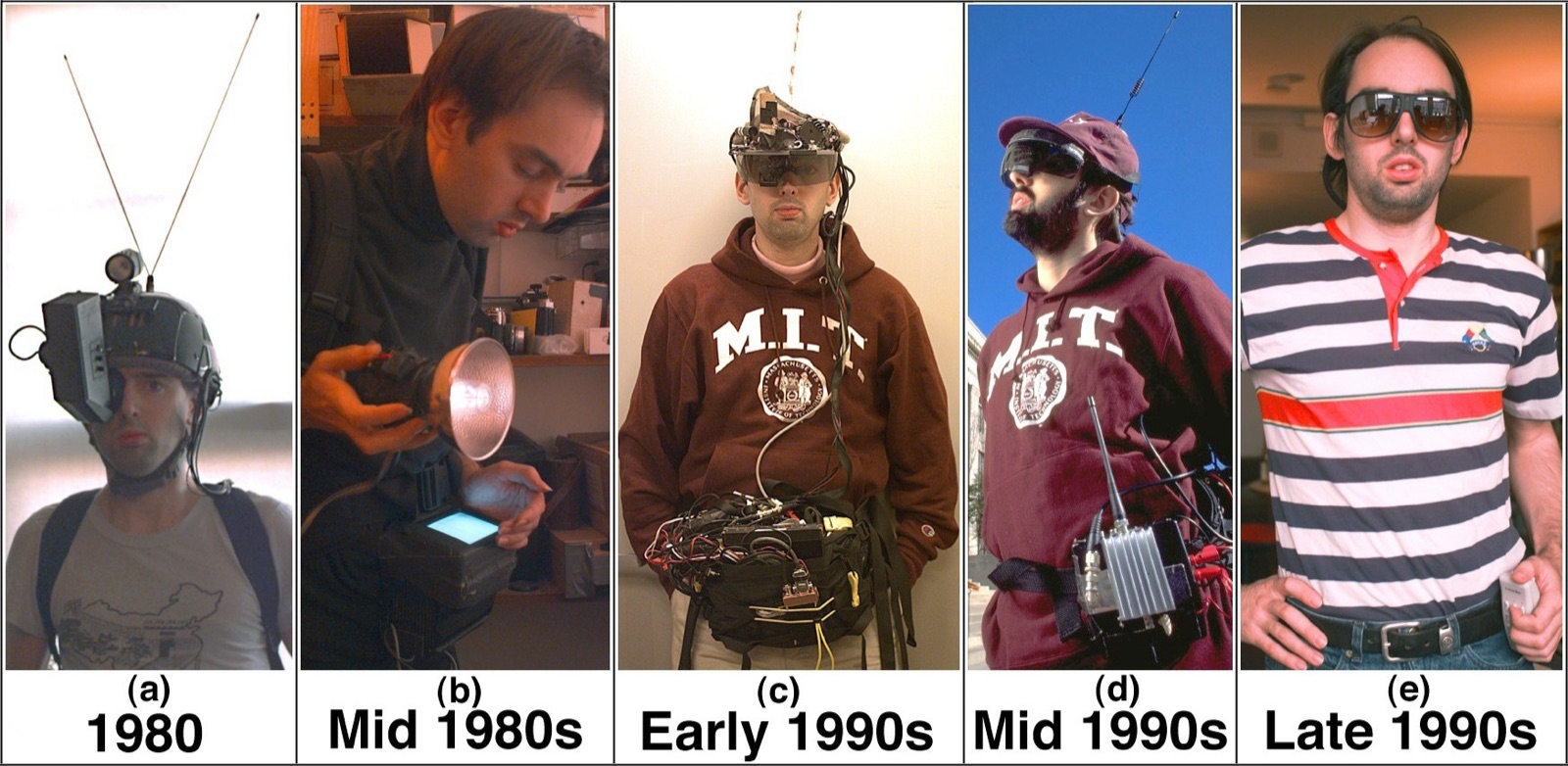
Glogger, CC BY-SA 3.0, via Wikimedia Commons.
A watch face is a few centimeters across and used at arm’s length, often with one hand busy (→ 69 Mobile patterns and gestures). Wearables also collect intimate data such as heart rate, sleep and location (→ 95 Privacy and data ethics).
In practice
- Show one thing per screen, the value the person raised their wrist for, at the largest size.
- Send long tasks such as setup, settings and reading to the paired phone.
- Use a haptic tap for alerts the wearer can act on without looking, and send fewer of them.
Ubiquitous computing
Ubiquitous computing (ubicomp) is computing spread through the environment in many small devices that people use without thinking of them as computers. Mark Weiser of Xerox PARC set it out in Scientific American in September 1991, opening with “The most profound technologies are those that disappear.”4 PARC built devices at three scales: inch-scale tabs, foot-scale pads and yard-scale boards. Weiser set the idea directly against virtual reality, which takes people into the computer (→ 71 Virtual, augmented and mixed reality).4
Japan reached the idea separately. Ken Sakamura of the University of Tokyo proposed a “Highly Functionally Distributed System” of cooperating embedded devices in 1987, and in 1989 he designed the TRON Intelligent House in Tokyo. The IEEE, which named it a milestone in 2024, describes about 1,000 networked computers in 333 m², and windows that opened for a breeze and closed when it rained.5
The Internet of Things
The Internet of Things (IoT) is the network of physical objects with sensors or actuators that exchange data over the internet: thermostats, door locks, streetlights, pallets in a warehouse. Kevin Ashton says the phrase began as the title of a 1999 presentation at Procter & Gamble, arguing that computers should gather data about physical goods themselves, through RFID tags and sensors.6
An IoT product is a service with several touchpoints: the object, a phone app, perhaps a voice assistant (→ 72 Conversational and AI interfaces), and a cloud service joining them (→ 55 Personas, journeys and service design). Most of the design work is in the states between them. What does the lock do when the Wi-Fi drops? How does the user know a command from the app reached the device? What happens when the company stops supporting it? A connected light switch still has to work as a light switch.
Security is a design problem too. In 2016 the Mirai malware took over more than 600,000 devices, mostly home routers and cameras, by trying 64 well-known default usernames and passwords. On 21 October 2016 it attacked the DNS provider Dyn and made many large websites unreachable.7 Since 29 April 2024 the UK has banned universal default and easily guessable passwords on consumer connectable products, and makers must publish how to report security issues and how long the product will get security updates.8
Calm technology
Calm technology is technology that informs without demanding attention, moving between the edge of awareness and its center as needed. Weiser and John Seely Brown described it in “Designing Calm Technology” (1995), in terms of the periphery, which is what people are attuned to without attending to it explicitly.9 Their example was Natalie Jeremijenko’s Dangling String, a 2.4-meter (8 ft) plastic string hung from a ceiling motor wired to the office Ethernet. Light traffic made it twitch, and heavy traffic made it whirl with a noise anyone in the room could hear without looking. Amber Case turned the idea into eight principles in Calm Technology (2015), the first being that technology should need the smallest possible amount of attention.1011 The test for a design: what can the person know without looking, and what can wait? (→ 43 Human cognition; → 96 Ethical design.)
See also
43 Human cognition · 45 Human-computer interaction: history and theory · 69 Mobile patterns and gestures · 71 Virtual, augmented and mixed reality · 72 Conversational and AI interfaces · 95 Privacy and data ethics
Sources
- Apple (n.d.). “Designing for watchOS.” Human Interface Guidelines.
- Ashton, K. (2009). “That ‘Internet of Things’ Thing.” RFID Journal.
- Bursztein, E. (2017). “Inside the infamous Mirai IoT Botnet: A Retrospective Analysis.” Cloudflare.
- Case, A. (2015). Calm Technology: Principles and Patterns for Non-Intrusive Design. O’Reilly.
- IEEE (2024). “The Pioneering TRON Intelligent House, 1989.” IEEE Milestone, ETHW.
- Rhodes, B. (n.d.). “A brief history of wearable computing.” MIT Media Lab.
- Thorp, E. O. (1998). “The Invention of the First Wearable Computer.” ISWC 1998.
- UK Government (2024). “Regulations: consumer connectable product security.”
- Weiser, M. (1991). “The Computer for the 21st Century.” Scientific American 265(3).
- Weiser, M. and Brown, J. S. (1995). “Designing Calm Technology.” Xerox PARC.
Notes
- Apple (n.d.). “Designing for watchOS.” Human Interface Guidelines. https://developer.apple.com/design/human-interface-guidelines/designing-for-watchos ↩
- Thorp, E. O. (1998). “The Invention of the First Wearable Computer.” Proceedings of the Second International Symposium on Wearable Computers, Pittsburgh. https://www.cs.virginia.edu/~evans/thorp.pdf ↩
- Rhodes, B. (n.d.). “A brief history of wearable computing.” MIT Wearable Computing Project. https://www.media.mit.edu/wearables/lizzy/timeline.html ↩
- Weiser, M. (1991). “The Computer for the 21st Century.” Scientific American 265(3): 94–104. https://graphics.stanford.edu/courses/cs428-03-spring/Papers/readings/General/Weiser_SciAm91.htm ↩ ↩
- IEEE (2024). “Milestones: The Pioneering TRON Intelligent House, 1989.” Engineering and Technology History Wiki. https://ethw.org/Milestones:The_Pioneering_TRON_Intelligent_House,_1989 ↩
- Ashton, K. (2009, June 22). “That ‘Internet of Things’ Thing.” RFID Journal. https://www.rfidjournal.com/that-internet-of-things-thing ↩
- Bursztein, E. (2017, December 14). “Inside the infamous Mirai IoT Botnet: A Retrospective Analysis.” Cloudflare blog, summarizing Antonakakis et al., “Understanding the Mirai Botnet,” USENIX Security 2017. https://blog.cloudflare.com/inside-mirai-the-infamous-iot-botnet-a-retrospective-analysis ↩
- UK Government (2024). “Regulations: consumer connectable product security.” https://www.gov.uk/guidance/regulations-consumer-connectable-product-security ↩
- Weiser, M. and Brown, J. S. (1995, December 21). “Designing Calm Technology.” Xerox PARC; printed in PowerGrid Journal 1(1), 1996. https://calmtech.com/papers/designing-calm-technology.html ↩
- Case, A. (2015). Calm Technology: Principles and Patterns for Non-Intrusive Design. O’Reilly. https://www.oreilly.com/library/view/calm-technology/9781491925874/ ↩
- Case, A. (n.d.). “Principles of Calm Technology.” https://calmtech.com/ ↩