Chapter 94: Intellectual property and licensing
Intellectual property is the group of legal rights in creations of the mind: copyright in works, trademarks in brand signs, patents in inventions, and design rights in the look of products. Each arises in its own way, lasts its own time and protects a different thing, so one bottle can carry all four. Designers meet these rights twice, as owners of what they make and as users of what others made.
Copyright
Copyright is the exclusive right to copy, adapt, distribute and show an original creative work: a drawing, a photograph, a page layout, the code of a website. Its international base is the Berne Convention of 1886, which now has 182 member states.1 Berne sets three principles. Protection is automatic, with no registration or © notice needed. Each member protects works from other members as it protects its own. And the minimum term is the author’s life plus 50 years.2 The WTO’s TRIPS Agreement (1994) binds its members to Berne and adds that copyright covers expressions, not ideas, procedures or methods of operation.3 This idea–expression distinction is why nobody owns card sorting or the idea of a hamburger menu, while a particular illustration of either belongs to whoever drew it.
Most countries go past the minimum. The US, the EU and the UK protect most works for the author’s life plus 70 years; India’s Copyright Act 1957 gives life plus 60.4567 When the term ends, the work enters the public domain and anyone may use it. In the US, registration is voluntary, but a US work must be registered before its owner can sue.8 US law also excludes names, titles, slogans and “typeface as typeface” from copyright altogether.9
Designs for useful objects are the hard case. In Star Athletica v. Varsity Brands (2017), about stripes and chevrons on cheerleading uniforms, the US Supreme Court held that a decorative feature of a useful article is protected only if it can be imagined as a work of art apart from the article and would qualify as one on its own.10 In Cofemel v G-Star Raw (2019), the EU Court of Justice held that a design’s aesthetic effect is not what earns it copyright; it needs to be original in the ordinary sense.11
Using someone else’s work without permission is sometimes lawful. Fair use is the US defense, decided by weighing four factors: the purpose and character of the use, the nature of the work, how much is taken, and the effect on the market for the original.12 The UK has narrower fair dealing, limited to listed purposes such as criticism, review, quotation and, since 2014, caricature, parody or pastiche.13 “I found it on a search engine” is not one of them.
Trademark
A trademark is a sign that distinguishes one business’s goods or services from another’s: a name, a logo, a slogan, sometimes a combination of colors.3 Copyright stops copying; a trademark stops confusion in the market. The usual test is likelihood of confusion: whether two marks are similar enough, on related enough goods, that buyers would think they come from the same source. It’s the most common reason the US Patent and Trademark Office (USPTO) refuses an application.14 Two businesses can share a name if they sell unrelated things.
In the US, using a mark in trade creates rights in the area where it’s used, and federal registration extends them nationwide. The ™ symbol (℠ for services) can go on any mark you claim, but ® only on a registered one, and only for the goods or services listed in the registration.15 TRIPS requires registrations to last at least seven years at a time.3 An EU trade mark lasts ten years from filing and can be renewed for further ten-year periods without limit.16 Before presenting a new name or logo, search the trademark registers in every market where it will be used (→ 28 Brands and brand strategy, → 29 Logo design).
Patents and registered designs
A utility patent protects how an invention works, for at least 20 years from the filing date under TRIPS, and the US term is 20 years from filing.1718 Getting one means a full public disclosure and an examination, and it’s usually the engineers’ concern more than the designers’.
Appearance has its own rights. TRIPS requires members to protect new or original industrial designs for at least ten years.19 The US does it with the design patent, which protects the ornamental look of a manufactured article, its shape, its surface decoration or both, for 15 years from grant on applications filed since 13 May 2015.20 Most other countries call the right a registered design. A registered EU design lasts five years from filing and can be renewed to 25. An unregistered design right needs no filing: the unregistered EU design protects a design for three years from the day it is first made public in the EU.21 These rules were codified as Regulation (EU) 2026/715, applied from 1 July 2026.22 The UK has a registered design, renewed every five years up to 25, and a UK design right for the shape of three-dimensional objects that ends 15 years after creation or 10 years after first sale, whichever comes first.2324
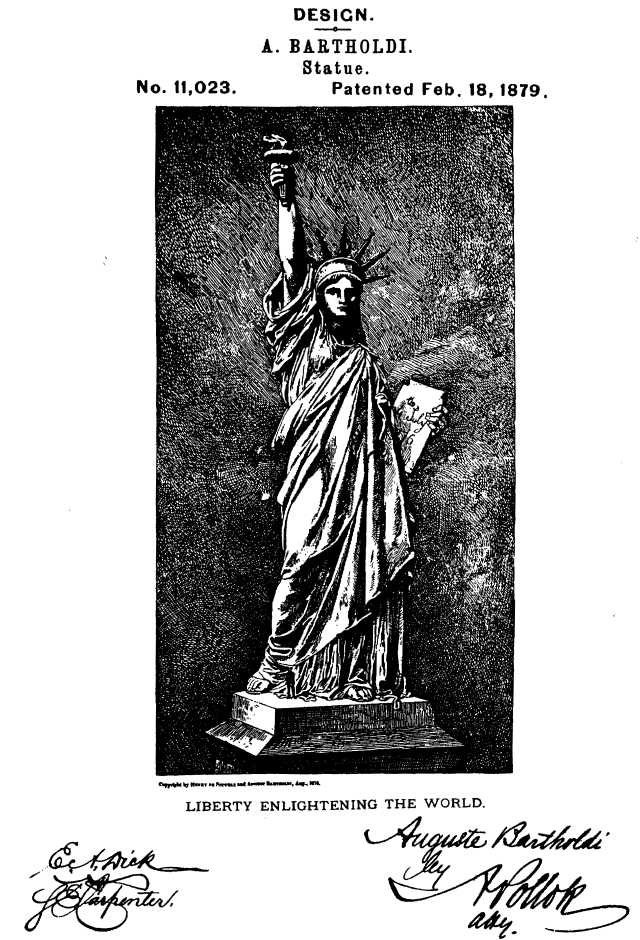
Frédéric Auguste Bartholdi, public domain, via Wikimedia Commons.
Work for hire and moral rights
Who owns a design when it’s made depends mostly on whether the designer is an employee. In US law a work made for hire belongs to the employer or client from the start. It applies in two cases: work an employee prepares within the scope of the job, and commissioned work in nine listed categories, such as a contribution to a collective work or an instructional text, where both sides sign a written agreement calling it a work for hire.25 A freelancer’s logo fits none of the nine, so a client who wants to own it needs a written assignment instead. Works for hire last 95 years from publication or 120 from creation, whichever ends first, and are exempt from the author’s right to end a transfer after 35 years.426 The UK and India have no such label but reach a similar result: an employer is the first owner of work made in the course of employment, unless agreed otherwise.277
Moral rights are an author’s personal rights to be named and to object to distortion that harms their reputation. Berne requires them,2 but countries implement them very differently. The US grants them only for “works of visual art”: paintings, drawings, prints, sculptures and exhibition photographs in signed editions of 200 or fewer. Posters, applied art, advertising, packaging and works for hire are all excluded, so most commercial design carries none.2528 In the UK, moral rights can’t be sold, but they can be waived, and the right to be named applies only once the author has asserted it, typically in the contract.29 India’s Copyright Act gives the author the right to claim authorship and to resist prejudicial distortion even after the copyright has been assigned.7
Creative Commons and stock licenses
Creative Commons is a set of standard public licenses that let creators allow reuse in advance. The organization was founded in 2001 and released its first licenses in 2002.31 The licenses combine four conditions: BY (credit the creator), SA (share adaptations under the same terms), NC (noncommercial use only) and ND (no adaptations), into six licenses from CC BY to CC BY-NC-ND.32 The current version, 4.0, came out in November 2013. A CC license can’t be revoked for copies already released. CC0 is a public domain dedication: the owner gives up every right the law allows.33 Client work is commercial, so NC images are almost never usable in it.
Stock libraries sell two kinds of license. A royalty-free license is priced by file size and allows repeated use within its terms; it is paid for, not free.34 A rights-managed license is priced by the specific use, such as print run and placement.34 Royalty-free still has limits. Adobe Stock’s standard license, for example, allows up to 500,000 copies and forbids merchandise whose main value is the image, such as a printed mug or T-shirt. Those uses need its extended license.35
Font and open-source licenses
A font is software, sold under a license that sets where it may be used: desktop, web, app, video (→ 20 Choosing, pairing and legibility). The US doesn’t protect typeface designs by copyright,9 but UK law does, for 25 years after the typeface is first marketed.36 Code has its own licenses. A permissive license such as MIT allows almost any use as long as the copyright and permission notice is kept in all copies.37 A copyleft license such as the GPL requires modified versions to stay free under the same terms,38 so check with developers before a design system ships copyleft code inside a closed product.
Attribution and permission
Credit and permission are separate. Naming the photographer doesn’t license the photograph, and a license that requires credit isn’t met without it. For Creative Commons work, Creative Commons recommends TASL: give the title, the author, the source (with a link) and the license (with a link).39 For anything else, get permission in writing, and keep it with the project files alongside the font and stock licenses. Write down what the permission covers: the medium, the territory, the period and whether the work can be changed. The professional side of credit, who gets named on a project and how, is in → 99 Professional responsibility. Who owns AI-generated images is covered in → 6 Contemporary design, 1970 to now.
See also
- 6 Contemporary design, 1970 to now
- 7 Design traditions beyond the West
- 20 Choosing, pairing and legibility
- 29 Logo design
- 42 Product and industrial design
- 99 Professional responsibility
Sources
- Adobe. “Adobe Stock license terms.” https://stock.adobe.com/license-terms
- Alamy. “How to price up image licences using price calculator.” https://www.alamy.com/blog/how-to-price-up-image-licences-using-price-calculator
- Court of Justice of the EU (2019). Cofemel v G-Star Raw, C-683/17, 12 September 2019.
- Creative Commons. “About CC licenses”; “Frequently asked questions”; “History”; “Best practices for attribution.” https://creativecommons.org/
- European Union. Directive 2006/116/EC on the term of protection of copyright; Regulation (EU) 2017/1001 on the EU trade mark; Regulation (EU) 2026/715 on European Union designs (codification).
- GNU Project. “What is copyleft?” https://www.gnu.org/licenses/copyleft.en.html
- Government of India. The Copyright Act, 1957, sections 17, 22 and 57. Text via WIPO Lex.
- LexisNexis UK (2026). “EU design reform: what changes on 1 July 2026.”
- Open Source Initiative. “The MIT License.” https://opensource.org/license/mit
- UK Government. Copyright, Designs and Patents Act 1988, sections 11, 12, 30A, 55, 79; gov.uk guidance on copyright, design right and registered designs.
- United States. Copyright Act, 17 U.S.C. §§ 101, 106A, 107, 203, 204, 302; 37 C.F.R. § 202.1.
- US Copyright Office. “Copyright in general” (FAQ).
- US Patent and Trademark Office. “What is a trademark?”; “Likelihood of confusion”; “Patent essentials”; MPEP § 1502.
- US Supreme Court (2017). Star Athletica, L.L.C. v. Varsity Brands, Inc., 580 U.S. 405.
- WIPO. “Summary of the Berne Convention for the Protection of Literary and Artistic Works (1886)”; WIPO Lex contracting parties list.
- WTO. Agreement on Trade-Related Aspects of Intellectual Property Rights (TRIPS), Articles 9, 15, 18, 25, 26, 33.
Notes
- WIPO Lex, Berne Convention contracting parties (182 listed, accessed 23 November 2026). https://www.wipo.int/wipolex/en/treaties/ShowResults?treaty_id=15 ↩
- WIPO. “Summary of the Berne Convention.” https://www.wipo.int/treaties/en/ip/berne/summary_berne.html ↩ ↩
- WTO. TRIPS Agreement, Art. 9(1)–(2), 15(1), 18. https://www.wto.org/english/docs_e/legal_e/27-trips_04_e.htm ↩ ↩ ↩
- 17 U.S.C. § 302(a), (c). https://www.law.cornell.edu/uscode/text/17/302 ↩ ↩
- Directive 2006/116/EC, Art. 1(1). https://eur-lex.europa.eu/legal-content/EN/TXT/?uri=CELEX:32006L0116 ↩
- Copyright, Designs and Patents Act 1988, s. 12(2). https://www.legislation.gov.uk/ukpga/1988/48/section/12 ↩
- The Copyright Act, 1957 (India), ss. 17(c), 22, 57(1). WIPO Lex text. https://www.wipo.int/wipolex/en/text/128097 ↩ ↩ ↩
- US Copyright Office. “Copyright in general.” https://www.copyright.gov/help/faq/faq-general.html ↩
- 37 C.F.R. § 202.1(a), (e). https://www.law.cornell.edu/cfr/text/37/202.1 ↩ ↩
- Star Athletica v. Varsity Brands, decided 22 March 2017. https://www.law.cornell.edu/supremecourt/text/15-866 ↩
- CJEU, C-683/17, Cofemel, operative part. https://eur-lex.europa.eu/legal-content/EN/TXT/?uri=CELEX:62017CJ0683 ↩
- 17 U.S.C. § 107. https://www.law.cornell.edu/uscode/text/17/107 ↩
- Copyright, Designs and Patents Act 1988, s. 30A, inserted 2014. https://www.legislation.gov.uk/ukpga/1988/48/section/30A ↩
- USPTO. “Likelihood of confusion.” https://www.uspto.gov/trademarks/search/likelihood-confusion ↩
- USPTO. “What is a trademark?” https://www.uspto.gov/trademarks/basics/what-trademark ↩
- Regulation (EU) 2017/1001, Art. 52. https://eur-lex.europa.eu/legal-content/EN/TXT/?uri=CELEX:32017R1001 ↩
- WTO. TRIPS Agreement, Art. 33. https://www.wto.org/english/docs_e/legal_e/27-trips_04c_e.htm ↩
- USPTO. “Patent essentials.” https://www.uspto.gov/patents/basics/essentials ↩
- WTO. TRIPS Agreement, Art. 25(1), 26(3). https://www.wto.org/english/docs_e/legal_e/27-trips_04b_e.htm ↩
- USPTO. Manual of Patent Examining Procedure, § 1502. https://www.uspto.gov/web/offices/pac/mpep/s1502.html ↩
- Regulation (EU) 2026/715, Art. 12(1), 13(2). https://eur-lex.europa.eu/eli/reg/2026/715/oj ↩
- LexisNexis UK (2026). https://www.lexisnexis.co.uk/legal/news/eu-design-reform-what-changes-on-1-july-2026 ↩
- gov.uk. “Renew your registered design.” https://www.gov.uk/renew-registered-design ↩
- gov.uk. “Design right: how long it lasts.” https://www.gov.uk/design-right/how-long-it-lasts ↩
- 17 U.S.C. § 101, definitions of “work made for hire” and “work of visual art.” https://www.law.cornell.edu/uscode/text/17/101 ↩ ↩
- 17 U.S.C. § 203. https://www.law.cornell.edu/uscode/text/17/203 ↩
- Copyright, Designs and Patents Act 1988, s. 11(2). https://www.legislation.gov.uk/ukpga/1988/48/section/11 ↩ ↩
- 17 U.S.C. § 106A. https://www.law.cornell.edu/uscode/text/17/106A ↩
- gov.uk. “The rights granted by copyright.” https://www.gov.uk/the-rights-granted-by-copyright ↩
- 17 U.S.C. § 204(a). https://www.law.cornell.edu/uscode/text/17/204 ↩
- Creative Commons. “History.” https://creativecommons.org/about/history/ ↩
- Creative Commons. “About CC licenses.” https://creativecommons.org/share-your-work/cclicenses/ ↩
- Creative Commons. “Frequently asked questions.” https://creativecommons.org/faq/ ↩
- Alamy. https://www.alamy.com/blog/how-to-price-up-image-licences-using-price-calculator ↩ ↩
- Adobe Stock. “License terms.” https://stock.adobe.com/license-terms ↩
- Copyright, Designs and Patents Act 1988, s. 55. https://www.legislation.gov.uk/ukpga/1988/48/section/55 ↩
- Open Source Initiative. “The MIT License.” https://opensource.org/license/mit ↩
- GNU Project. “What is copyleft?” https://www.gnu.org/licenses/copyleft.en.html ↩
- Creative Commons. “Best practices for attribution.” https://wiki.creativecommons.org/wiki/Best_practices_for_attribution ↩