Chapter 71: Virtual, augmented and mixed reality
Virtual, augmented and mixed reality are ways of putting computer-generated images into the space around a person instead of on a flat screen in front of them. For designers, the layout now surrounds the user, and a mistake can make someone physically sick.
VR, AR, MR and XR
Virtual reality (VR) is a display that replaces the user’s view of the physical world with a computer-generated one. Augmented reality (AR) is a view of the physical world with computer-generated content added to it. Pokémon Go (Niantic, July 2016), which put creatures on a phone’s camera view, took AR to a mass audience.1
In 1994 Paul Milgram and Fumio Kishino placed displays on a reality–virtuality continuum, running from a wholly real environment to a wholly virtual one. Everything in between they called mixed reality (MR). Near the real end sits AR. Near the virtual end sits augmented virtuality: a mainly virtual world with some real content in it, such as live video of the user’s own hands.23
XR is the umbrella term. The W3C’s WebXR standard uses it for all the hardware, applications and techniques of virtual and augmented reality.4 Headset XR uses a head-mounted display, which shows a separate image to each eye and tracks the head. Ivan Sutherland built one of the first at Harvard and described it in 1968; it hung from an overhead beam, hence the nickname “The Sword of Damocles”. The Computer History Museum, which holds it, dates it to about 1967.56 Headsets such as Apple Vision Pro (2024) show the room through passthrough: live video from outward cameras.78
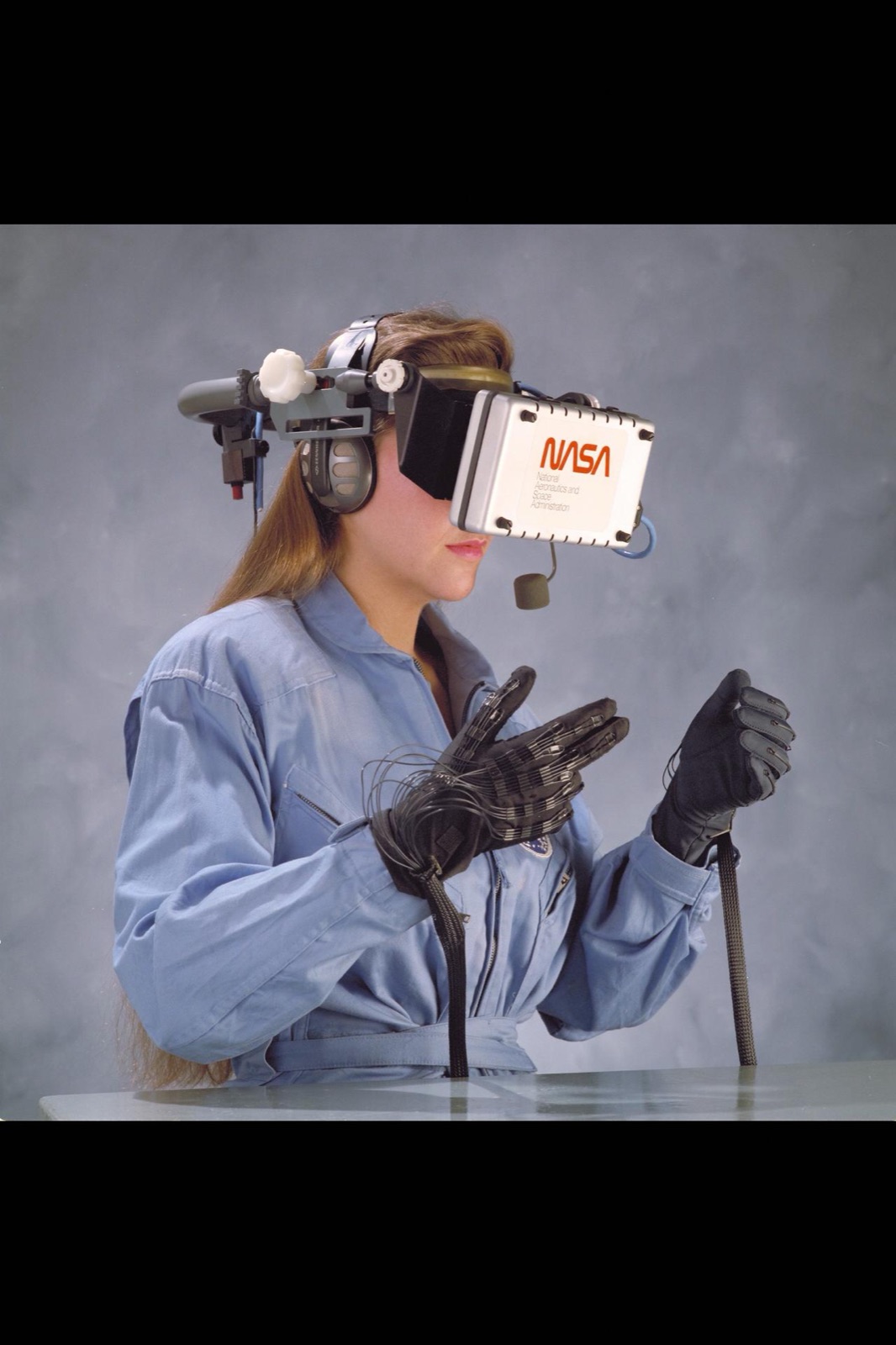
NASA Ames Research Center, public domain, via NASA Image and Video Library.
Spatial interfaces
A spatial interface is one whose elements are placed and used in three-dimensional space around the user. World-locked content stays at a fixed place in the room as the user turns their head. Head-locked content moves with the head and stays in front of the eyes wherever they look. Apple’s visionOS guidelines advise against head-locking most content, because it makes people feel stuck and confined.10
Apple recommends placing content people will read for a while at least one meter away. Each change of depth makes the eyes refocus, so frequent changes tire them.1011 Because visionOS uses where the eyes look as a pointer, interactive items need room: Apple asks for centers at least 60 points apart and rounded shapes, since the eye drifts to corners.11 It also prefers indirect gestures, such as a pinch made without raising the hand into view, over touching objects in mid-air, which tires the arm.10 Phone AR keeps the touch conventions of → 69 Mobile patterns and gestures.
Presence and comfort
Presence is the sense of being in the place a virtual environment shows. Mel Slater split it in 2009 into two parts. Place illusion is the feeling of being there. Plausibility illusion is the feeling that what happens is really happening. When both hold, people respond to the scene as if it were real, even though they know it isn’t.12
Headsets also cause cybersickness: nausea, disorientation and eye strain. The main trigger is vection, the illusion of self-motion produced by moving imagery while the body sits still. The eyes report motion that the vestibular system, the balance sense in the inner ear, doesn’t feel.13 Meta’s guidance gives the standard fixes:13
- Move the user by teleporting or snap turns instead of smooth gliding, and offer smooth movement only as an option.
- Keep acceleration short and rare, and match walking speed to the real one, about 1.4 m/s.
- Darken the edges of the view during movement (a vignette) to cut peripheral motion.
- Hold a steady frame rate.
The eyes add a second problem. A headset’s screens sit at one fixed focal distance while stereo images ask the eyes to converge on objects nearer or farther. Hoffman and colleagues showed in 2008 that this vergence-accommodation conflict makes stereo images slower to fuse and causes fatigue.14 Users can also walk into furniture, so visionOS fades the virtual scene back to passthrough when the head moves about 1.5 meters from where it started.8 Motion sensitivity is an accessibility issue as well (→ 36 Motion, video and sound; → 49 Accessibility and inclusive design), and headsets’ cameras map the rooms they’re used in (→ 95 Privacy and data ethics).
See also
37 3D design · 45 Human-computer interaction: history and theory · 49 Accessibility and inclusive design · 69 Mobile patterns and gestures · 70 Wearables, ubiquitous computing and IoT · 95 Privacy and data ethics
Sources
- Apple (n.d.). “Eyes,” “Immersive experiences” and “Spatial layout.” Human Interface Guidelines.
- Apple Newsroom (2024). “Apple Vision Pro available in the U.S. on February 2.”
- Computer History Museum (n.d.). “The Sword of Damocles: Early head-mounted display,” catalog 102680042.
- Hoffman, D. M., Girshick, A. R., Akeley, K. and Banks, M. S. (2008). “Vergence-accommodation conflicts hinder visual performance and cause visual fatigue.” Journal of Vision 8(3):33.
- Meta (n.d.). “Locomotion comfort and usability.” Meta Horizon developer documentation.
- Microsoft Learn (2021). “What is mixed reality?”
- Milgram, P. and Kishino, F. (1994). “A taxonomy of mixed reality visual displays.” IEICE Transactions on Information and Systems E77-D(12).
- Niantic (2016). “Pokémon GO launch.”
- Skarbez, R., Smith, M. and Whitton, M. C. (2021). “Revisiting Milgram and Kishino’s reality-virtuality continuum.” Frontiers in Virtual Reality 2.
- Slater, M. (2009). “Place illusion and plausibility can lead to realistic behaviour in immersive virtual environments.” Philosophical Transactions of the Royal Society B 364(1535).
- Sutherland, I. E. (1968). “A head-mounted three dimensional display.” AFIPS Fall Joint Computer Conference, 33.
- W3C (2026). WebXR Device API. Candidate Recommendation Draft.
Notes
- Niantic (2016, July 6). “Pokémon GO launch.” https://pokemongo.com/en/post/launch/ ↩
- Milgram, P. and Kishino, F. (1994). “A taxonomy of mixed reality visual displays.” IEICE Transactions on Information and Systems E77-D(12), 1321–1329. Cited by Microsoft Learn, “What is mixed reality?” https://learn.microsoft.com/en-us/windows/mixed-reality/discover/mixed-reality ↩ ↩
- Skarbez, R., Smith, M. and Whitton, M. C. (2021). “Revisiting Milgram and Kishino’s reality-virtuality continuum.” Frontiers in Virtual Reality 2:647997. https://www.frontiersin.org/journals/virtual-reality/articles/10.3389/frvir.2021.647997/full ↩
- W3C (2026). WebXR Device API, Candidate Recommendation Draft, 9 November 2026, “Terminology.” https://www.w3.org/TR/webxr/ ↩
- Sutherland, I. E. (1968). “A head-mounted three dimensional display.” Proceedings of the AFIPS Fall Joint Computer Conference, 33, 757–764. https://doi.org/10.1145/1476589.1476686 ↩
- Computer History Museum (n.d.). “The Sword of Damocles: Early head-mounted display,” catalog 102680042. https://www.computerhistory.org/collections/catalog/102680042 ↩
- Apple Newsroom (2024, January 8). “Apple Vision Pro available in the U.S. on February 2.” https://www.apple.com/newsroom/2024/01/apple-vision-pro-available-in-the-us-on-february-2/ ↩
- Apple (n.d.). “Immersive experiences.” Human Interface Guidelines. https://developer.apple.com/design/human-interface-guidelines/immersive-experiences ↩ ↩
- Microsoft Learn (2021, updated 2026). “What is mixed reality?” https://learn.microsoft.com/en-us/windows/mixed-reality/discover/mixed-reality ↩
- Apple (n.d.). “Spatial layout.” Human Interface Guidelines. https://developer.apple.com/design/human-interface-guidelines/spatial-layout ↩ ↩ ↩
- Apple (n.d.). “Eyes.” Human Interface Guidelines. https://developer.apple.com/design/human-interface-guidelines/eyes ↩ ↩
- Slater, M. (2009). “Place illusion and plausibility can lead to realistic behaviour in immersive virtual environments.” Philosophical Transactions of the Royal Society B 364(1535), 3549–3557. https://doi.org/10.1098/rstb.2009.0138 ↩
- Meta (n.d.). “Locomotion comfort and usability.” Meta Horizon developer documentation. https://developers.meta.com/horizon/design/locomotion-comfort-usability/ ↩ ↩
- Hoffman, D. M., Girshick, A. R., Akeley, K. and Banks, M. S. (2008). “Vergence-accommodation conflicts hinder visual performance and cause visual fatigue.” Journal of Vision 8(3):33. https://pmc.ncbi.nlm.nih.gov/articles/PMC2879326 ↩