Chapter 6: Contemporary design, 1970 to now
Since 1970, design has changed in two ways at once. Its style swung from modernist restraint to postmodern excess and, on screens, from imitation leather to flat color and back toward depth. Its tools changed more: the computer took over typesetting, then the page became a web page, and now software can draft the work itself.
Postmodernism and Memphis
Postmodernism is the reaction in design, from the late 1960s through the 1980s, against the modernist rule that form should be plain and follow function (→ 5 Modern movements, 1900–1970). Postmodern designers brought back ornament, color, historical reference and jokes. The architect Robert Venturi made the case in Complexity and Contradiction in Architecture (1966), a book the Pritzker Prize jury later said turned mainstream architecture away from modernism.1 He coined “less is a bore” as a reply to Mies van der Rohe’s “less is more”.2
The Portland Building in Oregon is the standard example. Michael Graves won the city’s design competition in 1980, largely because his scheme was the cheapest of the three finalists, and the building opened in 1982 at about $29 million.3 Its flat facade carries painted classical motifs in the chalky browns, slate blues and green-grays that became Graves’s palette. By 1990 parts of it had already been altered, some to correct design flaws.3
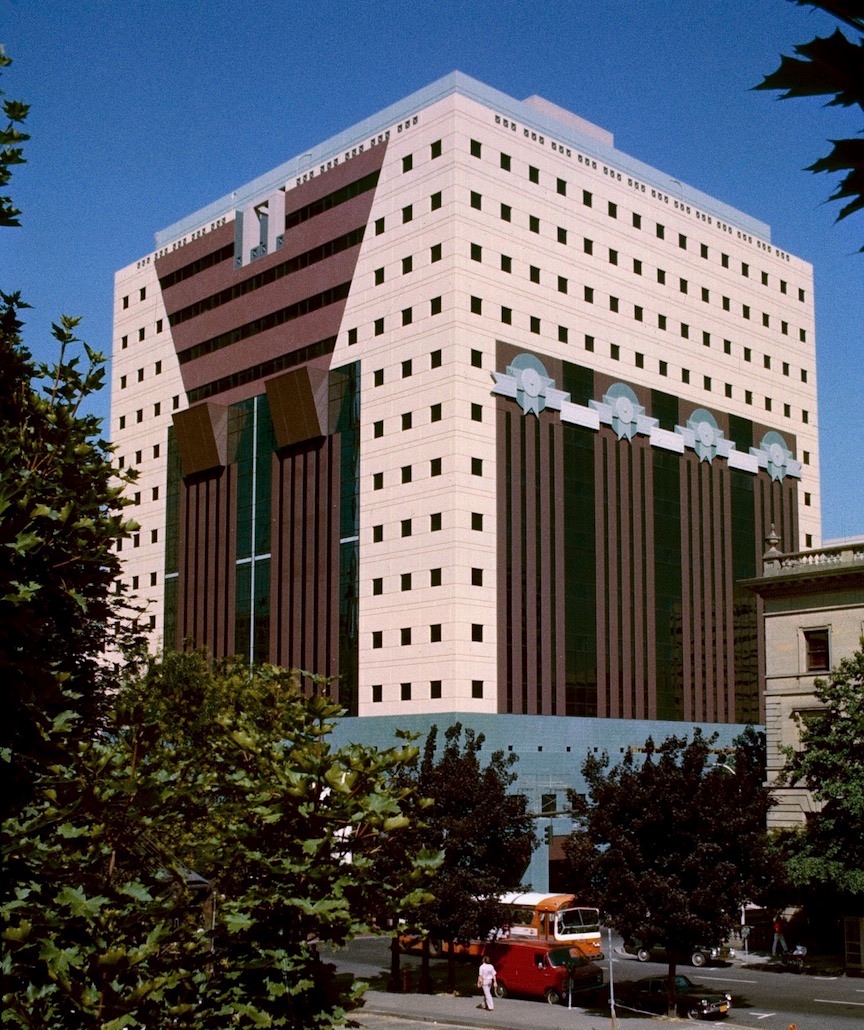
Steve Morgan, CC BY-SA 3.0, via Wikimedia Commons.
Memphis is the Milan design group that took the same attitude into furniture. In December 1980, Ettore Sottsass met younger designers at his apartment to plan a collection and named it after a Bob Dylan song he kept playing. The first collection opened at the Arc ‘74 showroom on 18 September 1981, in plastic laminate, printed glass and neon.4 The members came from Italy, Britain, France, the United States, Spain, Austria and Japan.4 Masanori Umeda’s Tawaraya (1981) was a boxing ring built around a tatami floor; his working title, Furniture 4½, named the four-and-a-half-mat room it measured.5 Sottsass left in 1985, and the group broke up in 1988.4
Desktop publishing
Desktop publishing (DTP) is page layout done on a personal computer and printed on a desktop printer, instead of being sent to a typesetting firm. It needed three products, all on sale by 1985: Apple’s Macintosh, Apple’s LaserWriter printer with Adobe’s PostScript language built in, and Aldus PageMaker, which shipped in July 1985.67 The name came from a late-1984 board meeting at Aldus. Asked to describe the product in two words, someone offered “desktop something”, and the company’s founder, Paul Brainerd, proposed “desktop publishing”.7
DTP moved typesetting into the designer’s studio, and it also put the same tools in front of people with no typographic training. Nothing in the software stopped anyone setting a newsletter in six typefaces.
Some designers treated the computer’s limits as material. Rudy VanderLans and Zuzana Licko started Emigre in 1984, the year the Macintosh appeared, and ran it until 2005.8 Licko drew her first typefaces as bitmaps on the Mac, built from the screen’s square pixels instead of fighting them.9 (→ 18 A history of type)
Early web design
Early web design is the period from the first website in 1991 to the spread of CSS layout, when designers worked around HTML to control how a page looked. Tim Berners-Lee’s site at info.cern.ch was text and links, and his WWW software went public in 1991.10 On 25 February 1993, Marc Andreessen of the National Center for Supercomputing Applications proposed an IMG tag so the Mosaic browser could show pictures inside the text.11
HTML still had no layout. Designers used table layout, building grids from tables meant for data, and the spacer GIF, a transparent one-pixel image stretched to hold space open. David Siegel published the spacer trick in Creating Killer Web Sites (1996), saying it gave reliable control of white space across browsers.12 A year later he wrote “The Web Is Ruined and I Ruined It”, calling such hacks “the duct tape of the web” and style sheets the future.13 Håkon Wium Lie had proposed CSS in October 1994, and CSS1 became a W3C Recommendation in December 1996,14 but browser support took years to catch up (→ 74 HTML and CSS).
Skeuomorphism and flat design
Skeuomorphism is imitating a physical material or object where the imitation does no work. Apple’s iOS apps of the early 2010s were full of it: a calendar with stitched leather, a podcast player that animated a reel-to-reel tape deck.15 Flat design is the reverse, an interface with no gloss, shadow or three-dimensional effect.16
Microsoft’s Metro style for Windows Phone 7 (2010) set out to “use type to echo the visual language of airport and metro system signage”.17 Apple announced the flat iOS 7 on 10 June 2013.18 Flat styles often removed the cues that showed what could be tapped, and Moran names that missing signifier as flat design’s biggest usability problem16 (→ 46 Affordances, signifiers, feedback and constraints). The correction is flat 2.0: mostly flat, with subtle shadows and layers.16 Google’s Material Design, introduced on 25 June 2014, is one version. Its designers modeled its surfaces on the way paper takes light and shadow1920 (→ 68 Platform guidelines).
Design and generative AI
Generative AI in design is the use of machine-learning models that produce images, text, layouts or code from a prompt or an example. It reached designers fast. OpenAI announced the DALL·E image model on 5 January 2021, Stability AI released Stable Diffusion with open model weights in August 2022, and ChatGPT followed on 30 November 2022.212223
The first argument was over training data, since most models learned from images their makers hadn’t licensed. Adobe answered with Firefly in March 2023, trained on Adobe Stock, openly licensed and public-domain images.24 The second is authorship. In January 2025 the US Copyright Office concluded that prompts alone don’t make someone the author of the output, though human selection, arrangement or changes to it can be protected25 (→ 94 Intellectual property and licensing).
Use is uneven. In Figma’s April 2025 survey of 2,500 users, 31% of designers used AI in core design work, against 59% of developers in core development work, and only 32% of all respondents said they could rely on its output.26 Designing AI products is covered in → 72 Conversational and AI interfaces, and their harms in → 96 Ethical design.
See also
5 Modern movements, 1900–1970 · 7 Design traditions beyond the West · 18 A history of type · 45 Human-computer interaction: history and theory · 46 Affordances, signifiers, feedback and constraints · 72 Conversational and AI interfaces
Sources
- Adobe (2023). “Adobe unveils Firefly, a family of new creative generative AI.” March 21.
- Andreessen, M. (1993). “proposed new tag: IMG.” www-talk mailing list, February 25.
- Apple (2013). “Apple unveils iOS 7.” Press release, June 10.
- Bishop, T. (2026). “PageMaker pioneer Paul Brainerd, 1947–2026.” GeekWire, February 19.
- CERN. “A short history of the Web.”
- Computer History Museum. Revolution: The First 2000 Years of Computing, “Personal computers: desktop publishing.”
- Design Museum. “Memphis.”
- Emigre. “About.”
- Gibson, Z. “Google’s Material Design: a look back at its beginning.” Google Design.
- Henry Ford, The. Emigre No. 3 (1985), collection record.
- Howarth, D. (2018). “Postmodernism pioneer Robert Venturi dies aged 93.” Dezeen, September 19.
- Hogan, A. (2025). “Figma’s 2025 AI report: perspectives from designers and developers.” Figma, April 24.
- Jitkoff, N. (2014). “This is material design.” Google Developers Blog, June 25.
- Lie, H. W., and Bos, B. “Cascading Style Sheets: a history.” W3C.
- Manjoo, F. (2012). “Should a calendar app look like a calendar?” Slate, November 1.
- Microsoft (2010). “Windows Phone 7 Series UI design & interaction guide.” Windows Developer Blog, March 18.
- Moran, K. (2015). “Flat design: its origins, its problems, and why flat 2.0 is better for users.” Nielsen Norman Group, September 27.
- OpenAI (2021). “DALL·E: creating images from text.” January 5.
- OpenAI (2022). “Introducing ChatGPT.” November 30.
- PCAD (Pacific Coast Architecture Database). “Portland Public Services Building.” University of Washington.
- Pritzker Architecture Prize. “Robert Venturi, 1991 laureate.”
- Siegel, D. (1996). Creating Killer Web Sites. Hayden Books.
- Siegel, D. (1997). “The Web is ruined and I ruined it.” Web Review, April 11.
- Stability AI (2022). “Stable Diffusion public release.” August 22.
- US Copyright Office (2025). Copyright and Artificial Intelligence, Part 2: Copyrightability. January 29.
- Yokoyama, I. (2021). “The tale of Tawaraya: from sketches to centre stage.” M+, June 2.
Notes
- Pritzker Architecture Prize, “Robert Venturi.” https://www.pritzkerprize.com/laureates/1991 ↩
- Howarth (2018), Dezeen. https://www.dezeen.com/2018/09/19/postmodernism-architecture-pioneer-robert-venturi-dies-aged-93/ ↩
- PCAD, “Portland Public Services Building.” https://pcad.lib.washington.edu/building/15383 ↩ ↩
- Design Museum, “Memphis.” https://designmuseum.org/memphis ↩ ↩ ↩
- Yokoyama (2021), M+. https://mplus.org.hk/en/magazine/tawaraya ↩
- Computer History Museum, Revolution. https://www.computerhistory.org/revolution/personal-computers/17/306 ↩
- Bishop (2026), GeekWire. https://geekwire.com/2026/pagemaker-pioneer-paul-brainerd-1947-2026-aldus-founder-devoted-his-second-chapter-to-the-planet/ ↩ ↩
- Emigre, “About.” https://emigre.com/About ↩
- The Henry Ford, Emigre No. 3. https://www.thehenryford.org/collections/explore/artifact/497570 ↩
- CERN, “A short history of the Web.” https://home.cern/science/computing/the-birth-of-the-web/short-history-web/ ↩
- Andreessen (1993). https://ksi.cpsc.ucalgary.ca/archives/WWW-TALK/www-talk-1993q1.messages/174.html ↩
- Siegel (1996), companion page “The single-pixel GIF trick.” Archived copy: https://people.sabanciuniv.edu/muratgermen/www.killersites.com/1-design/single_pixel.html ↩
- Siegel (1997), Web Review. Archived text: https://coverpages.org/siegelRuined.html ↩
- Lie and Bos, W3C. https://www.w3.org/Style/CSS20/history.html ↩
- Manjoo (2012), Slate. https://www.slate.com/articles/technology/technology/2012/11/scott_forstall_fired_skeumorphism_the_design_concept_that_s_tearing_apple.html ↩
- Moran (2015), NN/g. https://www.nngroup.com/articles/flat-design/ ↩ ↩ ↩
- Microsoft (2010). https://blogs.windows.com/windowsdeveloper/2010/03/18/windows-phone-7-series-ui-design-interaction-guide/ ↩
- Apple (2013). https://www.apple.com/newsroom/2013/06/10Apple-Unveils-iOS-7/ ↩
- Jitkoff (2014). https://developers.googleblog.com/this-is-material-design/ ↩
- Gibson, Google Design. https://design.google/library/material-design-launch-2014 ↩
- OpenAI (2021). https://openai.com/index/dall-e/ ↩
- Stability AI (2022). https://stability.ai/news-updates/stable-diffusion-public-release ↩
- OpenAI (2022). https://openai.com/index/chatgpt/ ↩
- Adobe (2023). https://news.adobe.com/news/news-details/2023/adobe-unveils-firefly-a-family-of-new-creative-generative-ai ↩
- US Copyright Office (2025), and NewsNet 1060. https://www.copyright.gov/newsnet/2025/1060.html ↩
- Hogan (2025), Figma. https://www.figma.com/blog/figma-2025-ai-report-perspectives/ ↩