Chapter 40: Packaging design
Packaging design is the design of a container, its construction and its printed surfaces together. A package has to protect the product, survive a warehouse and a truck, sell from a shelf or a screen, carry the information the law requires, and open without a knife. The graphic designer works with a structural designer, a converter who cuts and folds the board, and often a regulatory specialist.
Primary, secondary and tertiary packaging
Packaging is sorted into three levels by what each one does. The definitions most often quoted come from the EU’s 1994 packaging directive. Primary packaging (sales packaging) forms the sales unit the shopper buys. Secondary packaging (grouped packaging) holds several sales units, either sold together or used to restock shelves, and can be removed without affecting the product. Tertiary packaging (transport packaging) lets many units or groups be handled and transported without damage.1
For a bottle of olive oil, the bottle and its label are primary, the tray of twelve bottles in shrink film is secondary, and the pallet wrapped in stretch film is tertiary.
Most graphic design effort goes into the primary pack, because that is what the shopper sees. Secondary packs carry more design than they used to. A shelf-ready case tears open along a perforation and goes straight onto the shelf as a display, so its front face has to work as a sign. Online retail has blurred the levels further: the shipping case that protects an order in transit is also the first branded thing the customer touches.
Dielines
A dieline is the flat drawing of an unfolded package that shows where it will be cut, creased, perforated and glued. Artwork is laid out on top of it, and the converter uses it to make a cutting die: sharp steel rules that cut, and blunt rules that press a crease, bent to shape and set into a board. One stroke of a press turns a printed sheet into flat blanks ready to fold.
The idea dates from 1879, when Robert Gair, a paper-bag maker in New York, patented a machine for making folding boxes. His firm bent pliable metal rules into the outline of a box blank so that the same stroke cut and creased the board, with several dies working at once.2 Folding boxes soon became a basic food package, and the National Biscuit Company was an early client.2
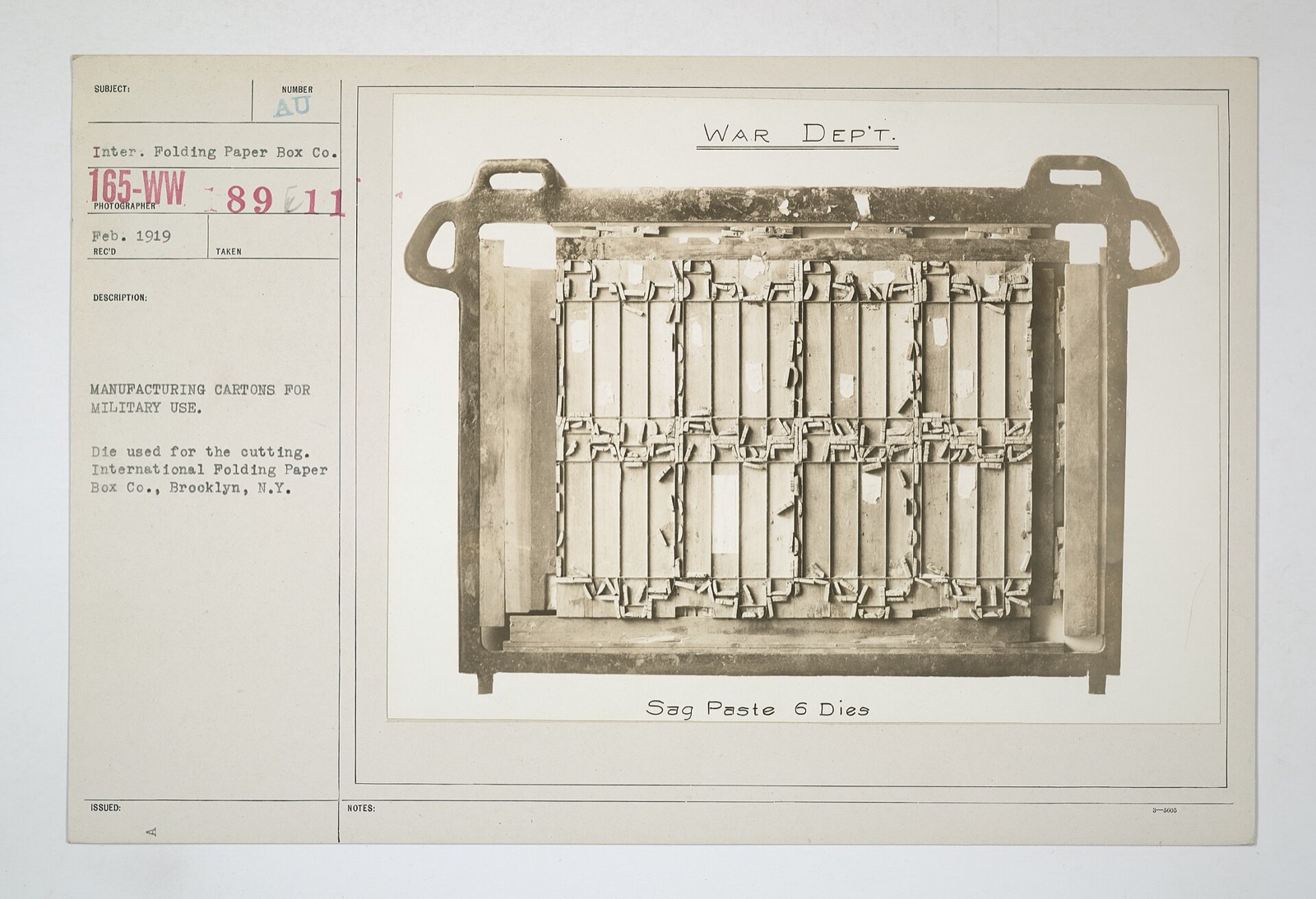
International Folding Paper Box Co., public domain, via Wikimedia Commons (US National Archives).
A common convention is a solid line for a cut and a dashed line for a fold, with the dieline drawn as a named spot color on its own layer above the artwork.3 Set the dieline to overprint with no fill, so that it never knocks a hole in the artwork beneath it (→ 38 Prepress and printing).4 Conventions vary between converters, so get the dieline from the converter who will make the die and keep their layers intact. Artwork runs past the cut lines into bleed, just as on a flat sheet.
Structural packaging design
Structural packaging design is the engineering of a package’s shape, material and construction: how it is cut from a flat sheet, folds, closes, protects, stacks and opens. Most structures start from a standard style rather than a blank page, and two catalogs give the styles numbers so that buyers and converters can name them in any language.
The FEFCO code, developed by the European corrugated board federation in the late 1960s, covers corrugated and solid board boxes. Its twelfth edition, published in 2022, added more than a hundred designs, including a series for retail and e-commerce.5 Style 0201 is the regular slotted container, the ordinary brown shipping box: all four flaps are the same length, and the outer flaps meet in the center. It wastes very little board and is the most common box style.6 For paperboard folding cartons the equivalent is the ECMA code of the European Carton Makers Association, whose 2010 digital edition held the 250 most common generic designs.7
Small choices in a style change cost and appearance. On a reverse tuck end carton the top and bottom flaps tuck toward opposite panels. Blanks nest closely, so more fit on a sheet, but a raw board edge shows on the front.8 A straight tuck end tucks both flaps toward the same panel, which keeps the front clean at some cost in board.8 Build a paper mockup before drawing anything final: a folded sample shows faster than a screen which way a flap opens and where the seam lands.3
Labeling and sustainability
Every market sets what a label must say, and often how big it must be. In the EU, mandatory food information must be set with an x-height of at least 1.2 mm, or 0.9 mm on packs whose largest surface is under 80 cm².9 US food rules organize the label around the principal display panel, the part most likely to be seen under customary retail display.10 India’s Legal Metrology rules require the month and year of manufacture, and a retail price stated as the maximum retail price inclusive of all taxes, in Indian currency; the price and quantity numerals must contrast with their background.11 Get the regulatory copy for each market before the layout.
Regulation now reaches into structure as well. The EU’s Packaging and Packaging Waste Regulation, in force since February 2025 and applying from 12 August 2026, aims to make all packaging recyclable in an economically viable way by 2030.12 It caps empty space in grouped, transport and e-commerce packaging at 50% from 2030, and requires a harmonized label showing material composition from August 2028, both dates later if the implementing acts arrive late.13 In the US and Canada, the How2Recycle label, begun in 2008 by the Sustainable Packaging Coalition, gives disposal instructions based on an assessment of each package.14 The designer’s choices of material, coating, window film and adhesive decide much of whether a pack can be recycled at all.
See also
15 Color in screen and print · 28 Brands and brand strategy · 38 Prepress and printing · 39 Paper and finishing · 42 Product and industrial design
Sources
- Algonquin College (n.d.). “Die lines.” AC Computer Graphics.
- CCL Healthcare (n.d.). “Reverse Tucks.”
- European Commission (n.d.). “Language and presentation of food information” and “Packaging waste.”
- European Parliament and Council (1994). Directive 94/62/EC on packaging and packaging waste.
- European Parliament and Council (2025). Regulation (EU) 2025/40 on packaging and packaging waste.
- FEFCO (2022). “FEFCO launches the 12th Edition of the FEFCO Code.”
- Fibre Box Association (2014). “Box Styles Basics.”
- Government of India (2011, as amended). Legal Metrology (Packaged Commodities) Rules, 2011.
- How2Recycle (n.d.). “About.”
- Keller and Heckman LLP (2021). PackagingLaw.com, on resin codes.
- New York City Landmarks Preservation Commission (2007). DUMBO Historic District Designation Report.
- Oregon Department of Environmental Quality (2021). “Recycling Labeling Laws Today.”
- Printcraft (2023). “How to create a Dieline.”
- Pro Carton (2010). Press release on the ECMA Code.
- US Code of Federal Regulations, 21 CFR 101.1.
Notes
- European Parliament and Council (1994). Directive 94/62/EC on packaging and packaging waste, Article 3(1). https://www.legislation.gov.uk/eudr/1994/62/article/3 ↩
- New York City Landmarks Preservation Commission (2007). DUMBO Historic District Designation Report (LP-2279), 18 December 2007. https://s-media.nyc.gov/agencies/lpc/lp/2279.pdf ↩ ↩
- Algonquin College (n.d.). “Die lines.” AC Computer Graphics, Graphic Design Program. https://cg.algonquindesign.ca/topics/dielines ↩ ↩
- Printcraft (2023, updated 2025). “How to create a Dieline.” https://www.printcraft.com.au/post/how-to-create-a-dieline ↩
- FEFCO (2022). “FEFCO launches the 12th Edition of the FEFCO Code.” Press release, Brussels, 30 March 2022. https://www.fefco.org/sites/default/files/2022_03_30_FEFCO%20launches%20the%2012th%20Edition%20of%20the%20FEFCO%20Code.pdf ↩
- Fibre Box Association (2014). “Box Styles Basics.” https://www.iopp.org/files/Fibrebox_Association_Box-Styles_Basics.pdf ↩
- Pro Carton (2010). Press release on the new ECMA Code, 26 May 2010. https://procarton.com/files/file_manager/press_0510/p_0510_ecm_e.htm ↩
- CCL Healthcare (n.d.). “Reverse Tucks.” https://cclhealthcare.com/packaging-products/pharmaceutical-folding-cartons/carton-styles-overview/reverse-tucks/ ↩ ↩
- European Commission (n.d.). “Language and presentation of food information,” on Regulation (EU) No 1169/2011, Article 13. https://food.ec.europa.eu/food-safety/labelling-and-nutrition/food-information-consumers-legislation/language-and-presentation-food-information_en ↩
- US Code of Federal Regulations, 21 CFR 101.1, “Principal display panel of package form food.” https://www.law.cornell.edu/cfr/text/21/101.1 ↩
- Government of India (2011, as amended to 13 February 2026). Legal Metrology (Packaged Commodities) Rules, 2011, Rules 6 and 9. Consolidated text, Khaitan & Co. https://www.khaitanco.com/sites/default/files/2026-03/Legal%20Metrology%20%28Packaged%20Commodities%29%20Rules%202011.pdf ↩
- European Commission (n.d.). “Packaging waste.” https://environment.ec.europa.eu/topics/waste-and-recycling/packaging-waste_en ↩
- European Parliament and Council (2025). Regulation (EU) 2025/40 on packaging and packaging waste, Articles 12 and 24. https://eur-lex.europa.eu/legal-content/EN/TXT/HTML/?uri=OJ:L_202500040 ↩
- How2Recycle (n.d.). “About.” https://how2recycle.info/about ↩
- Oregon Department of Environmental Quality (2021). “Recycling Labeling Laws Today.” Truth in Labeling Task Force. https://www.oregon.gov/deq/recycling/Documents/recTILlawsToday.pdf ↩ ↩
- Keller and Heckman LLP (2021). “Why are some resin codes solid triangle and others chasing arrows?” PackagingLaw.com, 22 September 2021. https://www.packaginglaw.com/index.php/ask-an-attorney/why-are-some-resin-codes-solid-triangle-and-others-chasing-arrows ↩