Chapter 5: Modern movements, 1900–1970
Between 1900 and 1970, design became a profession with its own schools, journals and clients in industry. Its movements argued about ornament, machines and who design was for. Their answers still sit inside ordinary work: the grid, sans serif type, standardized parts, the design brief written with an engineer.
Art Nouveau and the Vienna Secession
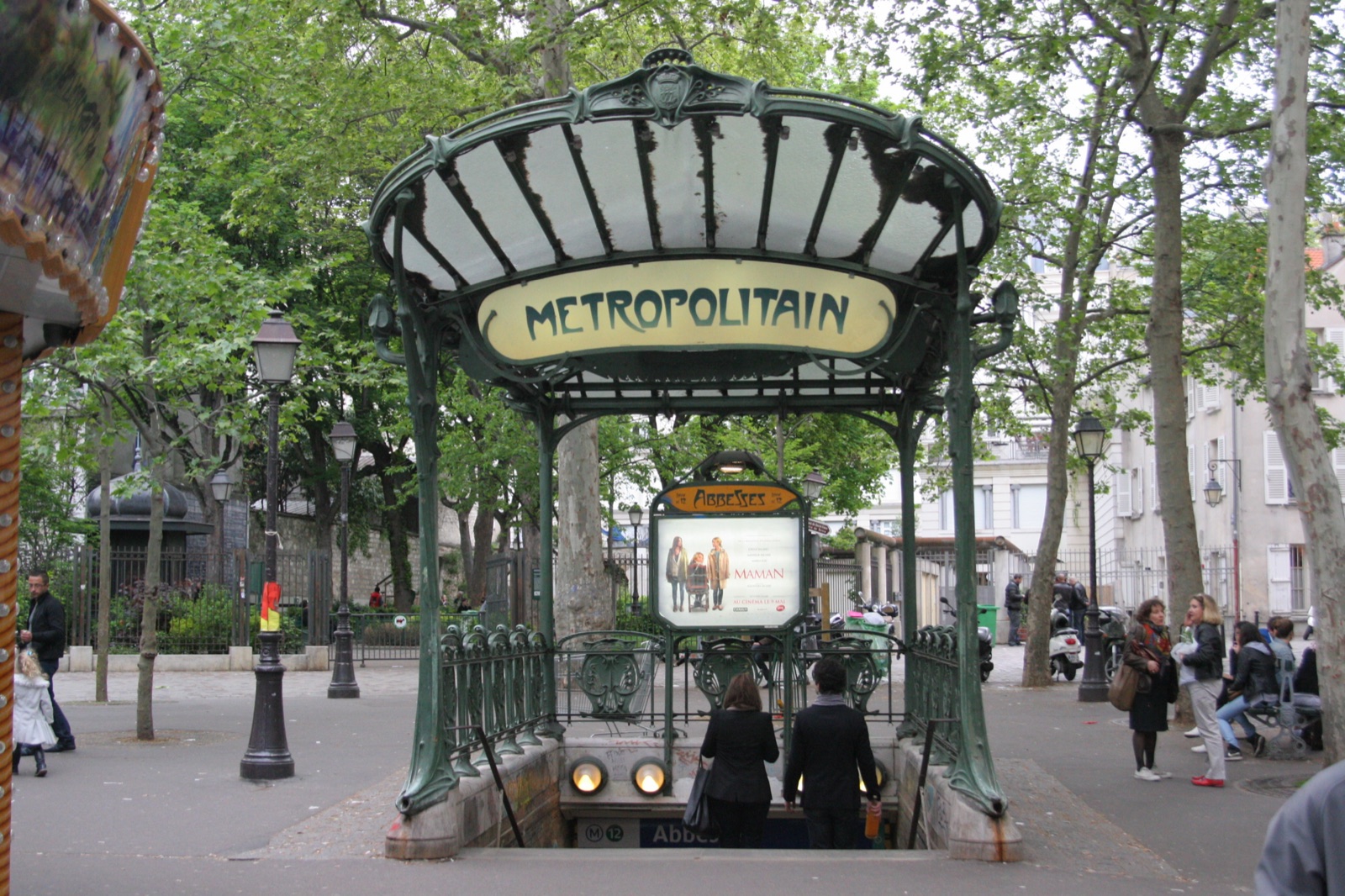
Art Nouveau is an international decorative style of about 1890 to 1914, built on long, flowing lines drawn from plants, stems and water. The name comes from a shop: in 1895 the Paris dealer Siegfried Bing, who had made his name selling Japanese art, renamed his gallery “L’Art Nouveau”.1 Vienna knew it as Jugendstil, and the 1900 Exposition Universelle in Paris took it to a mass audience.23
It is often described as a revolt against the machine, but its best-known public work was industrial. Hector Guimard designed the Paris Métro entrances as a kit of standardized cast-iron and glass parts that could be combined in five variations; by 1904, 141 stations had them, and 86 survive.4
In Vienna, a group of artists left the official Künstlerhaus on 3 April 1897 and formed the Vienna Secession, with Gustav Klimt as its first president. Joseph Maria Olbrich’s exhibition building followed in 1898.2 In 1903 Josef Hoffmann and Koloman Moser founded the Wiener Werkstätte, workshops that aimed to raise the craftsman to the status of the artist and to bring every art into one unity, a Gesamtkunstwerk or total work of art.2 The Viennese designers admired the British Arts and Crafts movement (→ 4 Design before 1900).2 The idea of one team designing everything a person touches reappears at the Bauhaus and later in corporate identity (→ 30 Identity systems). As a fashion, Art Nouveau ended with the First World War.3
Alexander Baranov, CC BY 2.0, via Wikimedia Commons.
De Stijl
De Stijl (“The Style”) is a Dutch group and journal founded in 1917 by Theo van Doesburg and Piet Mondrian.5 It reduced painting, furniture and buildings to horizontals and verticals, flat planes and primary colors plus black, white and gray. Mondrian called this abstract language Neoplasticism. The group included the architects Gerrit Rietveld and J. J. P. Oud. Mondrian left in 1923, after Van Doesburg began using diagonals, and Van Doesburg kept the journal going until 1931.5
Rietveld’s Red-Blue Chair, designed in 1918, is the movement in three dimensions: a frame of thin rails with two flat painted plywood boards for seat and back, each part kept visibly separate.6 It’s less a comfortable chair than a demonstration that furniture can be assembled from a few repeated parts.
Constructivism
Constructivism is a Russian movement, begun around 1915 by Vladimir Tatlin and Aleksandr Rodchenko, that treated art as the construction of useful things from industrial materials.7 After the 1917 revolution its members argued that easel painting was finished. A 1923 manifesto in the magazine Lef put it bluntly: “The material formation of the object is to be substituted for its aesthetic combination.”7 The position that artists should work for production became known as Productivism.
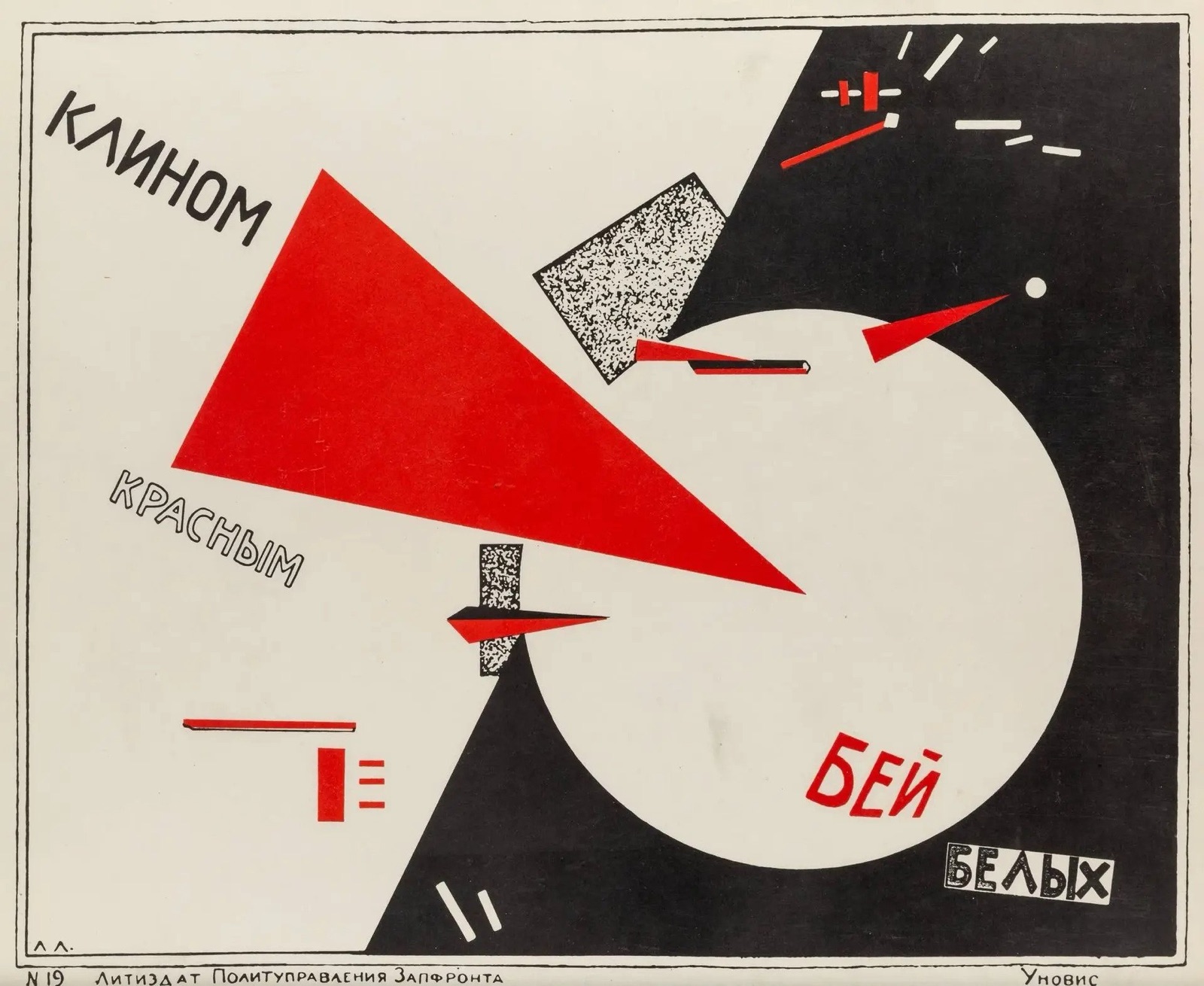
In practice that meant graphic design, textiles and photography. Liubov Popova began designing fabrics for the First State Textile Printing Factory in 1923.7 Rodchenko worked with the poet Vladimir Mayakovsky on the magazine Lef and on book covers, and turned to photography to make work that was, in the Art Institute of Chicago’s words, “socially and politically useful”.8 El Lissitzky designed Mayakovsky’s For the Voice (1923), a book of poems printed in red and black letterpress.9
The graphic vocabulary of diagonals, red and black, photomontage and type set at angles outlived the movement. Constructivism was suppressed in Russia in the 1920s, and émigrés such as Naum Gabo and Antoine Pevsner carried it west.7
El Lissitzky, public domain, via Wikimedia Commons.
Bauhaus
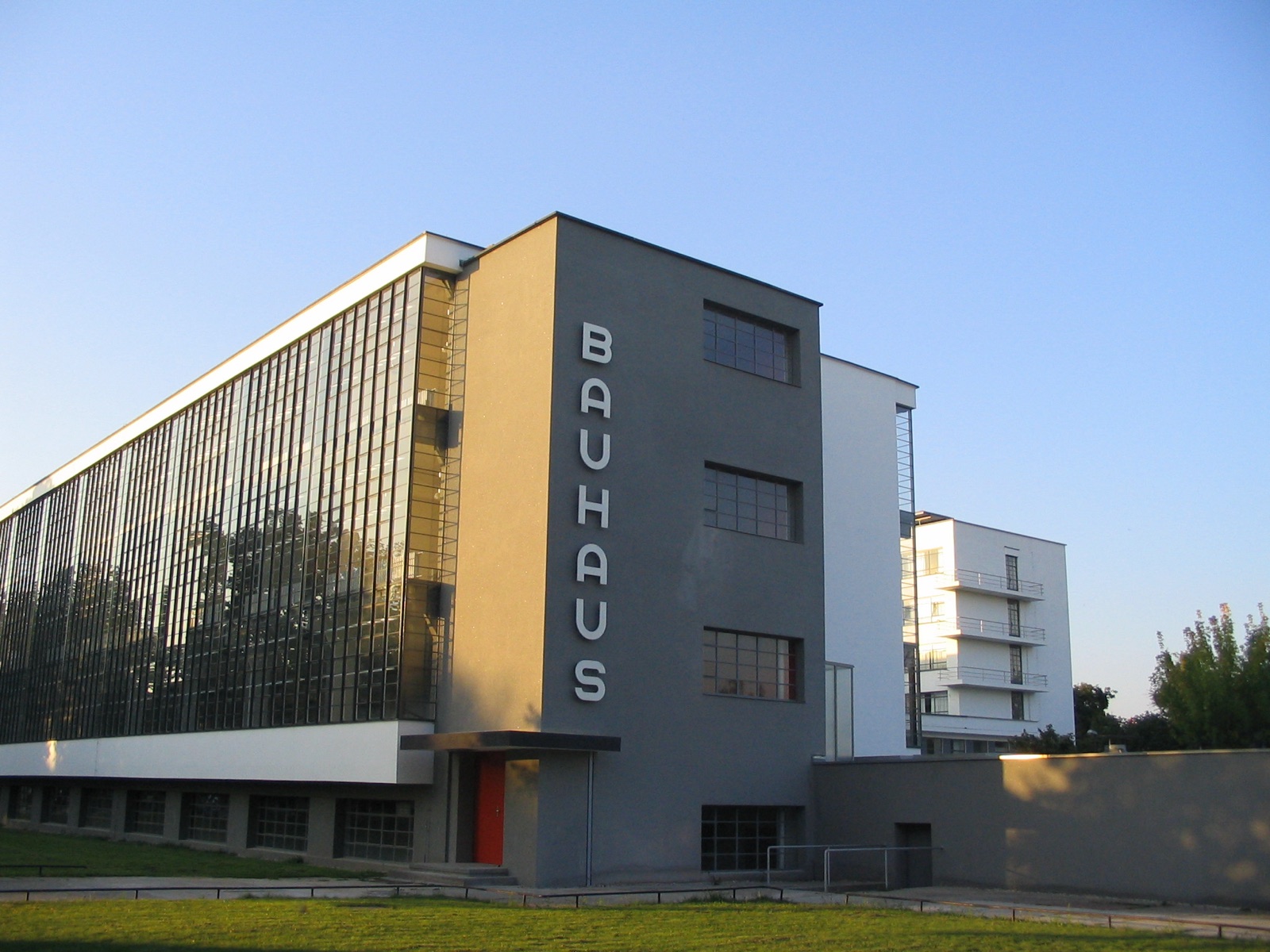
The Bauhaus is the German school of art, craft and design that Walter Gropius founded in Weimar in 1919.10 It aimed to bring art back into contact with everyday life and gave architecture and the applied arts equal standing with fine art. Teachers included Wassily Kandinsky, Paul Klee, László Moholy-Nagy and Josef Albers.10
The school moved to Dessau in 1925–26, into a building Gropius designed, which opened in December 1926.1011 Its directors after Gropius were Hannes Meyer (1928–1930), who pushed for cheap, easily transported furniture, and Ludwig Mies van der Rohe (1930–1933).11 The school moved to Berlin in 1932 and closed under Nazi pressure in 1933.10
What the Bauhaus left to practice was a working method more than a look: students designed objects meant to be made, not admired. Marianne Brandt, a student in the metal workshop, designed 28 lamp models there, and Marcel Breuer, who arrived as a student in 1920, had his first chair noticed two years later.11 After 1933 many teachers and students emigrated, mostly to the United States, and took the teaching with them.10
Cethegus, public domain, via Wikimedia Commons.
Art Deco
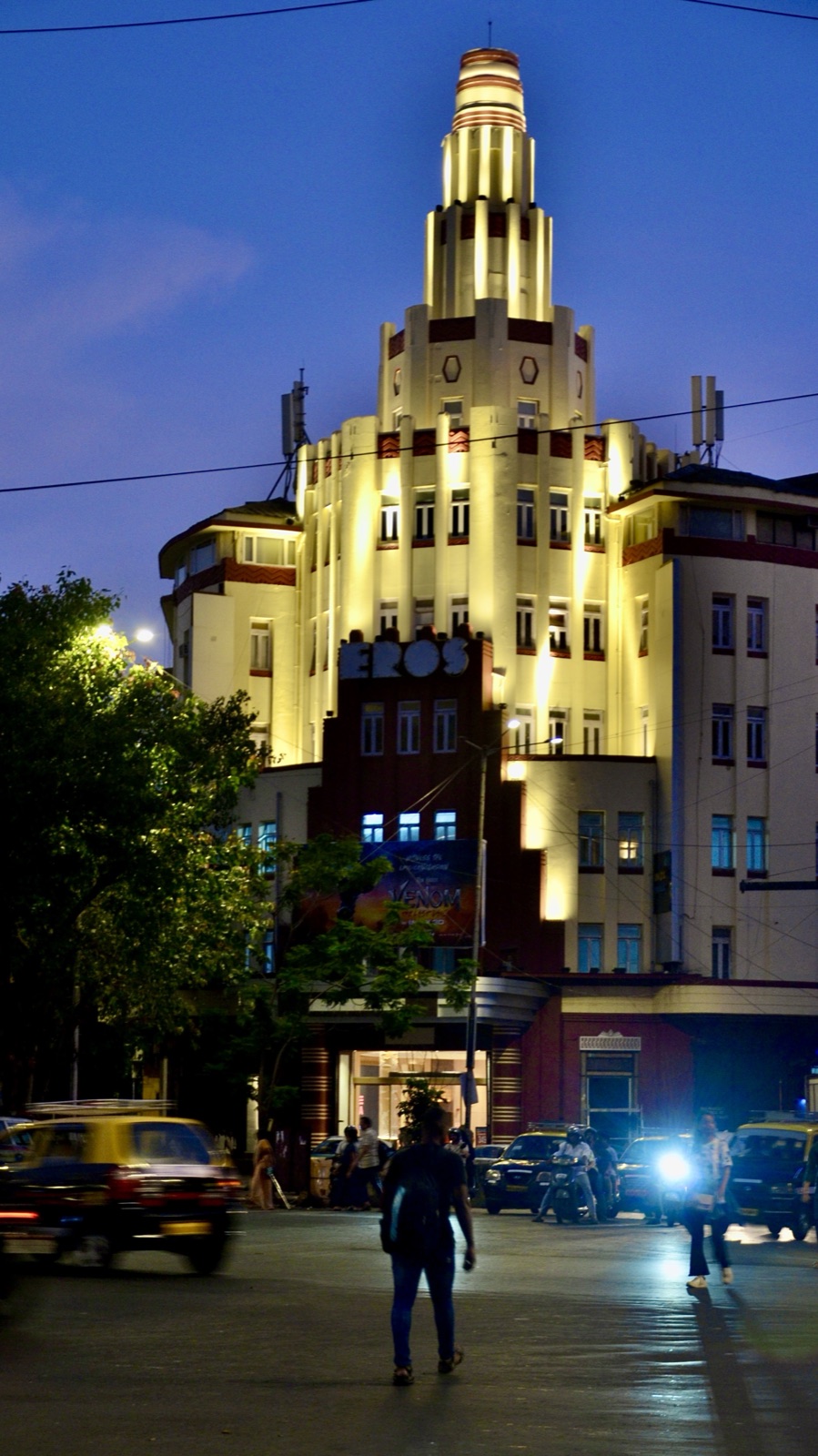
Art Deco is a style of the 1920s and 1930s that combined ornament, color and luxurious materials with images of machines and speed: geometric patterns, sunbursts, angular forms and streamlined curves.12 Its name comes from the 1925 Paris Exposition internationale des arts décoratifs et industriels modernes, but nobody used “Art Deco” at the time. The term first appeared in 1966 and spread after Bevis Hillier’s 1968 book Art Deco of the 20s and 30s.1213
It traveled worldwide through cinemas, hotels and apartment blocks, from New York and Miami Beach to Havana, Casablanca, Shanghai and Mumbai.12 Mumbai’s Eros Cinema, designed by Sohrabji Bhedwar and opened in February 1938, rises in stepped tiers faced in red Agra sandstone.14 It belongs to the Victorian Gothic and Art Deco Ensembles of Mumbai, which UNESCO inscribed as a World Heritage Site in 2018.15
Harshil s mehta, CC BY 4.0, via Wikimedia Commons.
Swiss Style
Swiss Style, also called the International Typographic Style, is the graphic design developed in Zurich and Basel after the Second World War and dominant from about 1950 to 1970.16 Its rules were few: a typographic grid, sans serif type, black-and-white photography instead of illustration, and no ornament. The Swiss National Library names Armin Hofmann, head of the Basel school, as one of its main teachers, and says it was not superseded until the 1970s and 1980s.16
Its journal was Neue Grafik, initiated by Josef Müller-Brockmann and published in 18 issues from 1958 to 1965 by Müller-Brockmann, Richard Paul Lohse, Hans Neuburg and Carlo Vivarelli.17 Vivarelli’s all-type cover template set the masthead in the sans serif Akzidenz-Grotesk.18 Müller-Brockmann later set out the method in Grid Systems in Graphic Design (1981), still in print.19
The style’s real influence came through companies. Its publisher, Lars Müller, calls it the model for the corporate design of increasingly global corporations.17 The column grids of web layouts, and design systems that fix type sizes and spacing for a whole product, apply the same idea (→ 23 Grid systems; → 18 A history of type).
Mid-century modern and the Ulm School
Mid-century modern is a label for the furniture, products and houses of the postwar decades, made in new materials such as molded plywood for mass production. The label came later: Cara Greenberg’s 1984 book Mid-Century Modern: Furniture of the 1950s popularized it.20 Its best-known product is the Eames LCW, a molded plywood lounge chair that Charles and Ray Eames introduced to the public at the Museum of Modern Art in 1946.21 The Indian government asked the Eameses for advice on design and industry, and their India Report (1958) recommended industrializing without losing the qualities of traditional craft, and led to the founding of the National Institute of Design in Ahmedabad in 1961 (→ 7 Design traditions beyond the West).22
The Ulm School, the Hochschule für Gestaltung (HfG) in Ulm, West Germany, ran from 1953 to 1968. Inge Scholl and Otl Aicher planned it with support from a foundation named for Scholl’s siblings Hans and Sophie, executed in 1943 for resisting the Nazis. Max Bill, its first rector, saw it as a continuation of the Bauhaus, and described its scope as “from the coffee cup to the housing estate”.23 After Bill resigned in 1957, younger teachers led by Tomás Maldonado built the “Ulm model”: design taught as a method grounded in science and theory, with the designer as an equal partner in industry rather than an artist above it.23
Ulm’s development groups worked as agencies for industry. Results included Braun audio equipment and the Lufthansa identity.23 The Braun SK 4 radio-phonograph, designed in 1956 by Hans Gugelot of Ulm with Dieter Rams, used new materials and plain forms to put the attention on function; its clear acrylic lid earned it the nickname “Snow White’s coffin”.24 The state parliament of Baden-Württemberg withdrew the school’s funding in November 1968, and it closed at the end of that year.23 For what came after, see → 6 Contemporary design, 1970 to now.
See also
- 1 What design is
- 4 Design before 1900
- 6 Contemporary design, 1970 to now
- 7 Design traditions beyond the West
- 23 Grid systems
- 30 Identity systems
Sources
- Barker, N. (2025). “A really quick guide to art deco.” Dezeen, March 3.
- Art Institute of Chicago. Collection records: Gerrit Rietveld, Red-Blue Chair; El Lissitzky, For Voice; Aleksandr Rodchenko, Vladimir Mayakovsky. Public API, api.artic.edu.
- Deutsches Museum. “SK 4 radio/record player combination.” Google Arts & Culture.
- Dreith, B. (2024). Interview with Cara Greenberg. Dezeen, October 9.
- Eames Office. “LCW.” eamesoffice.com.
- Fiederer, L. (2017). “AD Classics: Paris Métro entrance / Hector Guimard.” ArchDaily, August 10.
- Fonts in Use. “Neue Grafik.”
- HfG-Archiv Ulm. “History.” hfg-archiv.museumulm.de.
- Hoffman, M. (1987). “L’Art Nouveau.” The Christian Science Monitor, July 30.
- Incredible India (Government of India). “The Victorian and Art Deco Ensemble of Mumbai.”
- Lars Müller Publishers. Neue Grafik / New Graphic Design / Graphisme Actuel 1958–1965.
- Library of Congress. The Work of Charles and Ray Eames, exhibition, “Culture” section.
- Müller-Brockmann, J. (1981). Grid Systems in Graphic Design. Niggli.
- National Gallery of Victoria (2011). Vienna: Art and Design, “Definitions” and “Timeline”.
- Stiftung Bauhaus Dessau. “Better living with the Bauhaus.” Google Arts & Culture.
- Swiss National Library. “The International Style 1950–1970.”
- Tate. Art terms: Art Nouveau, De Stijl, Constructivism, Bauhaus, Art Deco.
- TIFR Bombay heritage pages. “Eros Cinema.”
Notes
- Hoffman, M. (1987). “L’Art Nouveau.” The Christian Science Monitor, July 30. https://www.csmonitor.com/1987/0730/hbing.html ↩
- National Gallery of Victoria, Vienna: Art and Design, “Definitions” (Secession; Secession building; Wiener Werkstätte). https://www.ngv.vic.gov.au/vienna/resources/definitions.html ↩ ↩ ↩ ↩
- Tate, “Art nouveau.” https://www.tate.org.uk/art/art-terms/a/art-nouveau ↩ ↩ ↩
- Fiederer, L. (2017). ArchDaily. https://www.archdaily.com/870687 ↩
- Tate, “De Stijl.” https://www.tate.org.uk/art/art-terms/d/de-stijl ↩ ↩
- Art Institute of Chicago, Gerrit Rietveld, Red-Blue Chair, designed 1918, made 1920/21, painted plywood. https://www.artic.edu/artworks/72246 ↩
- Tate, “Constructivism.” https://www.tate.org.uk/art/art-terms/c/constructivism ↩ ↩ ↩ ↩
- Art Institute of Chicago, catalog descriptions of Rodchenko, Pole Vault (https://www.artic.edu/artworks/90859) and Vladimir Mayakovsky (https://www.artic.edu/artworks/229011); record for Lef, 1923–24 (https://www.artic.edu/artworks/199233). ↩
- Art Institute of Chicago, El Lissitzky, For Voice (Dlia golosa), 1923. https://www.artic.edu/artworks/199109 ↩
- Tate, “Bauhaus.” https://www.tate.org.uk/art/art-terms/b/bauhaus ↩ ↩ ↩ ↩ ↩
- Stiftung Bauhaus Dessau, “Better living with the Bauhaus,” Google Arts & Culture. https://artsandculture.google.com/story/fwVRp9OxKkU1IA ↩ ↩ ↩
- Barker, N. (2025). Dezeen. https://www.dezeen.com/2025/03/03/art-deco-guide/ ↩ ↩ ↩
- Tate, “Art deco.” https://www.tate.org.uk/art/art-terms/a/art-deco ↩ ↩
- “Eros Cinema,” Bombay architecture pages, TIFR. https://theory.tifr.res.in/bombay/architecture/building/eros.html ↩
- Incredible India. https://www.incredibleindia.gov.in/en/maharashtra/mumbai/the-victorian-and-art-deco-ensemble-of-mumbai ↩
- Swiss National Library, “The International Style 1950–1970.” https://www.nb.admin.ch/en/the-international-style-1950-1970 ↩ ↩
- Lars Müller Publishers. https://www.lars-mueller-publishers.com/neue-grafiknew-graphic-designgraphisme-actuel1958-1965 ↩ ↩
- Fonts in Use, “Neue Grafik.” https://fontsinuse.com/uses/15395/neue-grafik ↩
- Müller-Brockmann, J. Grid Systems in Graphic Design. Niggli, © 1981; 12th ed. 2017 (CiNii record BB25923926). ↩
- Dreith, B. (2024). Dezeen. https://www.dezeen.com/2024/10/09/mid-century-modern-interview-cara-greenberg/ ↩
- Eames Office, “LCW.” https://www.eamesoffice.com/the-work/lcw/ ↩
- Library of Congress, The Work of Charles and Ray Eames. https://www.loc.gov/exhibits/eames/culture.html ↩
- HfG-Archiv Ulm, “History.” https://hfg-archiv.museumulm.de/en/history/ ↩ ↩ ↩ ↩
- Deutsches Museum, “SK 4 radio/record player combination,” Google Arts & Culture. https://artsandculture.google.com/asset/sk-4-radio-record-player-combination-braun-gmbh-frankfurt-am-main/1wF2e09B5G4BEQ ↩